IAE Academy

GATE BT

Mendelian genetics, gene interaction and linkage mapping

Study notes on Mendelian inheritance, gene interaction and linkage mapping for GATE BT. Covers Mendel's laws with probability, binomial and chi-square tools; dominance relationships, multiple alleles, lethal alleles, penetrance and expressivity; the six modified dihybrid ratios with their testcross ratios and the complementation test; two-point and three-point testcross mapping (recombination frequency, gene order, additivity, coefficient of coincidence, interference, Haldane mapping function); and extrachromosomal inheritance, told apart from maternal effect. Includes worked examples and 7 original GATE-style practice questions (MCQ/MSQ/NAT).

10 previous-year questions · 9 solved · 7 practice questions

Mendelian Inheritance: Laws and Crosses

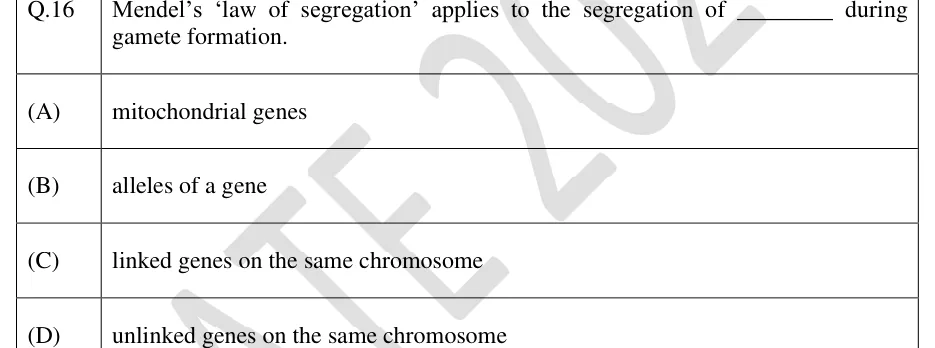
Mendel's two laws describe how alleles pass from parents to offspring. Law of Segregation: the two alleles of a gene separate from each other during gamete formation (meiosis), so each gamete carries only one allele of each gene. Law of Independent Assortment: alleles of different genes segregate into gametes independently of one another. This holds for genes on different (non-homologous) chromosomes. Genes on the same chromosome behave as if they assort independently only when they are so far apart that the recombination frequency between them is close to 50%.

The standard ratios in this section also assume complete dominance, full penetrance and equal survival of every genotype. Under these conditions most cross problems reduce to probability. Convention: a capital letter is the dominant allele and a lowercase letter the recessive allele (A/a, B/b).

Standard procedure for solving a cross problem

  1. Assign allele symbols (capital = dominant, lowercase = recessive) for every gene involved.

  2. Write the genotype of each parent, and check whether the genes are stated or assumed to assort independently or are linked.

  3. For independent genes, work out the probability at each locus separately (e.g. probability of aa, probability of Bb, ...).

  4. Combine the per-locus probabilities with the multiplication rule (AND) for a specific combined genotype or phenotype. Use the addition rule (OR) when more than one mutually exclusive genotype gives the same phenotype.

  5. For linked genes, first write the gametes with their actual frequencies (parental and recombinant), then combine them. A Punnett square with equal gamete frequencies is valid only for independent assortment.

MULTIPLICATION (AND) RULE

For two independent events, e.g. the genotype at one unlinked locus combined with the genotype at another unlinked locus.

ADDITION (OR) RULE

For mutually exclusive outcomes, e.g. two different genotypes that give the same phenotype.

NUMBER OF DISTINCT GAMETE TYPES FOR N HETEROZYGOUS, INDEPENDENTLY ASSORTING LOCI

n = number of heterozygous gene pairs. When all n loci assort independently, each gamete type has frequency .

Counts for a cross between two individuals heterozygous at n independently assorting loci (complete dominance)

Quantity

Number

Gamete types from each parent

Gamete combinations (squares in the Punnett square)

Distinct F2 genotypes

Distinct F2 phenotypes (complete dominance at every locus)

BINOMIAL PROBABILITY FOR A SET OF N OFFSPRING

The probability that exactly s of n offspring are of one kind (probability p each) and t are of the other kind (probability q each), with s + t = n and p + q = 1. Each offspring is treated as an independent event.

CHI-SQUARE GOODNESS-OF-FIT TEST

O = observed count and E = expected count in each class under the hypothesised ratio. Use counts, not percentages. Degrees of freedom = number of classes − 1. If the calculated is below the tabulated critical value at the chosen significance level (commonly 0.05), the deviation is attributed to chance and the hypothesised ratio is not rejected.

Genotypic and phenotypic ratios for standard crosses (complete dominance, independent assortment)

Cross

Genotypic ratio

Phenotypic ratio

Monohybrid self-cross, Aa × Aa

1 AA : 2 Aa : 1 aa

3 dominant : 1 recessive

Monohybrid testcross, Aa × aa

1 Aa : 1 aa

1 dominant : 1 recessive

Dihybrid self-cross, AaBb × AaBb

9 genotypes, 1 AABB : 2 AABb : 1 AAbb : 2 AaBB : 4 AaBb : 2 Aabb : 1 aaBB : 2 aaBb : 1 aabb

9 A_B_ : 3 A_bb : 3 aaB_ : 1 aabb

Dihybrid testcross, AaBb × aabb

4 genotypes, 1 AaBb : 1 Aabb : 1 aaBb : 1 aabb

1 : 1 : 1 : 1

WORKED EXAMPLE

In a dihybrid cross AaBb × AaBb (genes unlinked, complete dominance at both loci), what fraction of the offspring is dominant for exactly one of the two traits (dominant at A but recessive at B, OR recessive at A but dominant at B)?

Solution
  1. P(A_) = 3/4 and P(bb) = 1/4, so P(A_bb) = 3/4 × 1/4 = 3/16.

  2. P(aa) = 1/4 and P(B_) = 3/4, so P(aaB_) = 1/4 × 3/4 = 3/16.

  3. The two outcomes are mutually exclusive, so add them: 3/16 + 3/16 = 6/16 = 3/8.

Answer: 3/8 (6 out of every 16 offspring)

WORKED EXAMPLE

Two parents are both Aa (a is recessive). They have 4 children. What is the probability that exactly 2 of the 4 children are aa?

Solution
  1. For each child, P(aa) = p = 1/4 and P(not aa) = q = 3/4. Each child is independent.

  2. Number of orders in which 2 of 4 children can be aa: .

  3. P = 6 × (1/4)² × (3/4)² = 6 × 1/16 × 9/16 = 54/256 = 27/128.

Answer: 27/128 ≈ 0.211

EXAM TIP

If a question asks only for a probability, not a full list of phenotypes, do not draw a 16-box Punnett square. Apply the multiplication and addition rules one locus at a time. It is faster and avoids arithmetic slips.

Extensions of Mendelian Ratios: Dominance, Multiple Alleles, Lethal Alleles

Mendel's ratios assume that one allele of a gene is completely dominant, that each gene has only two alleles and that every genotype is equally viable. Several well-documented departures from this still follow predictable rules:

  • how the two alleles of one gene interact in the heterozygote (the dominance relationship)
  • genes with more than two alleles in the population (multiple alleles)
  • alleles that kill the individual in a particular genotype (lethal alleles)

Dominance relationships at a single gene

Relationship

Heterozygote (F1) phenotype

F2 ratio (self-cross)

Example

Complete dominance

Identical to one homozygous parent

3 : 1

The classical Mendelian case.

Incomplete dominance

Intermediate, not seen in either parent

1 : 2 : 1 (phenotypic ratio = genotypic ratio)

Red × white flowers giving pink F1 (e.g. snapdragon, four o'clock plant).

Codominance

Both parental phenotypes expressed fully and distinctly in the same individual

1 : 2 : 1 (phenotypic ratio = genotypic ratio)

MN blood group; the AB phenotype of the ABO system.

Recognising which relationship applies

  1. If the F1 heterozygote looks identical to one parent, dominance is complete.

  2. If the F1 heterozygote is intermediate between the two parents, dominance is incomplete.

  3. If the F1 heterozygote shows both parental traits at once, each fully and distinctly (not blended), the alleles are codominant.

  4. In all three cases the genotypic ratio of a monohybrid self-cross is 1 : 2 : 1. Only with complete dominance do the phenotypes collapse to 3 : 1.

Multiple alleles means that more than two alleles of a gene exist in a population. Any one diploid individual still carries at most two of them, and each parent passes on only one, so segregation is unchanged.

The ABO blood group is the standard example, with alleles , and . and are codominant with each other, and both are completely dominant over . This gives 6 genotypes but only 4 phenotypes (A, B, AB and O).

GENOTYPES POSSIBLE WITH N ALLELES AT ONE LOCUS (DIPLOID)

Made up of n homozygotes and heterozygotes. For n = 3 (ABO): 3 + 3 = 6 genotypes.

A lethal allele kills individuals of a particular genotype before they can be scored.

  • Dominant visible effect, lethal when homozygous. This is the case usually tested; the yellow coat allele of mice is the textbook example. Crossing two heterozygotes, Yy × Yy, gives 1 YY (dies) : 2 Yy : 1 yy. The live offspring are therefore 2 yellow (Yy) : 1 non-yellow (yy), a 2 : 1 ratio, and every surviving yellow animal is heterozygous.
  • Recessive lethal with no visible effect in the heterozygote. From Aa × Aa, the aa class dies. All survivors show the dominant phenotype, but their genotypes are 1 AA : 2 Aa, so 2/3 of the survivors are carriers.
  • Dominant lethal. It kills heterozygotes too, so it is normally lost in the generation in which it arises. It can persist only if it acts after reproductive age.

Other terms that change how a genotype shows up as a phenotype

  1. Pleiotropy: one gene affects several different phenotypic traits.

  2. Penetrance: the percentage of individuals with a given genotype that show the expected phenotype at all. Incomplete penetrance makes observed ratios fall short of the Mendelian ones.

  3. Expressivity: the degree or severity with which the phenotype is expressed among the individuals that do show it.

EXAM TIP

If a cross expected to give 3 : 1 gives about 2 : 1 instead, first suspect an allele that is lethal when homozygous and has a visible effect in the heterozygote.

Gene Interaction and Epistasis

Gene interaction occurs when two different genes affect the same phenotype. Epistasis is the form of interaction in which the genotype at one locus masks or modifies the expression of another locus.

In the F2 of a dihybrid self-cross, the four classes A_B_ : A_bb : aaB_ : aabb still occur in the proportions 9 : 3 : 3 : 1. Epistasis merges some of these classes into one visible phenotype, so the modified ratio still totals 16 parts. The ratios below assume complete dominance at both loci, independent assortment, full penetrance and equal viability of all classes.

Standard modified dihybrid ratios (F2 of AaBb × AaBb, 16 parts)

Interaction type

F2 ratio

Classes merged

Testcross ratio (AaBb × aabb)

Genetic basis

Recessive epistasis

9 : 3 : 4

9 A_B_ : 3 A_bb : 4 (aaB_ + aabb)

1 : 1 : 2

Homozygous recessive aa masks the genotype at gene B, so aaB_ and aabb look alike.

Dominant epistasis

12 : 3 : 1

12 (A_B_ + A_bb) : 3 aaB_ : 1 aabb

2 : 1 : 1

A dominant allele A masks gene B, so A_B_ and A_bb look alike.

Duplicate recessive epistasis (complementary genes)

9 : 7

9 A_B_ : 7 (A_bb + aaB_ + aabb)

1 : 3

The phenotype needs at least one dominant allele at BOTH genes. Homozygous recessive at either gene gives the alternative phenotype.

Duplicate dominant epistasis (duplicate genes)

15 : 1

15 (A_B_ + A_bb + aaB_) : 1 aabb

3 : 1

A dominant allele at EITHER gene is enough for the phenotype. Only aabb differs.

Dominant and recessive interaction (inhibitor gene)

13 : 3

13 (A_B_ + A_bb + aabb) : 3 aaB_

3 : 1

A dominant allele at gene A, OR the genotype bb, gives the same phenotype. Only aaB_ differs.

Duplicate genes with cumulative effect

9 : 6 : 1

9 A_B_ : 6 (A_bb + aaB_) : 1 aabb

1 : 2 : 1

A dominant allele at both loci gives one phenotype, at only one of the two loci (either one) an intermediate phenotype, and at neither (aabb) a third.

Do not confuse 9 : 6 : 1 with purely additive (polygenic) action. If each contributing allele adds an equal amount with no dominance, the phenotype depends on how many contributing alleles are present (0 to 4). The F2 of the dihybrid then has five classes in the ratio 1 : 4 : 6 : 4 : 1. In 9 : 6 : 1, by contrast, AAbb (two dominant alleles) looks like Aabb (one) and differs from AaBb (two).

Complementation test procedure

  1. Cross two true-breeding lines that each carry a recessive mutation and show the same mutant phenotype (e.g. two colourless mutant strains). The test works only for recessive mutations.

  2. Score the phenotype of the F1, which carries the two mutations in trans (one from each parent).

  3. If the F1 is wild type, the mutations complement each other and lie in different genes: each parent supplies a working copy of the gene the other lacks.

  4. If the F1 is mutant, the mutations fail to complement and are placed in the same complementation group, which normally corresponds to the same gene.

WORKED EXAMPLE

A plant breeder self-crosses a doubly heterozygous plant and scores 900 purple : 700 white among 1600 F2 progeny. What type of gene interaction is this, and what is the genotypic explanation?

Solution
  1. Convert to sixteenths: 900/1600 × 16 = 9 and 700/1600 × 16 = 7, a 9 : 7 ratio.

  2. A 9 : 7 ratio (four classes merged into 9 and 7) matches duplicate recessive epistasis (complementary gene action).

  3. Purple needs at least one dominant allele at both genes: A_B_ = 9/16 purple. A plant homozygous recessive at either gene (A_bb, aaB_ or aabb = 3 + 3 + 1 = 7/16) is white.

Answer: Duplicate recessive (complementary) epistasis, 9 : 7. Colour needs a dominant allele at both loci at the same time.

EXAM TIP

To identify an interaction from observed F2 counts, express each class as a fraction of the total and multiply by 16. Then match which of the 9 : 3 : 3 : 1 classes have merged, using the table above.

Linkage, Recombination and Chromosome Mapping

Genes close together on the same chromosome are linked: they tend to be inherited together in their parental combination instead of assorting independently. A double heterozygote can carry linked alleles in two phases:

  • coupling (cis), AB/ab: both dominant alleles on one homologue
  • repulsion (trans), Ab/aB: one dominant allele on each homologue

Crossing over between non-sister chromatids at the four-strand stage of prophase I produces recombinant gametes. The farther apart two genes lie, the more likely a crossover falls between them, so recombination frequency is used to measure map distance.

Convention: recombination frequency is written as a fraction or a percentage, and 1% recombination = 1 map unit = 1 centimorgan (cM).

RECOMBINATION FREQUENCY (MAP DISTANCE)

Measured in a testcross (heterozygote × fully recessive homozygote), where each offspring's phenotype shows the gamete it received from the heterozygote. The observed RF never exceeds 50%, the value for independent assortment. Over long intervals it underestimates the true map distance, because two (or any even number of) crossovers between the markers restore the parental combination and go undetected. Map distances are therefore built by adding short intervals.

HALDANE MAPPING FUNCTION

r = observed recombination frequency as a fraction (r < 0.5); d = map distance in morgans (multiply by 100 for cM). Assumes crossovers occur independently along the chromosome (no interference). For small r, d ≈ r.

COEFFICIENT OF COINCIDENCE

Expected double crossovers = RF(interval 1) × RF(interval 2) × total offspring. Both RFs are taken as fractions and each already includes the double-crossover classes. This expectation assumes that crossovers in the two intervals are independent.

INTERFERENCE

I = 1: complete interference (no double crossovers observed). I = 0: crossovers in the two intervals occur independently (observed = expected). I < 0 (c.o.c. > 1): negative interference, more double crossovers than expected.

Procedure for a three-point testcross (gene order and map distances)

  1. Testcross a triple heterozygote to a fully recessive homozygote and tabulate the 8 offspring classes with their counts.

  2. The two most frequent, reciprocal classes are the parental (non-crossover) types. They show the allele arrangement on each parental chromosome.

  3. The two least frequent, reciprocal classes are normally the double-crossover (DCO) types. Compare a DCO class allele by allele with the parental class it most resembles. The one gene whose allele differs is the middle gene, because two crossovers exchange only the middle locus.

  4. With the gene order fixed, compute RF for each adjacent interval. Use that interval's single-crossover classes PLUS the DCO classes, since every DCO is recombinant in both intervals.

  5. The distance between the outer genes is the sum of the two intervals. It is larger than the RF measured directly between the outer genes, because DCOs look parental for the outer pair.

  6. Compute the coefficient of coincidence and the interference from the observed and expected DCO counts.

Classes of offspring in a three-point testcross, by frequency

Class

Relative frequency

What produced it

Parental (non-crossover)

Highest

No crossover in either interval; matches the parental chromosomes.

Single crossover, interval 1

Intermediate

One crossover between the first gene and the middle gene only.

Single crossover, interval 2

Intermediate

One crossover between the middle gene and the third gene only.

Double crossover (DCO)

Lowest (none if interference is complete)

One crossover in each interval; differs from a parental class only at the middle gene.

WORKED EXAMPLE

A linked-gene testcross AaBb × aabb gives 440 AaBb, 445 aabb, 60 Aabb and 55 aaBb among 1000 offspring. Find the recombination frequency and the map distance between A and B.

Solution
  1. The two most frequent classes are AaBb (440) and aabb (445). They come from AB and ab gametes, so the heterozygous parent was in coupling (AB/ab). Total parental = 885.

  2. The recombinant classes are Aabb (60) and aaBb (55), from Ab and aB gametes. Total recombinant = 115.

  3. RF = 115/1000 × 100% = 11.5%.

Answer: RF = 11.5%, so A and B are 11.5 map units (cM) apart.

WORKED EXAMPLE

A triple heterozygote is testcrossed to aa bb cc. The 1000 offspring are listed with alleles in the order A, B, C (not necessarily chromosome order): A B C 360; a b c 350; a B C 70; A b c 80; A b C 55; a B c 65; A B c 8; a b C 12. Find the gene order, the map distances, the coefficient of coincidence and the interference.

Solution
  1. Parental classes (most frequent): A B C and a b c. DCO classes (least frequent): A B c and a b C.

  2. Compare the DCO A B c with the parental A B C: only C differs. So C is the middle gene and the order is A–C–B.

  3. Interval A–C: single crossovers are the classes where A has changed partners relative to C and B: a B C (70) + A b c (80) = 150. RF(A–C) = (150 + 20)/1000 = 17%, i.e. 17 cM.

  4. Interval C–B: single crossovers are A b C (55) + a B c (65) = 120. RF(C–B) = (120 + 20)/1000 = 14%, i.e. 14 cM.

  5. Map distance A–B = 17 + 14 = 31 cM. Scoring only A and B directly would give (150 + 120)/1000 = 27%, because the 20 DCOs look parental for A and B.

  6. Expected DCO = 0.17 × 0.14 × 1000 = 23.8. c.o.c. = 20/23.8 ≈ 0.84, so I = 1 − 0.84 ≈ 0.16.

Answer: Order A–C–B; A–C = 17 cM, C–B = 14 cM, A–B = 31 cM; c.o.c. ≈ 0.84; interference ≈ 0.16.

EXAM TIP

Sort the eight classes by count before anything else. Take the most frequent pair as parental and the least frequent pair as the DCOs. Then check that each DCO differs from a parental class at exactly one gene. That gene is the middle gene.

Extrachromosomal (Cytoplasmic) Inheritance

Some genes lie not on nuclear chromosomes but in the DNA of mitochondria and, in plants and algae, chloroplasts. In most animals and most flowering plants, the zygote receives these organelles from the egg cytoplasm and essentially none from the sperm or pollen. Organelle-encoded traits are therefore inherited through the mother (maternal inheritance) and do not follow Mendelian segregation ratios.

This is not universal. Plastids are transmitted mainly through the pollen in many conifers and from both parents in some flowering plants.

Features that distinguish extrachromosomal inheritance from nuclear (Mendelian) inheritance

  1. Reciprocal crosses give different results, and the offspring follow the maternal parent whatever the paternal genotype. A nuclear autosomal gene gives the same result in both directions.

  2. Segregation does not follow the 3 : 1, 1 : 2 : 1 or 9 : 3 : 3 : 1 ratios expected of nuclear alleles.

  3. A cell holds many copies of organelle DNA, so it can carry a mixture of normal and mutant organelle genomes (heteroplasmy). As these sort out at random during cell division, severity varies among offspring of one cross instead of forming discrete ratios.

  4. The trait cannot be mapped to a nuclear chromosome by linkage analysis, because the gene is not on a nuclear chromosome.

Nuclear versus extrachromosomal inheritance

Feature

Nuclear (Mendelian) inheritance

Extrachromosomal (cytoplasmic) inheritance

Reciprocal cross result

Identical in both directions (autosomal genes)

Different; follows the parent that contributes the cytoplasm (usually the mother)

Segregation pattern

Fixed Mendelian ratios (3:1, 9:3:3:1, ...)

Non-Mendelian, often variable

Location of the gene

Nuclear chromosomes

Mitochondrial or chloroplast DNA

Copies per cell

Two in a diploid cell

Many copies per organelle, many organelles per cell

Standard examples

  1. Leaf variegation in the four o'clock plant (Mirabilis jalapa): seeds from green branches give green seedlings, from white branches white seedlings, and from variegated branches green, white or variegated seedlings. The pollen source makes no difference.

  2. Petite mutants of yeast: a neutral mitochondrial petite crossed with wild type gives all wild-type (grande) progeny, and a suppressive petite gives mostly petite progeny. A segregational petite (nuclear mutation) segregates 2 : 2 in tetrads.

  3. Chlamydomonas: chloroplast genes (e.g. some streptomycin-resistance markers) are inherited from the mt+ mating-type parent only.

  4. Cytoplasmic male sterility in crop plants such as maize: caused by the mitochondrial genome and reversible by nuclear restorer (Rf) genes.

Do not confuse cytoplasmic inheritance with the maternal effect. In a maternal effect, a NUCLEAR gene in the mother determines the offspring's phenotype, through products she deposits in the egg. The classic example is the direction of shell coiling in snails (dextral allele D dominant to sinistral d): an offspring's coiling depends on its mother's genotype, not its own. Reciprocal crosses differ here too, but the gene segregates in Mendelian ratios, with the phenotypic ratio appearing one generation later. Cytoplasmic traits never show nuclear segregation.

EXAM TIP

The fastest diagnostic is the reciprocal cross. If swapping which parent is the female changes the offspring so that they track the mother, and this persists over generations through the female line, think extrachromosomal inheritance. If the difference is explained by the mother's nuclear genotype and Mendelian ratios reappear a generation later, it is a maternal effect.

PREVIOUS-YEAR QUESTIONS

10 questions from the BT papers

Try each question first, then open the answer. One shows the official answer only. We placed each question under a topic ourselves; the exam paper does not label topics.

See these papers in full: GATE BT 2026 · GATE BT 2025 · GATE BT 2024 · GATE BT 2022 · GATE BT 2020 · GATE BT 2019

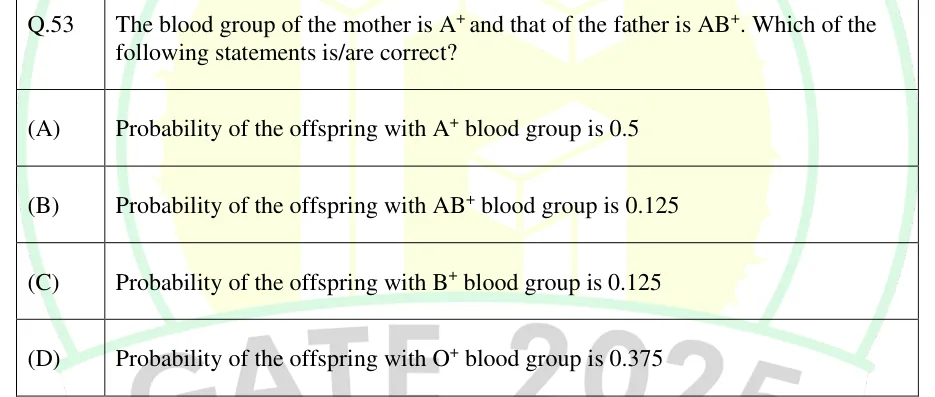
GATE 2025 BT Q.53

GATE 2025 · BTQ.53 · 2 marks · MSQ

The blood group of the mother is A+ and that of the father is AB+. Which of the following statements is/are correct?

  1. (A)

    Probability of the offspring with A+ blood group is 0.5

  2. (B)

    Probability of the offspring with AB+ blood group is 0.125

  3. (C)

    Probability of the offspring with B+ blood group is 0.125

  4. (D)

    Probability of the offspring with O+ blood group is 0.375

Official answer
See the question in the paper
GATE 2025 BT Q.53: official answer

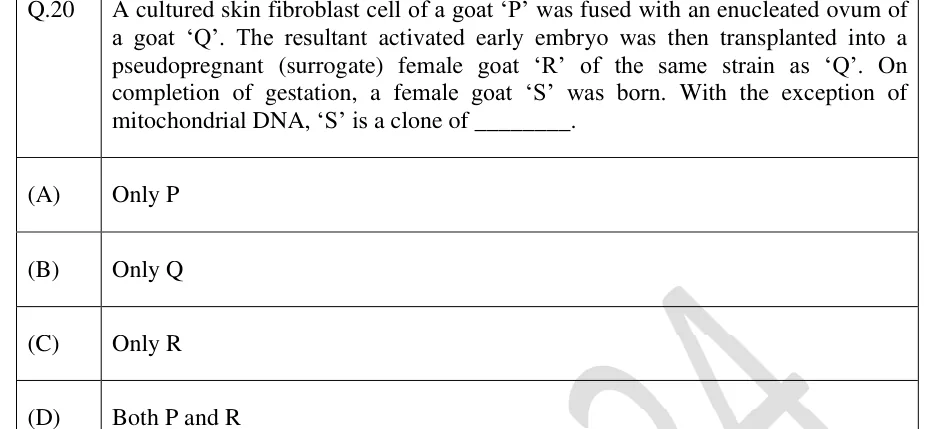
GATE 2024 BT Q.20

GATE 2024 · BTQ.20 · 1 mark · MCQ

A cultured skin fibroblast cell of a goat 'P' was fused with an enucleated ovum of a goat 'Q'. The resultant activated early embryo was then transplanted into a pseudopregnant (surrogate) female goat 'R' of the same strain as 'Q'. On completion of gestation, a female goat 'S' was born. With the exception of mitochondrial DNA, 'S' is a clone of ________.

  1. (A)

    Only P

  2. (B)

    Only Q

  3. (C)

    Only R

  4. (D)

    Both P and R

Answer and solution
See the question in the paper
GATE 2024 BT Q.20: answer and solution

GATE 2020 BT Q.30

GATE 2020 · BTQ.30 · 2 marks · MCQ

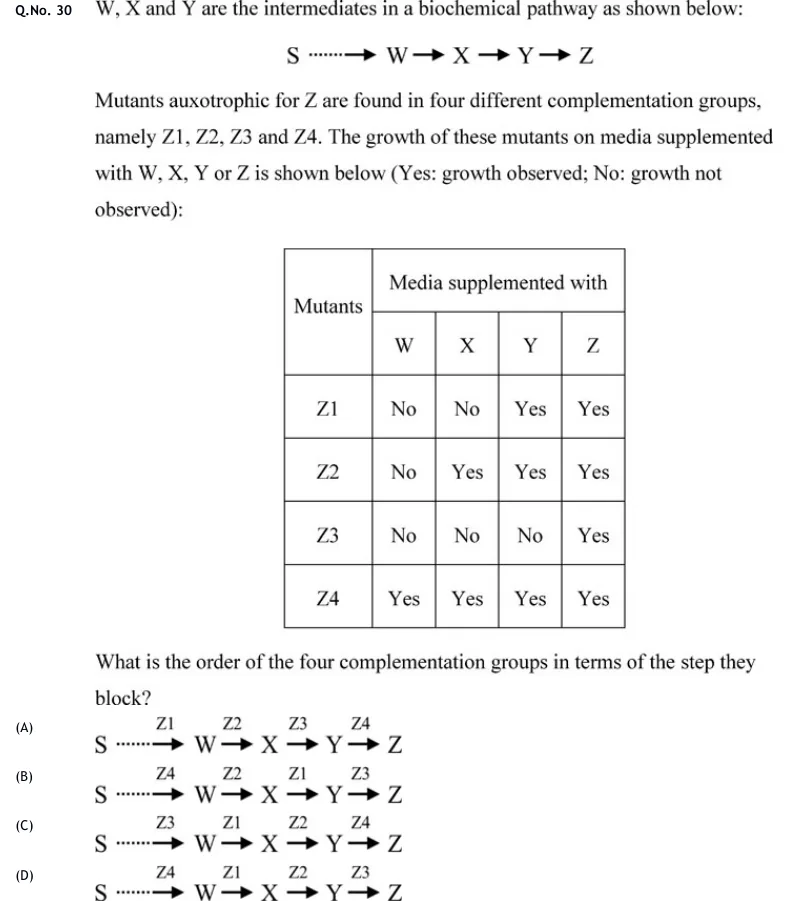
W, X and Y are the intermediates in a biochemical pathway as shown below:

S ⋯⋯> W → X → Y → Z

Mutants auxotrophic for Z are found in four different complementation groups, namely Z1, Z2, Z3 and Z4. The growth of these mutants on media supplemented with W, X, Y or Z is shown below (Yes: growth observed; No: growth not observed):

Mutants | W | X | Y | Z
Z1 | No | No | Yes | Yes
Z2 | No | Yes | Yes | Yes
Z3 | No | No | No | Yes
Z4 | Yes | Yes | Yes | Yes

What is the order of the four complementation groups in terms of the step they block?

GATE 2020 BT question 30: A pathway diagram: S connected by a dashed arrow to W, then solid arrows W→X→Y→Z.Tap to open full size
Figure from the GATE 2020 BT paper. It is part of the question.
Figure description

A pathway diagram: S connected by a dashed arrow to W, then solid arrows W→X→Y→Z. Below it, a 4-row x 4-column data table listing growth (Yes/No) of mutants Z1–Z4 on media supplemented with W, X, Y, or Z respectively (as given in the stem). The four options (A–D) each redraw the same pathway S ⋯> W → X → Y → Z with the four mutant labels (in some order of Z1–Z4) placed above the four arrows, indicating which mutant blocks which step: (A) Z1, Z2, Z3, Z4 in that order over the four arrows; (B) Z4, Z2, Z1, Z3; (C) Z3, Z1, Z2, Z4; (D) Z4, Z1, Z2, Z3.

  1. (A)

    S ⋯(Z1)⋯> W —(Z2)→ X —(Z3)→ Y —(Z4)→ Z

  2. (B)

    S ⋯(Z4)⋯> W —(Z2)→ X —(Z1)→ Y —(Z3)→ Z

  3. (C)

    S ⋯(Z3)⋯> W —(Z1)→ X —(Z2)→ Y —(Z4)→ Z

  4. (D)

    S ⋯(Z4)⋯> W —(Z1)→ X —(Z2)→ Y —(Z3)→ Z

Answer and solution
GATE 2020 BT Q.30: answer and solution

GATE 2020 BT Q.31

GATE 2020 · BTQ.31 · 2 marks · MCQ

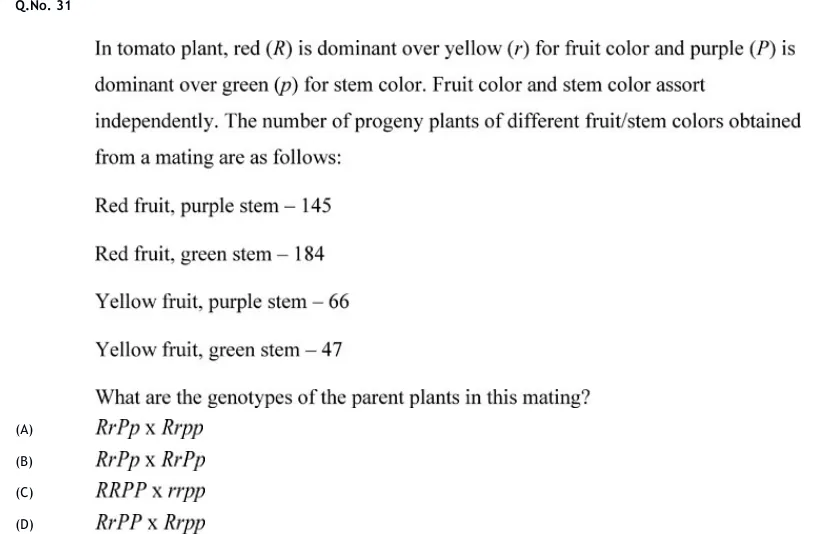
In tomato plant, red (R) is dominant over yellow (r) for fruit color and purple (P) is dominant over green (p) for stem color. Fruit color and stem color assort independently. The number of progeny plants of different fruit/stem colors obtained from a mating are as follows:
Red fruit, purple stem – 145
Red fruit, green stem – 184
Yellow fruit, purple stem – 66
Yellow fruit, green stem – 47
What are the genotypes of the parent plants in this mating?

  1. (A)

    RrPp x Rrpp

  2. (B)

    RrPp x RrPp

  3. (C)

    RRPP x rrpp

  4. (D)

    RrPP x Rrpp

Answer and solution
See the question in the paper
GATE 2020 BT Q.31: answer and solution

GATE 2019 BT Q.47

GATE 2019 · BTQ.47 · 2 marks · NAT

In pea plants, purple color of flowers is determined by the dominant allele while white color is determined by the recessive allele. A genetic cross between two purple flower-bearing plants results in an offspring with white flowers. The probability that the third offspring from these parents will have purple flowers is ________ (rounded off to 2 decimal places).

Answer and solution
See the question in the paper
GATE 2019 BT Q.47: answer and solution

PRACTICE

7 questions to test yourself

PRACTICE 11 mark · MCQ

A dihybrid self-cross (AaBb × AaBb) of two independently assorting genes affecting one phenotype gives an F2 ratio of 9 : 3 : 4 instead of 9 : 3 : 3 : 1. This ratio is characteristic of which type of gene interaction?

  1. (A)

    Duplicate recessive epistasis (9:7)

  2. (B)

    Recessive epistasis (9:3:4)

  3. (C)

    Dominant epistasis (12:3:1)

  4. (D)

    Duplicate dominant epistasis (15:1)

Answer and solution

Answer: (B)

  1. The parts still total 16 (9 + 3 + 4), so this is a modified 9 : 3 : 3 : 1 in which two classes have merged.

  2. The 4 is one single-dominant class (3) merged with the double-recessive class (1). The other single-dominant class (3) and the double-dominant class (9) stay separate.

  3. This happens when homozygous recessive aa hides the genotype at the second gene, so aaB_ looks like aabb.

  4. Masking by a homozygous recessive genotype at another gene is recessive epistasis, which gives 9 : 3 : 4.

PRACTICE 22 marks · NAT

In a three-point testcross, the recombination frequency between genes A and B is 20% and between genes B and C is 10% (B lies between A and C). Out of 1000 testcross offspring, 10 are double crossovers. Calculate the coefficient of coincidence.

Answer and solution

Answer: (accepted range )

  1. Expected double crossovers = RF(A–B) × RF(B–C) × total = 0.20 × 0.10 × 1000 = 20.

  2. Observed double crossovers = 10.

  3. Coefficient of coincidence = observed/expected = 10/20 = 0.5.

PRACTICE 32 marks · MSQ

Which of the following phenotypic ratios, obtained in the F2 of a dihybrid self-cross of two independently assorting genes, indicate epistatic gene interaction (a modification of the standard dihybrid ratio because one gene affects the expression of another)? Select all that apply.

  1. (A)

    3:1

  2. (B)

    9:7

  3. (C)

    9:3:3:1

  4. (D)

    15:1

Answer and solution

Answer: (B), (D)

  1. 3 : 1 is the monohybrid ratio for a single gene and involves no interaction between two genes.

  2. 9 : 3 : 3 : 1 is the unmodified dihybrid ratio: four distinct phenotypic classes, no interaction.

  3. 9 : 7 merges A_bb, aaB_ and aabb into one class: duplicate recessive epistasis (a dominant allele is needed at both loci). This is epistasis.

  4. 15 : 1 merges A_B_, A_bb and aaB_ into one class: duplicate dominant epistasis (a dominant allele at either locus is enough). This is epistasis.

  5. The epistatic ratios are therefore 9 : 7 and 15 : 1.

PRACTICE 41 mark · MCQ

Reciprocal crosses are made between two plant varieties: Variety X as female × Variety Y as pollen parent, and Variety Y as female × Variety X as pollen parent. For a particular leaf-colour trait, the offspring of each cross always resemble their female (seed) parent, and this continues in later generations whenever the same line is used as the female. This pattern is best explained by:

  1. (A)

    Simple autosomal dominant inheritance

  2. (B)

    Simple autosomal recessive inheritance

  3. (C)

    Cytoplasmic (maternal/extrachromosomal) inheritance

  4. (D)

    X-linked inheritance

Answer and solution

Answer: (C)

  1. A nuclear autosomal gene, dominant or recessive, gives the same result in both directions of a reciprocal cross, because both parents contribute nuclear alleles equally. This rules out A and B.

  2. An X-linked gene gives results that differ between reciprocal crosses in a sex-dependent way. Its offspring do not simply copy the mother generation after generation, and many plants have no sex chromosomes at all. This rules out D.

  3. Offspring that copy the female parent in both directions, persistently over generations, are the hallmark of extrachromosomal inheritance. In most flowering plants chloroplasts and mitochondria reach the zygote through the egg cytoplasm, not the pollen.

  4. The trait is therefore governed by cytoplasmic (maternal) inheritance, most plausibly through chloroplast or mitochondrial genes.

PRACTICE 51 mark · NAT

In mice, allele Y gives a yellow coat in heterozygotes (Yy) and is lethal when homozygous (YY embryos die before birth); yy mice are non-yellow. Two yellow mice are crossed. What fraction of the live-born offspring is expected to be yellow? (Give your answer as a decimal to 3 places.)

Answer and solution

Answer: (accepted range )

  1. Both parents are yellow and so must be Yy (YY does not survive).

  2. Yy × Yy gives 1 YY : 2 Yy : 1 yy at conception.

  3. YY dies, leaving 2 Yy (yellow) : 1 yy (non-yellow) among live-born offspring.

  4. Fraction yellow = 2/3 ≈ 0.667.

PRACTICE 62 marks · MCQ

A plant heterozygous for three linked genes (A/a, B/b, C/c) is testcrossed to aa bb cc. Alleles are listed in the order A, B, C, which is not necessarily their order on the chromosome. The two most frequent offspring classes are A B C and a b c, and the two least frequent classes are a B C and A b c. What is the gene order on the chromosome?

  1. (A)

    A–B–C

  2. (B)

    B–A–C

  3. (C)

    A–C–B

  4. (D)

    Cannot be determined without the single-crossover class counts

Answer and solution

Answer: (B)

  1. The most frequent classes, A B C and a b c, are parental. The least frequent, a B C and A b c, are the double crossovers.

  2. Compare the DCO a B C with the parental A B C: only gene A differs.

  3. Compare the DCO A b c with the parental a b c: again only gene A differs.

  4. A double crossover exchanges only the middle gene, so A is in the middle and the order is B–A–C (the same as C–A–B).

  5. The DCO classes alone fix the order, so no map distances are needed and option D is wrong.

PRACTICE 71 mark · NAT

In a cross between two doubly heterozygous plants, Aa Bb × Aa Bb, the two gene pairs assort independently. What fraction of the offspring is expected to show the double recessive phenotype (aabb)? (Give your answer as a decimal.)

Answer and solution

Answer: (accepted range )

  1. Each locus segregates independently, so treat A/a and B/b separately.

  2. P(aa) = 1/4 (from Aa × Aa).

  3. P(bb) = 1/4 (from Bb × Bb).

  4. By the multiplication rule, P(aabb) = 1/4 × 1/4 = 1/16 = 0.0625.

OFFICIAL GATE 2027 SYLLABUS WORDING

Copied from the GATE 2027 syllabus; see all 2027 syllabi.

GATE BT

Mendelian inheritance; Gene interaction; Complementation; Linkage, recombination and chromosome mapping; Extra chromosomal inheritance

Preparing in Kolkata? IAE Academy's course for GATE BT.