GATE 2025 BT Q.12
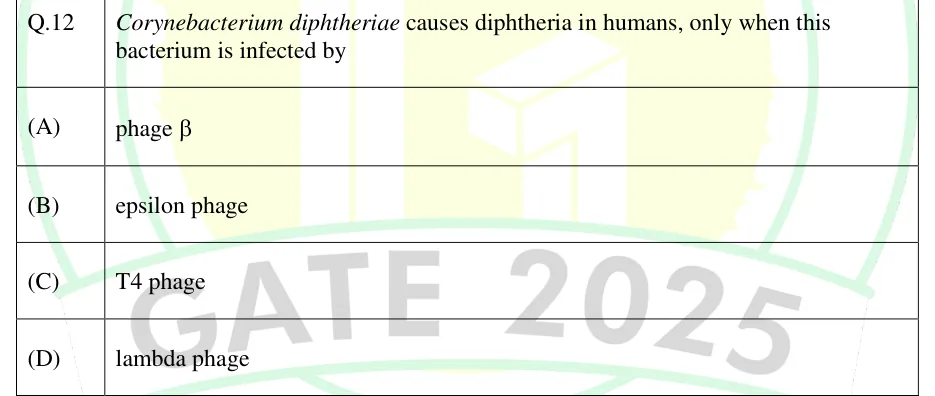
Corynebacterium diphtheriae causes diphtheria in humans, only when this bacterium is infected by
- (A)
phage β
- (B)
epsilon phage
- (C)
T4 phage
- (D)
lambda phage

GATE BT
Bacteria exchange genes by three mechanistically distinct routes of horizontal gene transfer: transformation (uptake of free DNA), conjugation (plasmid-driven transfer through cell contact), and transduction (phage-packaged DNA, generalized or specialized). Incoming chromosomal DNA is kept only if homologous recombination integrates it; plasmids and integrating phage genomes need no homology. These notes cover Hfr time-of-entry mapping, cotransduction and cotransformation mapping (the Wu formula and gene ordering), how generalized and specialized transduction differ in mechanism, and bacterial and eukaryotic transposable elements with their cut-and-paste, replicative and RNA-mediated mechanisms.
2 previous-year questions · 2 solved · 7 practice questions
Horizontal (lateral) gene transfer (HGT) is the movement of DNA between cells other than from parent to offspring. In bacteria it happens by three mechanistically unrelated routes: transformation (uptake of free DNA from the surroundings), conjugation (direct cell-to-cell transfer, driven by a conjugative plasmid) and transduction (DNA carried inside a bacteriophage particle).
The transferred donor DNA (the exogenote) usually enters as a fragment. For that region the recipient becomes a partial diploid (merozygote), holding the fragment alongside its own chromosome (the endogenote). A chromosomal fragment is inherited stably only if RecA-dependent homologous recombination integrates it. That requires an even number of crossovers, because a single crossover between a linear fragment and a circular chromosome would open the chromosome. A self-replicating plasmid, or a phage genome that integrates site-specifically, does not need homologous recombination to be kept.
Feature | Transformation | Conjugation | Transduction |
|---|---|---|---|
DNA source | Free DNA in the surroundings | Donor cell, through a mating bridge | Donor DNA packaged in a phage capsid |
Vehicle | None (direct uptake) | Conjugative pilus and mating apparatus (tra genes) | Bacteriophage particle |
Recipient requirement | Competence (natural, or induced artificially) | A cell lacking the plasmid (e.g. F⁻); cells already carrying F show surface/entry exclusion | A surface receptor for the phage |
DNA that enters | Natural: dsDNA is bound, one strand is degraded and a single strand enters. Artificial (CaCl₂, electroporation): double-stranded DNA, e.g. a plasmid, enters | One strand (the T-strand) is transferred 5′ end first; the complementary strand is synthesised in donor and recipient | A double-stranded fragment is injected |
Amount transferred | Fragments typically carrying a few genes | A whole plasmid; for Hfr, a chromosome segment whose length depends on how long mating lasts | At most one headful (about 44 kb for P22, about 100 kb for P1; roughly 1–2% of the chromosome) |
Stopped by DNase added to the medium? | Yes | No | No (the DNA is protected inside the capsid) |
Needs cell-to-cell contact? | No | Yes | No |
EXAM TIP
Conventions. Bacterial genotype symbols are three lowercase letters, usually italic in print, with a capital letter for separate loci of one pathway or operon (lacZ, lacY). Alleles take a superscript: + for wild type, − for mutant (leu⁺, leu⁻), and r or s for resistance or sensitivity (strʳ, strˢ). Phenotypes begin with a capital letter in roman type (Leu⁺ means the cell grows without added leucine). Recombination frequency (RF) is a fraction or a percentage, and 1% RF = 1 map unit (cM). Bacterial conjugation maps use a different unit, minutes of transfer time.
Some bacteria (e.g. Streptococcus pneumoniae, Bacillus subtilis, Haemophilus influenzae) are naturally competent. Competence is a regulated physiological state; in some species a secreted peptide signal induces it at high cell density. Competent cells bind double-stranded DNA from the surroundings, degrade one strand and bring the other into the cytoplasm as single-stranded DNA (ssDNA). Some species (e.g. H. influenzae, Neisseria) preferentially take up DNA that carries a short, species-specific uptake sequence. E. coli is not naturally competent under usual laboratory conditions. It is made artificially competent by CaCl₂ treatment followed by heat shock, or by electroporation (a brief electric pulse that makes the envelope temporarily permeable). By these methods double-stranded DNA, typically a plasmid, enters the cell.
Double-stranded DNA binds the competence machinery on the cell surface.
A nuclease degrades one strand while the complementary strand is brought into the cytoplasm.
Protective and loading proteins coat the incoming single strand, and RecA is loaded onto it.
RecA-mediated strand exchange pairs the donor strand with the homologous region of the chromosome and swaps it in, forming a heteroduplex region. Replication or mismatch repair then yields a cell carrying the donor allele (a stable transformant).
If no homologous integration occurs, the incoming linear ssDNA is degraded and nothing is inherited. A transforming plasmid, by contrast, is kept because it replicates on its own.
Adding DNase to the medium abolishes transformation. This is the operational test that separates it from conjugation and transduction.
EXAM TIP
Two markers close together on the donor chromosome are likely to arrive on the same DNA fragment and be inherited together. This is cotransformation, and it becomes less frequent as the distance between the markers grows. It is used to order closely linked genes. The test works at low DNA concentration, where a cell rarely takes up two separate fragments. Linkage is indicated when the frequency of cotransformation is well above the product of the two single-marker transformation frequencies.
The F (fertility) plasmid is a conjugative plasmid about 100 kb long. Its tra genes build the F-pilus and the transfer apparatus. On contact with a recipient, an F-encoded relaxase nicks one strand at the nic site within the origin of transfer (oriT). That strand (the T-strand) passes into the recipient 5′ end first, while replication in the donor replaces it (rolling-circle-type transfer). The recipient makes the complementary strand and recircularises the plasmid. An F⁺ × F⁻ mating therefore turns the recipient F⁺, and the donor stays F⁺.
F carries insertion sequences (IS2, IS3) and the transposon Tn1000, and copies of these elements are scattered around the chromosome. Homologous recombination between an element on F and a matching chromosomal copy integrates F into the chromosome. The result is an Hfr (high-frequency recombination) strain, which transfers chromosomal genes far more often than an F⁺ strain does. Transfer always starts inside the integrated F at oriT and runs in one direction. Part of F leads, then chromosomal genes follow in fixed order, and the rest of F comes last. The integration site and orientation fix the starting point and direction for each Hfr strain.
Strain | F status | What it transfers | Recipient outcome |
|---|---|---|---|
F⁺ | F plasmid free in the cytoplasm | A copy of F (chromosomal genes only rarely, via Hfr cells arising in the culture) | Recipient becomes F⁺ |
F⁻ | No F | Nothing (recipient only) | — |
Hfr | F integrated into the chromosome (at an IS or Tn1000 copy) | Chromosomal genes in a fixed order from oriT; the rest of F goes last and is rarely transferred | Recipient usually stays F⁻; it becomes Hfr only if the whole chromosome is transferred, which is rare |
F′ | F excised imprecisely, carrying adjacent chromosomal genes | The F′ plasmid (F plus those chromosomal genes) | Recipient becomes F′ and a partial diploid (merodiploid) for the carried genes (sexduction, or F-duction) |
Setup. Hfr and F⁻ strains that differ in selectable markers are mixed. Typically the F⁻ is streptomycin-resistant and the Hfr streptomycin-sensitive, so plating on streptomycin kills the donor (counterselection).
Interruption. At intervals, samples are agitated in a blender to break mating pairs apart. Each sample is plated on selective medium and the recombinants are scored for donor markers.
Order of entry. A gene nearer oriT enters earlier. For each marker, plotting the percentage of recombinants that carry it against sampling time and extrapolating to zero gives its time of entry.
Gradient of transfer. Mating pairs break apart at random, so fewer pairs stay joined long enough to pass on distal genes. Markers that enter later therefore also reach a lower maximum frequency among recombinants. Complete transfer of the E. coli chromosome takes about 100 minutes at 37 °C and seldom happens.
Integration. Donor DNA enters as a linear fragment, so an even number of crossovers is needed to recover a recombinant.
Map unit. The result is a map in minutes (the E. coli map spans about 100 minutes). Minutes are roughly proportional to physical distance, but they are not the RF-based map unit (cM).
Circular map. Different Hfr strains have F integrated at different sites and in either orientation, so each transfers the same gene order from a different origin and in either direction. The gene orders overlap only if the chromosome map is circular.
INTERRUPTED-MATING TIME-OF-ENTRY DISTANCE
t₁ and t₂ are the times of entry (minutes after mixing) of two markers transferred by the same Hfr strain in the same direction. Distances from different Hfr strains are compared only after aligning each strain's order on the circular map.
WORKED EXAMPLE
An Hfr strain transfers three markers with these times of entry: thr⁺ at 2 min, aziʳ at 9 min and lac⁺ at 18 min. What is the map distance between aziʳ and lac⁺, and which of the three genes lies closest to oriT?
The map distance is the difference in time of entry: 18 − 9 = 9 minutes.
The marker with the earliest time of entry is transferred first and so lies closest to oriT. That marker is thr⁺, at 2 minutes.
Answer: The aziʳ–lac⁺ distance is 9 minutes, and thr⁺ is nearest oriT.
A generalized transducing phage packages one fixed length of host DNA, a headful. Two markers can arrive in the same particle only if they lie closer together than one headful. The closer they are, the higher their cotransduction frequency; markers more than a headful apart are never cotransduced. Cotransformation works on the same logic.
Interrupted mating gives a different kind of distance, in minutes, read from the order and time of entry. In Hfr crosses co-inheritance also falls with distance, because of the gradient of transfer. Do not mix up the units of the two methods: minutes of entry time on one side, cotransduction frequency on the other.
COTRANSDUCTION FREQUENCY (DEFINITION)
C is a fraction (multiply by 100 for a percentage). Select for one donor marker, then score the unselected marker. Cotransformation frequency is defined the same way among transformants.
WU FORMULA (GENERALIZED TRANSDUCTION)
C is the cotransduction frequency (a fraction), d the distance between the two markers, and L the length of the packaged fragment. d and L must be in the same unit, either kb or map minutes; for P1, L is about 2 min of the E. coli map. The formula assumes the fragment ends fall at random and holds for d < L. C falls to 0 as d approaches L and is taken as 0 for d ≥ L.
DISTANCE FROM COTRANSDUCTION FREQUENCY (WU FORMULA REARRANGED)
Use this to find d from a measured cotransduction frequency C (as a fraction, not a percentage). The same conditions as the Wu formula apply.
RECOMBINATION FREQUENCY AND MAP UNITS
RF is expressed as a percentage, and 1% RF = 1 map unit (cM). It applies to crosses scored for recombinant and parental classes (including phage crosses). This scale cannot be converted directly into the minutes of an interrupted-mating map.
Ordering from pairwise frequencies. A higher cotransduction frequency means the markers are closer. Among three markers, the pair with the lowest cotransduction frequency is the outermost pair, and the third marker lies between them.
Three-factor transduction. Select for one donor marker and score the other two. The recombinant class that needs four crossovers instead of two is the rarest. The gene order is the one that makes that class need the most crossovers; in effect, the middle gene is the one whose allele is exchanged in the rarest class.
WORKED EXAMPLE
In P1 transductions, the pairwise cotransduction frequencies are a–b = 0.60, a–c = 0.40 and b–c = 0.20. What is the gene order?
Higher cotransduction means closer: a–b is the closest pair and b–c the farthest.
Since b and c are the least often cotransduced, they are the outermost pair, which puts a in the middle.
Check with the Wu formula, taking L = 1: d(a,b) = 1 − 0.60^{1/3} ≈ 0.157 and d(a,c) = 1 − 0.40^{1/3} ≈ 0.263. With a in the middle, d(b,c) ≈ 0.420, so the predicted C(b,c) = (0.580)³ ≈ 0.195, which agrees with the measured 0.20.
Answer: The order is b–a–c.
EXAM TIP
'Map distance' can mean three things that cannot be converted into one another: minutes (Hfr time of entry), map units (cM) from recombination frequency, and the distance d in the Wu formula (in kb or minutes, in the same unit as L). Identify which method the question describes before choosing a formula.
Generalized transduction comes from a packaging error during lytic growth. Phages such as P1 (E. coli) and P22 (Salmonella) fill each head by the headful mechanism. Packaging starts at a pac site, and each cut is set by how much DNA fits in the head rather than by sequence. Now and then a head is filled with a fragment of host chromosome instead of phage DNA. The resulting transducing particle holds host DNA only. Almost any chromosomal gene can be carried this way, although P22 shows some hot spots. P1 and P22 are temperate phages, but their generalized transducing particles form during lytic growth.
Specialized transduction uses a temperate phage that integrates at one fixed chromosomal site. λ integrates at attB, which lies between gal and bio in E. coli. When a lysogen is induced, the prophage occasionally excises imprecisely and takes the adjacent host genes in place of some phage genes (λdgal carrying gal, or λdbio carrying bio). As a result, only genes that flank the attachment site can be transferred.
Feature | Generalized transduction | Specialized transduction |
|---|---|---|
Typical phage | P1, P22 (headful packaging) | λ (site-specific integration) |
Genes transferable | Almost any chromosomal gene | Only genes flanking the prophage attachment site |
Origin of the error | Host DNA packaged into a head during lytic growth | Imprecise excision of the prophage when a lysogen is induced |
Particle contents | Host DNA only, no phage genome | A phage genome with some phage genes replaced by adjacent host genes |
How the donor DNA is kept | Homologous recombination into the chromosome (complete) or persistence without replication (abortive) | Integration of the hybrid phage (often with a helper phage, giving a double lysogen) or homologous recombination |
Lysates | One kind | LFT (low-frequency transducing) lysate from an induced lysogen; HFT (high-frequency transducing) lysate from a double lysogen carrying the defective phage and a helper phage |
λdgal has lost phage genes needed for lytic growth, so it cannot form plaques. It grows only with a wild-type helper phage. λdbio keeps the genes needed for lysis and forms plaques (it is written λpbio).
Inducing a double lysogen (λ plus λdgal) gives an HFT lysate, in which a large fraction of the particles are transducing, because the helper supplies the missing functions.
EXAM TIP
A generalized transducing particle carries no phage genome, so the recipient is not lysed. Infections are done at low multiplicity so that the same cell is rarely also infected by a normal phage. In complete transduction the fragment is recombined into the chromosome, and it gives stable, normal-sized colonies. In abortive transduction the fragment persists without replicating and passes to only one daughter cell at each division. It can still be expressed, so on selective medium it forms minute colonies.
Plasmids are extrachromosomal DNA molecules that replicate on their own and are usually circular. A conjugative (self-transmissible) plasmid carries tra genes and an oriT; examples are F and the R plasmids that carry several antibiotic-resistance genes. A mobilizable plasmid carries its own oriT, usually with mob genes, but lacks tra genes. It can be transferred only when a conjugative plasmid in the same cell supplies the transfer machinery.
Transformation, conjugation and transduction are the routes of HGT, and plasmids and transposons are the mobile elements those routes carry. HGT explains how traits such as antibiotic resistance spread quickly between unrelated bacterial lineages.
Transposable elements are DNA segments that move from one site to another, within a replicon or between replicons (chromosome, plasmid, phage). They move by their own transposase, without needing homologous recombination; transposition does not depend on RecA.
Bacterial element | Structure | Cargo genes | Transposition mechanism |
|---|---|---|---|
Insertion sequence (IS) | Short (about 0.7–2.5 kb); terminal inverted repeats flanking usually only the transposase gene(s) | None; its only phenotype is the mutation it causes by inserting | Most move by cut-and-paste (conservative); some IS families transpose replicatively |
Composite transposon (e.g. Tn5, Tn10) | A central segment flanked by two copies of an IS element (often in inverted orientation) | Antibiotic resistance or other marker genes | Cut-and-paste (conservative), using a transposase encoded by the flanking IS |
Tn3-family (complex) transposon | A single unit that encodes its own transposase and resolvase, with short terminal inverted repeats and no flanking IS copies | Antibiotic resistance, e.g. bla (ampicillin resistance) in Tn3 | Replicative: a cointegrate forms and a resolvase resolves it by site-specific recombination at res |
Transposition generates a short target-site duplication, a direct repeat of a few base pairs whose length is characteristic of the element. It arises because the transposase makes a staggered cut in the target, and the single-stranded gaps are filled in after insertion.
Insertion into a gene usually causes a loss-of-function (insertional) mutation. Insertion into an upstream gene of an operon can also have a polar effect, reducing expression of the genes downstream.
Transposition needs no sequence homology, so a transposon can move between unrelated replicons. This is how resistance genes get onto conjugative plasmids and then spread horizontally.
Eukaryotic class | Examples | Mechanism | Notes |
|---|---|---|---|
Class I: LTR retrotransposon | Ty1 (yeast), copia (Drosophila) | Copy-and-paste through an RNA intermediate: transcription, then reverse transcription, then integration | Flanked by long terminal repeats; organised like a retrovirus without a functional envelope gene |
Class I: non-LTR retrotransposon | LINEs (e.g. human L1), SINEs (e.g. Alu) | Copy-and-paste through an RNA intermediate | LINEs encode reverse transcriptase; SINEs encode none and use LINE machinery (non-autonomous) |
Class II: DNA transposon | Ac/Ds (maize), P element (Drosophila) | Cut-and-paste through a DNA intermediate, by transposase | Terminal inverted repeats. Ac is autonomous; Ds lacks a functional transposase and moves only when Ac is present |
EXAM TIP
A transposon provides the resistance gene and the ability to insert into DNA. To move between cells it still needs a transfer route: it rides on a conjugative plasmid, or moves by transformation or transduction.
Temperate phages have two alternative life cycles. In the lytic cycle the phage replicates, packages its DNA and lyses the host; packaging errors during this cycle produce generalized transduction. In the lysogenic cycle the phage genome persists as a quiescent prophage. λ integrates into the chromosome; P1 is instead kept as a plasmid. The prophage is replicated along with the host until induction starts lytic growth, and imprecise excision of an integrated prophage produces specialized transduction. Two phage genomes infecting the same cell can recombine. Phage crosses (e.g. plaque-morphology × host-range markers) are scored like bacterial crosses: RF = recombinant plaques ÷ total plaques × 100%.
Generalized transducing phages (P1, P22) package by the headful mechanism. Packaging starts at a pac site and each cut is set by head capacity, not by sequence. When packaging starts on host DNA (for P22, at pac-like sequences in the chromosome), a transducing particle results.
λ integrates by site-specific recombination between attP (phage) and attB (bacterial), catalysed by Int. Excision needs Int and Xis. Because the site is fixed, specialized transducing derivatives (λdgal, λdbio) always carry the same flanking genes.
EXAM TIP
How to tell them apart: headful, pac-initiated packaging of almost any host gene means generalized transduction; integration at a fixed attB/attP site, with only the flanking genes carried, means specialized transduction.
PREVIOUS-YEAR QUESTIONS
Try each question first, then open the answer. We placed each question under a topic ourselves; the exam paper does not label topics.
See these papers in full: GATE BT 2025 · GATE BT 2019
Corynebacterium diphtheriae causes diphtheria in humans, only when this bacterium is infected by
phage β
epsilon phage
T4 phage
lambda phage
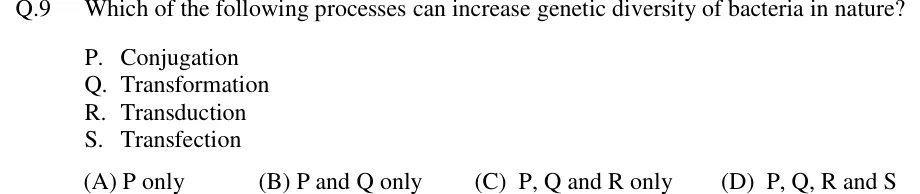
Which of the following processes can increase genetic diversity of bacteria in nature?
P. Conjugation
Q. Transformation
R. Transduction
S. Transfection
P only
P and Q only
P, Q and R only
P, Q, R and S
PRACTICE
Which statement is TRUE of specialized transduction but NOT of generalized transduction?
Only host genes located near the prophage's chromosomal attachment site can be transferred.
Any bacterial chromosomal gene can be transferred.
The phage packages host DNA by a headful mechanism initiated at pac or pac-like sites, independent of any fixed chromosomal attachment site.
Transducing particles are produced during lytic growth after the phage infects a non-lysogenic host.
Answer: (A)
Specialized transduction comes from imprecise excision of a prophage integrated at one fixed attB site, so only genes flanking that site (gal or bio for λ) can be carried. This makes A true of specialized transduction only.
B, C and D all describe generalized transduction (P1, P22): headful packaging of almost any host gene during lytic infection.
In specialized transduction the particles arise when a lysogen is induced, and only flanking genes are carried, so B, C and D are false for it. The answer is A.
In an interrupted-mating experiment with a single Hfr strain, three donor markers first appear among the Hfr × F⁻ recombinants at these times after mixing: gene P at 5 minutes, gene Q at 15 minutes and gene R at 25 minutes. Using the time-of-entry convention, what is the map distance (in minutes) between gene P and gene R?
Answer:
For two markers transferred by the same Hfr in the same direction, map distance = later time of entry − earlier time of entry.
Gene P enters at 5 min and gene R at 25 min.
Map distance = 25 − 5 = 20 minutes.
Which of the following statements about an Hfr × F⁻ conjugation cross are correct?
An Hfr chromosome forms by homologous recombination between an insertion sequence (IS) on the F plasmid and a copy of the same IS element on the bacterial chromosome.
In essentially every mating pair, the entire Hfr chromosome is transferred into the recipient before the pair separates naturally.
Genes located closer to the origin of transfer (oriT) enter the recipient earlier and appear sooner among recombinants in an interrupted-mating experiment.
After a successful Hfr × F⁻ mating, the F⁻ recipient itself becomes Hfr.
Answer: (A), (C)
A is correct. F carries IS elements (and Tn1000) that have copies on the chromosome, and recombination between a matching pair integrates F.
B is incorrect. Mating pairs usually break apart well before the roughly 100 minutes needed for complete transfer, which is why a gradient of transfer exists.
C is correct. This is the basis of interrupted-mating mapping.
D is incorrect. The rest of F is transferred last and seldom arrives, so the recipient normally stays F⁻.
The correct options are A and C.
Two chromosomal markers are separated by a distance d = 20 kb. A generalized transducing phage packages fragments of length L = 100 kb. Using the Wu formula, calculate the expected cotransduction frequency (in %) for these two markers.
Answer: (accepted range )
Wu formula: C = (1 − d/L)³, valid for d < L, with d and L in the same unit.
C = (1 − 20/100)³ = (0.8)³.
(0.8)³ = 0.512, which is 51.2%.
Which statement correctly contrasts the transposition mechanism of a composite transposon (e.g. Tn10) with that of a Tn3-family transposon?
Composite transposons move by a replicative mechanism, forming a cointegrate that a resolvase resolves, while Tn3-family elements move by simple cut-and-paste.
Composite transposons are flanked by two IS elements and typically transpose by a cut-and-paste (conservative, non-replicative) mechanism, whereas Tn3-family elements transpose replicatively, forming a cointegrate that a site-specific resolvase later resolves.
Both composite and Tn3-family transposons transpose only through an RNA intermediate, like retrotransposons.
Composite transposons cannot carry antibiotic-resistance genes, whereas Tn3-family elements always do.
Answer: (B)
Composite transposons (Tn5, Tn10) have central genes flanked by two IS copies that supply the transposase. They transpose by cut-and-paste.
Tn3-family elements encode both transposase and resolvase. They transpose replicatively: a cointegrate forms and is resolved at res.
A reverses the two mechanisms. C is false because bacterial transposons move through DNA intermediates. D is false because both types commonly carry resistance genes. The answer is B.
A generalized transducing phage packages fragments equivalent to 2.0 minutes of the E. coli map. Two markers show a cotransduction frequency of 21.6%. Using the Wu formula, what is the distance between the two markers in minutes?
Answer: (accepted range )
Rearranged Wu formula: d = L(1 − C^{1/3}), with C as a fraction.
C = 0.216, and C^{1/3} = 0.6 because 0.6³ = 0.216.
d = 2.0 × (1 − 0.6) = 2.0 × 0.4 = 0.8 minutes.
Two auxotrophic bacterial strains are placed in the two arms of a U-tube, separated by a filter that stops bacterial cells but lets phage-sized particles through. Prototrophic recombinants appear, and adding DNase to both arms does not stop them from appearing. By which process was the DNA most likely transferred?
Transformation
Conjugation
Transduction
Transposition
Answer: (C)
Conjugation needs direct cell-to-cell contact, and the filter prevents it. This rules out B.
Free DNA in the medium would be destroyed by DNase, so transformation would be abolished. This rules out A.
Transposition moves DNA between sites inside a cell, not between cells. This rules out D.
DNA packaged in a phage capsid is protected from DNase and can pass through the filter, so the process is transduction. The answer is C.
OFFICIAL GATE 2027 SYLLABUS WORDING
Copied from the GATE 2027 syllabus; see all 2027 syllabi.
GATE BT
Microbial genetics - transformation, transduction and conjugation; Bacterial gene mapping; Horizontal gene transfer and transposable elements
Preparing in Kolkata? IAE Academy's course for GATE BT.