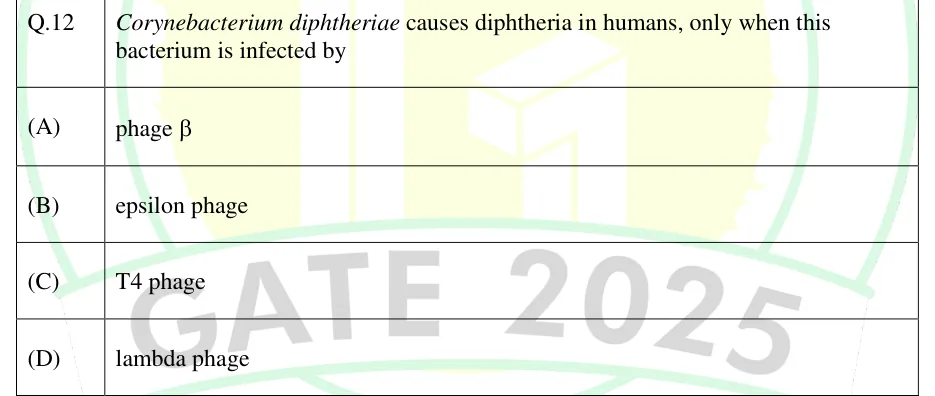
Corynebacterium diphtheriae causes diphtheria in humans, only when this bacterium is infected by
- (A)
phage β
- (B)
epsilon phage
- (C)
T4 phage
- (D)
lambda phage

Corynebacterium diphtheriae causes diphtheria in humans, only when this bacterium is infected by
phage β
epsilon phage
T4 phage
lambda phage
ANSWER
(A) phage β: lysogenic conversion by phage β, which carries the diphtheria toxin gene (tox), makes C. diphtheriae toxigenic.
Official answer: ASource: Official answer key, GATE 2025 BT (IIT Roorkee)
The question asks which bacteriophage must lysogenize Corynebacterium diphtheriae for it to become toxigenic (disease-causing) — i.e., which phage carries the diphtheria toxin gene (tox).
Fact: the gene encoding diphtheria toxin (tox) is not part of the C. diphtheriae chromosome. It is carried on the genome of a temperate (lysogenic) bacteriophage, and toxin is expressed only in strains lysogenized by such a phage — a phenomenon called lysogenic (phage) conversion.
The phage responsible is corynephage β (and closely related tox+ corynephages); only C. diphtheriae strains lysogenized by phage β express diphtheria toxin and cause diphtheria.
Option (A) phage β — correct: this is the toxin-converting phage of C. diphtheriae.
Option (B) epsilon phage — incorrect: epsilon toxin is associated with Clostridium perfringens, a different organism, not with C. diphtheriae toxin conversion.
Option (C) T4 phage — incorrect: T4 is a virulent (lytic) phage of E. coli; it has no lysogenic relationship with Corynebacterium and is unrelated to toxin production.
Option (D) lambda phage — incorrect: lambda is a lysogenic phage of E. coli used as a classic molecular biology model, but it does not carry the diphtheria tox gene.
Hence, only lysogenic conversion by phage β makes C. diphtheriae toxigenic, giving answer (A).
KEY IDEA
Diphtheria toxin production by Corynebacterium diphtheriae is not encoded by the bacterial chromosome — it requires lysogenic conversion by the temperate corynephage β (bearing the tox gene), a classic textbook example of phage/lysogenic conversion in bacterial pathogenesis.
WATCH OUT FOR
Confusing this with other toxin-conversion systems (e.g., epsilon toxin of Clostridium perfringens) or with well-known model phages (T4, a lytic E. coli phage; lambda, a lysogenic E. coli phage) that have no role in C. diphtheriae toxigenicity.
From the GATE 2025 BT paper. Every question of this paper · Download the full paper · All 2 Microbial genetics questions, with notes