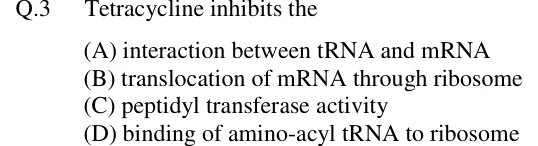
Tetracycline inhibits the
- (A)
interaction between tRNA and mRNA
- (B)
translocation of mRNA through ribosome
- (C)
peptidyl transferase activity
- (D)
binding of amino-acyl tRNA to ribosome

Tetracycline inhibits the
interaction between tRNA and mRNA
translocation of mRNA through ribosome
peptidyl transferase activity
binding of amino-acyl tRNA to ribosome
ANSWER
D — binding of amino-acyl tRNA to ribosome
Official answer: DSource: Official answer key, GATE 2019 BT (IIT Madras)
Tetracycline is a well-known bacterial translation inhibitor that binds the 30S ribosomal subunit.
Its specific mechanism is steric blockage of the A site on the 30S subunit, which prevents the aminoacyl-tRNA-EF-Tu-GTP ternary complex from docking there.
Option A (interaction/pairing between tRNA and mRNA) is not tetracycline's target — codon-anticodon pairing proceeds once a tRNA is positioned; this is not tetracycline's described mechanism.
Option B (translocation of mRNA/tRNA through the ribosome) is the EF-G-dependent step, blocked by drugs such as fusidic acid, not tetracycline.
Option C (peptidyl transferase activity, the 50S ribozyme reaction) is inhibited by chloramphenicol, not tetracycline.
Option D (binding of amino-acyl tRNA to the ribosome) matches tetracycline's textbook mechanism exactly — it blocks the A site so aminoacyl-tRNA cannot bind.
Therefore the correct answer is D.
KEY IDEA
Tetracycline is a bacteriostatic protein-synthesis inhibitor that binds the 30S ribosomal subunit and sterically blocks the A site, preventing the aminoacyl-tRNA-EF-Tu-GTP ternary complex from docking — it stops aminoacyl-tRNA from binding to the ribosome.
WATCH OUT FOR
Confusing tetracycline (blocks aminoacyl-tRNA binding at the A site) with chloramphenicol (blocks peptidyl transferase) or fusidic acid (blocks translocation/EF-G recycling).
From the GATE 2019 BT paper. Every question of this paper · Download the full paper · All 21 Gene expression questions, with notes