
IAE Academy

GATE 2022 BT Q.51: solution and answer

GATE 2022 · BTQ.51 · 2 marks · MSQ

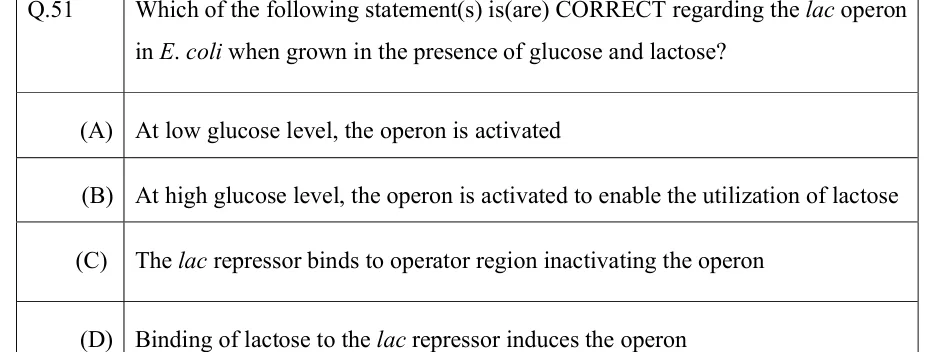
Which of the following statement(s) is(are) CORRECT regarding the lac operon in E. coli when grown in the presence of glucose and lactose?

  1. (A)

    At low glucose level, the operon is activated

  2. (B)

    At high glucose level, the operon is activated to enable the utilization of lactose

  3. (C)

    The lac repressor binds to operator region inactivating the operon

  4. (D)

    Binding of lactose to the lac repressor induces the operon
See the question in the paper

Answer and solution

ANSWER

The correct options are (A) and (C). The operon is activated when glucose is low (cAMP-CAP activation with lactose present), and the lac repressor switches it off by binding the operator. (D) is false because the true inducer that binds the repressor is allolactose, not lactose.

Official answer: A, CSource: Official answer key, GATE 2022 BT (IIT Kharagpur)

  1. The lac operon is under two independent controls. Negative control: the lac repressor (lacI product) binds the operator and blocks transcription unless an inducer is present. Positive control: the cAMP-CAP complex binds the CAP site upstream of the promoter and is needed for strong transcription. Glucose acts on both: it lowers cAMP, and it causes inducer exclusion, where the glucose transport system inhibits lactose permease (LacY) so that little lactose enters the cell.

  2. (A) At low glucose level, the operon is activated. CORRECT. When glucose is low, cAMP rises and binds CAP, and the cAMP-CAP complex binds the CAP site and recruits RNA polymerase. Lactose is also present here, so the repressor has been removed from the operator. With both controls favourable, the operon is actively transcribed. This is the second phase of diauxic growth.

  3. (B) At high glucose level, the operon is activated to enable the utilization of lactose. INCORRECT. High glucose lowers cAMP, so there is no cAMP-CAP activation, and inducer exclusion keeps lactose out of the cell. This is catabolite repression. The cell uses glucose first and does not switch the operon on for lactose until glucose runs out.

  4. (C) The lac repressor binds to operator region inactivating the operon. CORRECT. This is the negative-control mechanism, and it is a true statement about the operon. It also holds for the conditions in the question. While glucose is high, inducer exclusion keeps lactose out, so almost no allolactose forms and the repressor stays bound to the operator. The operon remains off even though lactose is in the medium.

  5. (D) Binding of lactose to the lac repressor induces the operon. INCORRECT. Lactose itself is not the inducer and does not bind the repressor. A small amount of lactose is converted by beta-galactosidase (by transglycosylation) into its isomer allolactose (-1,6 linked instead of lactose's -1,4). Allolactose binds the repressor, changes its shape and releases it from the operator. The statement names the wrong molecule, so it is false as written.

  6. So the correct statements are (A) and (C).

KEY IDEA

The lac operon has two controls: the repressor on the operator (negative control) and cAMP-CAP (positive control). Glucose lowers cAMP and blocks lactose uptake (inducer exclusion). The molecule that actually binds the repressor is allolactose, an isomer that beta-galactosidase makes from lactose.

WATCH OUT FOR

Many students mark (D) because textbooks loosely say "lactose induces the operon". But the repressor binds allolactose, not lactose. Others reject (C) because lactose is present. While glucose is high, inducer exclusion keeps lactose out of the cell, so the repressor stays on the operator.

From the GATE 2022 BT paper. Every question of this paper · Download the full paper · All 21 Gene expression questions, with notes

More Gene expression questions