
IAE Academy

GATE 2022 BT Q.52: solution and answer

GATE 2022 · BTQ.52 · 2 marks · MSQ

Emerging viruses such as SARS-CoV2 cause epidemics. Which of the following process(es) contribute to the rise of such viruses?

  1. (A)

    Mutation of existing virus

  2. (B)

    Jumping of existing virus from current to new hosts

  3. (C)

    Spread of virus in the new host population

  4. (D)

    Replication of virus outside a host
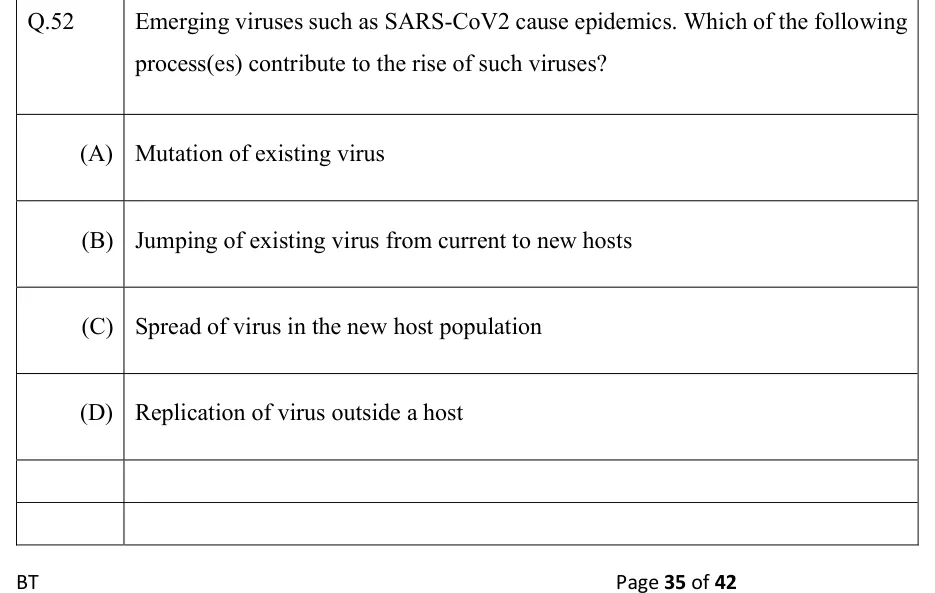
See the question in the paper

Answer and solution

ANSWER

Options A, B and C are correct; option D is incorrect.

Official answer: A, B, CSource: Official answer key, GATE 2022 BT (IIT Kharagpur)

  1. Option A — Mutation of existing virus: Point mutations and recombination/reassortment continually generate new viral variants with altered host range, antigenicity, or transmissibility; this is a well-documented mechanism underlying the emergence of epidemic viruses. Correct.

  2. Option B — Jumping of existing virus from current to new hosts: Cross-species (zoonotic) spillover is the classic first step by which a virus circulating in an animal reservoir enters a new host population, as seen with SARS-CoV-2, HIV, and influenza. Correct.

  3. Option C — Spread of virus in the new host population: A spillover event only becomes an epidemic if the virus subsequently achieves sustained transmission within the new host population; without this step it remains an isolated dead-end infection rather than an epidemic. Correct.

  4. Option D — Replication of virus outside a host: Viruses are obligate intracellular parasites with no independent metabolic or ribosomal machinery, so they cannot replicate outside a living host cell; extracellular viral replication is not a real biological process. Incorrect.

  5. The processes that contribute to the rise of emerging epidemic viruses are mutation (A), host-jumping/spillover (B), and spread within the new host population (C): final answer A, B, C.

KEY IDEA

Viral emergence (the appearance/rise of "new" epidemic viruses like SARS-CoV-2) is a multi-step process: genetic change generates variant viruses, spillover moves them into a new host species, and sustained transmission within that new host population turns a spillover event into an epidemic. All three are recognized drivers; a virus replicating outside a living host cell is not a real biological process, since viruses are obligate intracellular parasites.

WATCH OUT FOR

Treating "jumping to a new host" (B) as sufficient by itself and forgetting that sustained spread within the new host population (C) is a separate, necessary step for an epidemic to result — a single spillover infection that doesn't transmit further is a dead end, not an epidemic. A second common error is assuming any exotic-sounding process (D) must be a distractor testing obscure virology rather than recognizing it contradicts the basic obligate intracellular nature of viruses.

From the GATE 2022 BT paper. Every question of this paper · Download the full paper · All 11 Population & evolution questions, with notes

More Population & evolution questions