
IAE Academy

GATE 2026 BT Q.38: solution and answer

GATE 2026 · BTQ.38 · 2 marks · MCQ

Match the genetic disorders in Column I to the corresponding underlying cause in Column II.

Column I:
P. Klinefelter Syndrome
Q. Turner syndrome
R. Bloom syndrome
S. Xeroderma pigmentosum

Column II:
1. X-chromosome insufficiency
2. DNA helicase mutations
3. Nucleotide excision repair defects
4. Extra X chromosome(s) in a male
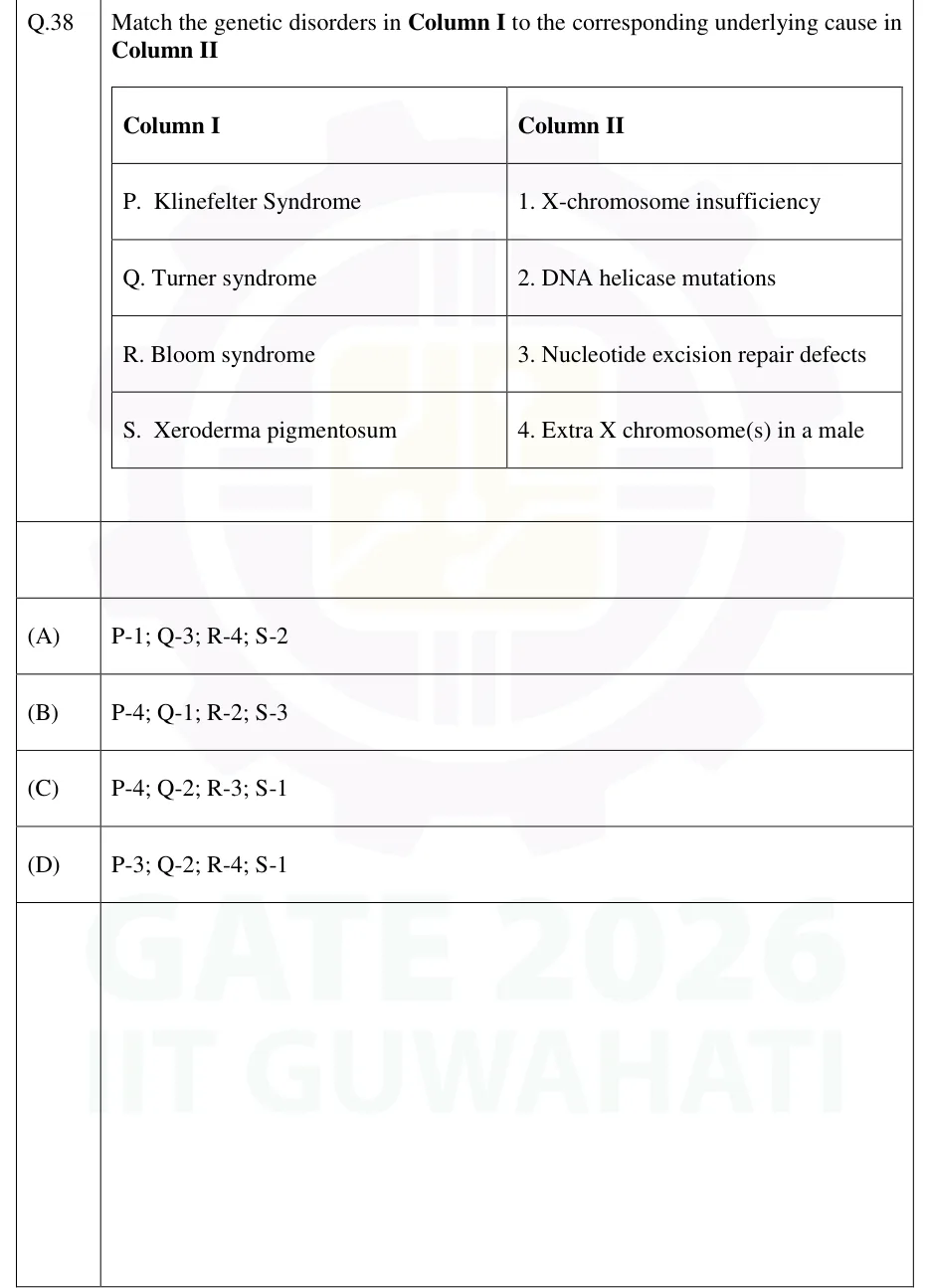
GATE 2026 BT question 38: A 4-row, 2-column matching table.Tap to open full size
Figure from the GATE 2026 BT paper. It is part of the question.
Figure description

A 4-row, 2-column matching table. Column I header, rows P-S list the four disorders (Klinefelter Syndrome, Turner syndrome, Bloom syndrome, Xeroderma pigmentosum). Column II header, rows 1-4 list the four causes (X-chromosome insufficiency, DNA helicase mutations, Nucleotide excision repair defects, Extra X chromosome(s) in a male). No graphical figure, purely a text matching table.

  1. (A)

    P-1; Q-3; R-4; S-2

  2. (B)

    P-4; Q-1; R-2; S-3

  3. (C)

    P-4; Q-2; R-3; S-1

  4. (D)

    P-3; Q-2; R-4; S-1

Answer and solution

ANSWER

The correct match is P-4, Q-1, R-2, S-3 — option (B): Klinefelter syndrome is an extra X in a male, Turner syndrome is X-chromosome insufficiency, Bloom syndrome is a DNA helicase (BLM/RecQ) mutation, and Xeroderma pigmentosum is a nucleotide excision repair defect.

Official answer: BSource: Official answer key, GATE 2026 BT (IIT Guwahati)

  1. Klinefelter syndrome has karyotype 47,XXY (or variants with more X chromosomes) — a male with one or more extra X chromosomes → matches Column II item 4 ("Extra X chromosome(s) in a male").

  2. Turner syndrome has karyotype 45,X — a female with only a single X chromosome, i.e. a deficiency of X-chromosome material → matches item 1 ("X-chromosome insufficiency").

  3. Bloom syndrome is caused by mutations in the BLM gene, which encodes a RecQ-family DNA helicase; loss of helicase function causes genomic instability → matches item 2 ("DNA helicase mutations").

  4. Xeroderma pigmentosum results from defects in genes of the nucleotide excision repair (NER) pathway, impairing repair of UV-induced DNA damage → matches item 3 ("Nucleotide excision repair defects").

  5. Combining: P-4; Q-1; R-2; S-3, which is option (B).

KEY IDEA

Each disorder maps to one specific molecular/chromosomal defect: Klinefelter (47,XXY, extra X in a male), Turner (45,X, X insufficiency), Bloom syndrome (BLM helicase mutation causing genomic instability), and Xeroderma pigmentosum (NER pathway defect impairing repair of UV damage).

WATCH OUT FOR

Confusing Bloom syndrome (a RecQ helicase defect causing chromosome instability/sister-chromatid exchange) with Xeroderma pigmentosum (an NER defect specific to UV-damage repair) — both are DNA-repair-related disorders, but only XP is a nucleotide excision repair defect, and only Bloom is a helicase mutation.

From the GATE 2026 BT paper. Every question of this paper · Download the full paper · All 11 Population & evolution questions, with notes

More Population & evolution questions