
IAE Academy

GATE 2023 BT Q.14: solution and answer

GATE 2023 · BTQ.14 · 1 mark · MCQ

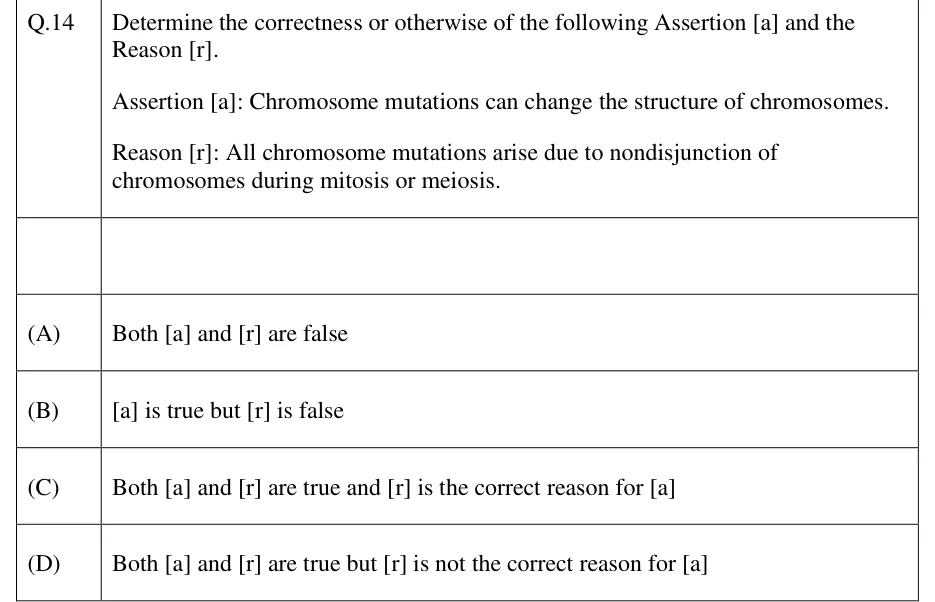
Determine the correctness or otherwise of the following Assertion [a] and the Reason [r].

Assertion [a]: Chromosome mutations can change the structure of chromosomes.

Reason [r]: All chromosome mutations arise due to nondisjunction of chromosomes during mitosis or meiosis.

  1. (A)

    Both [a] and [r] are false

  2. (B)

    [a] is true but [r] is false

  3. (C)

    Both [a] and [r] are true and [r] is the correct reason for [a]

  4. (D)

    Both [a] and [r] are true but [r] is not the correct reason for [a]
See the question in the paper

Answer and solution

ANSWER

GATE BT 2023 Q.14: The correct answer is (B) — Assertion [a] is true but Reason [r] is false.

Official answer: BSource: Official answer key, GATE 2023 BT (IIT Kanpur)

  1. Classify what each term describes. In standard cytogenetic classification, mutations affecting chromosomes fall into two distinct categories: (i) chromosomal (structural) mutations — deletions, duplications, inversions and translocations, which change the STRUCTURE/arrangement of a chromosome; and (ii) genomic (numerical) mutations — aneuploidy (e.g. trisomy, monosomy) and polyploidy, which change the NUMBER of chromosomes.

  2. Evaluate Assertion [a]: 'Chromosome mutations can change the structure of chromosomes.' This is simply the definition of a structural chromosome mutation, so [a] is TRUE.

  3. Evaluate Reason [r]: 'All chromosome mutations arise due to nondisjunction of chromosomes during mitosis or meiosis.' Nondisjunction is the failure of homologous chromosomes (meiosis I) or sister chromatids (meiosis II or mitosis) to separate properly; its consequence is a change in chromosome NUMBER in the daughter cells (aneuploidy), not a change in chromosome structure.

  4. Structural chromosome mutations instead result from chromosome breakage (caused by radiation, mutagenic chemicals, or errors in recombination/replication) followed by incorrect rejoining — a mechanism unrelated to nondisjunction.

  5. So [r] wrongly attributes structural chromosome mutations to nondisjunction, and its blanket claim 'All chromosome mutations arise due to nondisjunction' is also over-general even for numerical mutations. Hence [r] is FALSE.

  6. Since [a] is true and [r] is false, options (A), (C) and (D) — which all require [r] to be true — are eliminated, leaving option (B).

KEY IDEA

Chromosome (structural) mutations — deletions, duplications, inversions, translocations — change chromosome STRUCTURE and arise from breakage-and-faulty-rejoining; genomic (numerical) mutations — aneuploidy, polyploidy — change chromosome NUMBER and arise from nondisjunction. The two mechanisms and the two categories are distinct, so Reason [r] conflates them.

WATCH OUT FOR

Treating "chromosome mutation" as a blanket term covering any chromosome-related abnormality, and then assuming nondisjunction (the most commonly taught mutational mechanism) must be the cause — missing that nondisjunction specifically produces numerical (genomic), not structural, changes.

From the GATE 2023 BT paper. Every question of this paper · Download the full paper · All 11 Population & evolution questions, with notes

More Population & evolution questions