GATE 2026 DA Q.46
Let be the eigenvalues of the matrix , where is in radians.
Which one of the following options lists all the possible values of satisfying ?
- (A)
- (B)
- (C)
- (D)

GATE DA
The determinant of a square matrix is one number that says whether the matrix is invertible and how it scales volume. An eigenvector is a non-zero vector that the matrix maps to a scalar multiple of itself, and that scalar is the eigenvalue. The two ideas are tied together: the trace is the sum and the determinant is the product of the eigenvalues. These notes cover determinant rules, the characteristic equation, eigenvalues of related and special matrices, diagonalisability and the Cayley-Hamilton theorem.
6 previous-year questions · 6 solved · 5 practice questions
Matrices are real and square of size unless stated. Vectors are column vectors in bold, ; is the transpose and is the identity. Eigenvalues are written , are counted with algebraic multiplicity unless stated, and may be complex even for a real matrix. is the Euclidean norm and is the trace, the sum of the diagonal entries. The characteristic polynomial is taken as . The other common convention, , differs from it by the factor and has the same roots.
The determinant is defined only for a square matrix. It is zero exactly when is singular. Each of the following is equivalent to that: the rows (or columns) of are linearly dependent, has a non-zero solution, and has rank less than .
DETERMINANT OF A 2 BY 2 MATRIX
Always valid for a 2 by 2 matrix.
COFACTOR EXPANSION ALONG ROW I
A is n by n and i is any fixed row. M_ij is the determinant of the (n-1) by (n-1) matrix left after deleting row i and column j. The same works along any column. Expand along the row or column with the most zeros.
Swapping two rows (or two columns) multiplies the determinant by .
Multiplying one row by multiplies the determinant by .
Adding a multiple of one row to another row leaves the determinant unchanged.
Two equal rows, one row a multiple of another, or a zero row give determinant .
The determinant of a triangular (upper or lower) or diagonal matrix is the product of its diagonal entries.
If a matrix is block upper or lower triangular with square diagonal blocks, its determinant is the product of the determinants of those blocks.
PRODUCT, TRANSPOSE AND INVERSE
A and B are n by n. The inverse rule needs det(A) not equal to 0. Applying the product rule repeatedly gives det(A^k) = (det A)^k for every integer k >= 1.
SCALAR MULTIPLE
A is n by n. The factor c comes out of each of the n rows, so the power is n, the size of the matrix.
ADJOINT (ADJUGATE)
A is n by n with n >= 2, and adj(A) is the transpose of the cofactor matrix. If det(A) is not 0, then A^{-1} = adj(A)/det(A). Also adj(adj A) = (det A)^{n-2} A for n >= 3, and adj(adj A) = A for n = 2.
VANDERMONDE DETERMINANT
In general, the n by n matrix whose i-th row is 1, x_i, x_i^2, ..., x_i^{n-1} has determinant equal to the product of (x_j - x_i) over all i < j. It is non-zero exactly when the x_i are distinct.
EXAM TIP
In general . The determinant is multiplicative, not additive. Also , so for a matrix the sign flips but for a matrix it does not.
A number is an eigenvalue of if there is a non-zero vector with ; this is an eigenvector for . Any non-zero multiple of an eigenvector is again an eigenvector, so eigenvectors are never unique. When the eigenspace of is one-dimensional, its eigenvector is fixed up to a non-zero scalar multiple. The zero vector is never an eigenvector, but is allowed as an eigenvalue. A real matrix can have non-real eigenvalues, and these occur in complex-conjugate pairs.
CHARACTERISTIC EQUATION
A is n by n. The n roots of this equation, counted with multiplicity over the complex numbers, are the eigenvalues. For each root, solve (A - lambda I)x = 0 to find the eigenvectors.
CHARACTERISTIC EQUATION OF A 2 BY 2 MATRIX
Valid for any 2 by 2 matrix; it is det(A - lambda I) = 0 written out.
CHARACTERISTIC EQUATION OF A 3 BY 3 MATRIX
c_2 is the sum of the three principal 2 by 2 minors: for each i, delete row i and column i, take the determinant, and add the three results. This is det(A - lambda I) = 0 multiplied through by -1.
TRACE AND DETERMINANT FROM THE EIGENVALUES
A is n by n, and the eigenvalues are counted with algebraic multiplicity. Hence A is singular if and only if 0 is an eigenvalue. Applying the trace rule to A^k gives tr(A^k) = lambda_1^k + ... + lambda_n^k for every integer k >= 1.
Form and expand to get the characteristic polynomial.
Solve the polynomial for the eigenvalues, and check them against the trace and the determinant.
For each eigenvalue , row-reduce and solve .
The non-zero solutions are the eigenvectors for . Together with they form the eigenspace, whose dimension is the geometric multiplicity.
For a triangular or diagonal matrix the eigenvalues are the diagonal entries. Row operations generally change the eigenvalues, so never row-reduce first and then read eigenvalues off the reduced matrix. and have the same characteristic polynomial and so the same eigenvalues, although their eigenvectors can differ.
Let be with and . The table gives the matching eigenvalue and eigenvector of each related matrix. Where the eigenvector column says , the same vector works.
Matrix | Eigenvalue | Eigenvector | Condition |
|---|---|---|---|
any scalar | |||
any scalar | |||
integer (any integer if is invertible) | |||
invertible (so ) | |||
, a polynomial in | any polynomial | ||
invertible | |||
(same set of eigenvalues) | may differ from | none | |
(same set of eigenvalues) | an invertible matrix (similar matrices) |
Type of real matrix | What is known about its eigenvalues |
|---|---|
Triangular or diagonal | the diagonal entries |
Block triangular with square diagonal blocks | the eigenvalues of the diagonal blocks, taken together |
Symmetric () | all real; eigenvectors for distinct eigenvalues are orthogonal |
Symmetric positive definite ( and for every ) | all positive (for positive semidefinite, all ) |
Skew-symmetric () | zero or purely imaginary; for odd , is an eigenvalue and |
Orthogonal () | magnitude (so any real ones are ); |
Idempotent () | each eigenvalue is or |
Nilpotent ( for some ) | all equal to |
Singular | at least one eigenvalue is |
Rank-one ( non-zero vectors) | once and repeated times (algebraic multiplicity) |
EXAM TIP
Let be the matrix of all ones. It is the rank-one matrix with , so its eigenvalues are (once) and ( times). Hence has eigenvalues (once, eigenvector ) and (repeated times).
AB AND BA
So AB and BA have the same eigenvalues with the same multiplicities, although their eigenvectors can differ. If A is m by n and B is n by m, AB and BA have the same non-zero eigenvalues with the same multiplicities, and the larger product has extra zero eigenvalues.
EXAM TIP
In general the eigenvalues of and are not sums or products of eigenvalues of and . The exception is a common eigenvector: if and , then is an eigenvector of with eigenvalue and of with eigenvalue . What always holds is and .
Let be and let be one of its eigenvalues. The algebraic multiplicity of is the number of times it is a root of the characteristic polynomial. Its geometric multiplicity is . Always geometric algebraic.
DIAGONALISATION
A, P and D are n by n and P is invertible. The columns of P are n linearly independent eigenvectors, in the same order as the eigenvalues on the diagonal of D. This factorisation exists if and only if A has n linearly independent eigenvectors.
Eigenvectors belonging to distinct eigenvalues are linearly independent.
If has distinct eigenvalues, it is diagonalisable (sufficient, not necessary).
is diagonalisable (over the complex numbers) if and only if, for every eigenvalue, the geometric multiplicity equals the algebraic multiplicity. For a diagonalisation with real and , all eigenvalues must also be real.
A repeated eigenvalue does not by itself stop diagonalisation. The identity has the eigenvalue repeated times and is already diagonal. By contrast, has the repeated eigenvalue but only one independent eigenvector, so it is not diagonalisable.
The eigenvalue has geometric multiplicity . Hence is at least the number of non-zero eigenvalues counted with algebraic multiplicity, with equality when is diagonalisable (for example, when is real symmetric).
SPECTRAL THEOREM FOR REAL SYMMETRIC MATRICES
A is an n by n real symmetric matrix, Q is an n by n orthogonal matrix whose columns are orthonormal eigenvectors, and Lambda is the diagonal matrix of the matching eigenvalues. A real symmetric matrix has real eigenvalues, its eigenvectors for distinct eigenvalues are orthogonal, and it is always diagonalisable by an orthogonal matrix.
RAYLEIGH QUOTIENT BOUNDS
A is an n by n real symmetric matrix with smallest eigenvalue lambda_min and largest eigenvalue lambda_max. Each bound is attained at an eigenvector for that eigenvalue, so the maximum of x^T A x over unit vectors (||x|| = 1) is lambda_max and the minimum is lambda_min.
WORKED EXAMPLE
Let . Find its eigenvalues and eigenvectors, and compute .
and , so , giving and .
For : , so and an eigenvector is .
For : , so and an eigenvector is .
The matrix has eigenvalues : for and for .
The determinant is the product of these eigenvalues. Check by direct computation: , whose determinant is .
Answer: Eigenvalues 5 and 2 with eigenvectors and (or any non-zero multiples); .
WORKED EXAMPLE
A real matrix has eigenvalues , and , and . Find , and the eigenvalues of .
The trace gives , so .
. This is non-zero, so is invertible and .
.
The eigenvalues of are : , and .
Check: .
Answer: , , and the eigenvalues of are .
CAYLEY-HAMILTON THEOREM
A is n by n, and the constant term c of p is replaced by cI. Every square matrix satisfies its own characteristic equation. For a 2 by 2 matrix: A^2 - tr(A) A + det(A) I = 0.
The theorem has two common uses. First, any power of can be reduced to a polynomial in of degree at most , by repeatedly replacing the highest power using the relation. Second, if , multiplying the relation by expresses as a polynomial in . For a matrix, .
EXAM TIP
Two quick checks on a computed characteristic polynomial. With , the constant term is , the leading coefficient is , and the coefficient of is . With the monic convention , the coefficient of is and the constant term is . In either convention, a non-zero constant term means the matrix is invertible.
PREVIOUS-YEAR QUESTIONS
Try each question first, then open the answer. We placed each question under a topic ourselves; the exam paper does not label topics.
See these papers in full: GATE DA 2026 · GATE DA 2025 · GATE DA 2024
Let be the eigenvalues of the matrix , where is in radians.
Which one of the following options lists all the possible values of satisfying ?
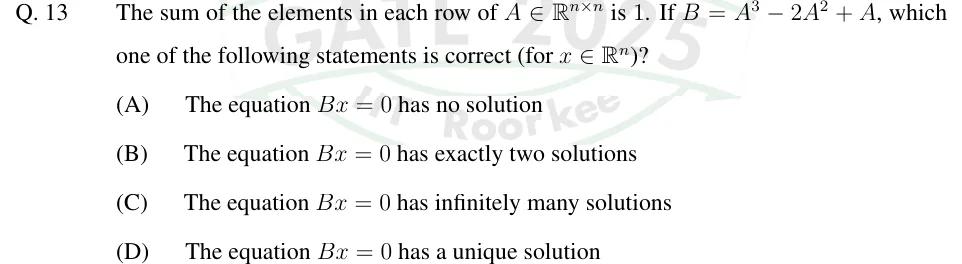
The sum of the elements in each row of is 1. If , which one of the following statements is correct (for )?
The equation has no solution
The equation has exactly two solutions
The equation has infinitely many solutions
The equation has a unique solution
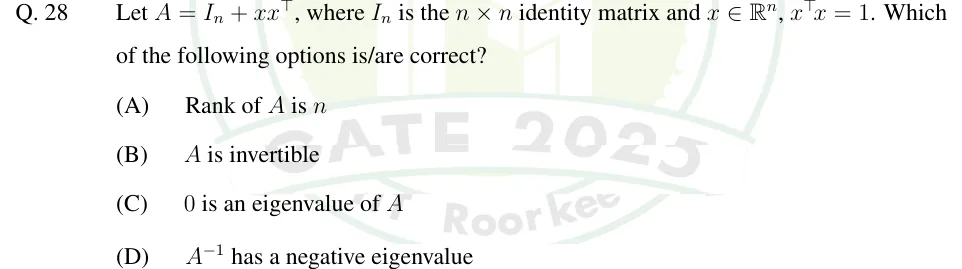
Let , where is the identity matrix and , . Which of the following options is/are correct?
Rank of is
is invertible
is an eigenvalue of
has a negative eigenvalue
Let be such that . Which one of the following statements is ALWAYS correct?
is invertible
Determinant of is
The sum of the diagonal elements of is
and have the same rank
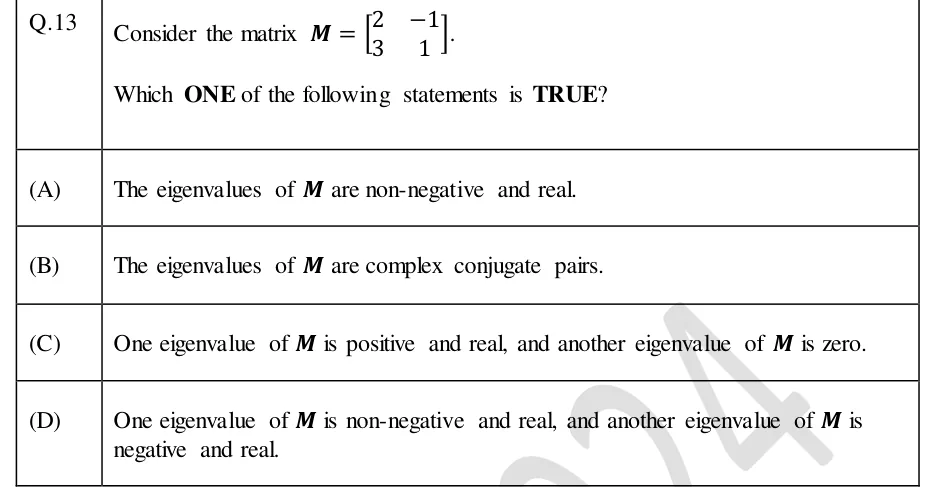
Consider the matrix .
Which ONE of the following statements is TRUE?
The eigenvalues of are non-negative and real.
The eigenvalues of are complex conjugate pairs.
One eigenvalue of is positive and real, and another eigenvalue of is zero.
One eigenvalue of is non-negative and real, and another eigenvalue of is negative and real.
Consider the matrix . The determinant of is ______.
PRACTICE
A real matrix has eigenvalues , and . Find the value of .
Answer:
The matrix has eigenvalues .
For these are .
The determinant is the product of the eigenvalues: .
A real matrix has characteristic equation and . Which statement is correct?
is diagonalisable because its eigenvalues are real
is not diagonalisable
is singular
Answer: (B)
The eigenvalue has algebraic multiplicity .
Its geometric multiplicity is , which is less than .
So does not have three linearly independent eigenvectors and is not diagonalisable. B is true and A is false.
The eigenvalues are and none is zero, so is non-singular (C false) and , not (D false).
Let . Which of the following statements are correct?
is diagonalisable
An eigenvector for the eigenvalue is orthogonal to every eigenvector for the eigenvalue
has an eigenvalue
Answer: (A), (B), (C)
Every row sums to , so is an eigenvector with eigenvalue .
is the all-ones matrix, which has rank . So the eigenvalue has geometric multiplicity , and therefore algebraic multiplicity at least .
With the eigenvalue as well, the eigenvalues are , which agrees with the trace .
is real symmetric, so it is diagonalisable (A true), and eigenvectors for distinct eigenvalues are orthogonal (C true). Directly: the eigenvectors for satisfy , which says they are orthogonal to .
(B true).
The eigenvalues of are , so is not one of them (D false).
Let . By the Cayley-Hamilton theorem, for real numbers and . Find .
Answer:
and , so , that is .
.
is not a multiple of , so and are linearly independent and , are unique: , , and .
Let . What is ?
1
2
4
8
Answer: (C)
Expanding along the first row: . As a check, is a Vandermonde matrix with , so .
is , so .
, so the result is .
OFFICIAL GATE 2027 SYLLABUS WORDING
Copied from the GATE 2027 syllabus; see all 2027 syllabi.
GATE DA
eigenvalues and eigenvectors, determinant
Preparing in Kolkata? IAE Academy's course for GATE DA.