GATE 2026 DA Q.22
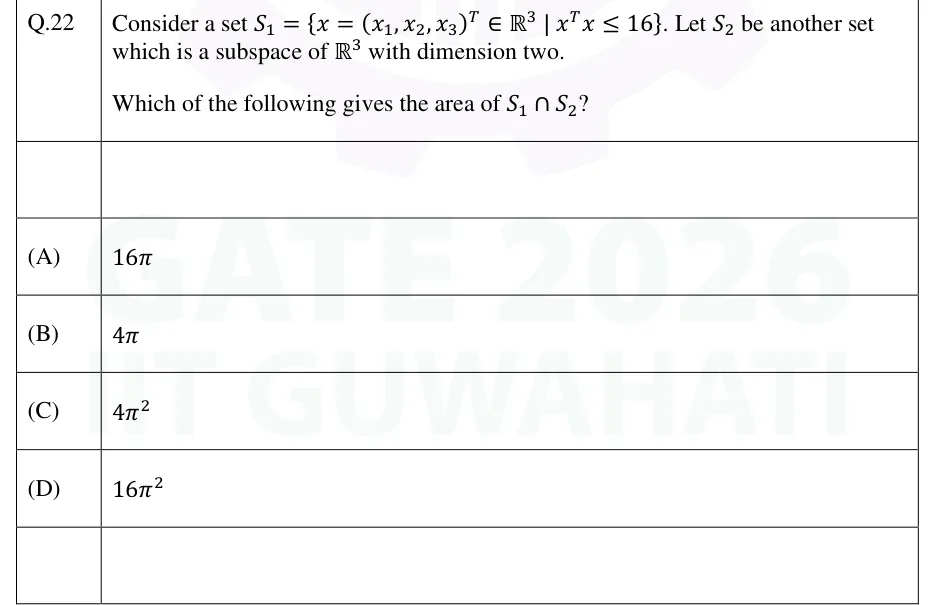
Consider a set . Let be another set which is a subspace of with dimension two.
Which of the following gives the area of ?
- (A)
- (B)
- (C)
- (D)

GATE DA
Vector spaces, subspaces, and linear dependence and independence
A vector space is a set closed under addition and scalar multiplication, and a subspace is a subset that is itself a vector space. Linear independence, span, basis and dimension tell you how large such a space is. GATE questions ask you to test whether a set is a subspace, to decide whether vectors are independent (often with an unknown parameter), and to find the dimension of a span or null space.
3 previous-year questions · 3 solved · 5 practice questions
Conventions. All vector spaces are over the real numbers. Vectors in are column vectors, written in bold, e.g. . To save space, denotes the same column vector written on one line. is the transpose, and an matrix has rows and columns. A vector space is a set that is closed under addition and scalar multiplication, where those operations obey the usual rules (commutativity, associativity, a zero vector, additive inverses, distributivity, ). For GATE you rarely check all the rules; you work with a subset of a known space and test it with the subspace test.
SUBSPACE TEST
Applies to any subset W of a vector space V. If the zero vector is missing, W fails immediately.
SUBSPACES UNDER INTERSECTION AND SUM
W1 and W2 are finite-dimensional subspaces of a vector space V. The intersection and the sum W1+W2 (all u+v with u in W1, v in W2) are always subspaces. The union is a subspace exactly when one of the two contains the other.
Subspaces of and . The subspaces of are exactly (dimension 0), lines through the origin (dimension 1), planes through the origin (dimension 2) and itself (dimension 3). In they are , lines through the origin and . A line or plane that does not pass through the origin is never a subspace.
Subspace or not
Set | Subspace? | Reason |
|---|---|---|
Yes | Solution set of a homogeneous linear equation; dimension 2 | |
No | Does not contain | |
No | is outside; not closed under addition | |
No | is outside; not closed under scalar multiplication | |
Solutions of | Yes | Null space of |
Solutions of , | No | Does not contain |
Symmetric matrices | Yes | Dimension |
Invertible matrices | No | Zero matrix excluded; is singular |
Polynomials of degree at most | Yes | Dimension |
Polynomials of degree exactly | No | has no degree |
EXAM TIP
Check the zero vector first. It disposes of every set defined by an equation with a non-zero right-hand side, and of every set that excludes the origin. If is present, look for a counterexample to closure with small numbers such as and , or use a scalar of .
A linear combination of is any vector with real scalars . The set of all such combinations is the span.
SPAN
The span is always a subspace, and it is the smallest subspace containing the given vectors.
MEMBERSHIP IN A COLUMN SPACE
A is m x n real, b is in R^m. Use it to decide whether a vector lies in the span of given vectors.
Adding a vector that is already in the span does not change the span. Removing a vector that is a combination of the others does not change it either. This is why a spanning set can be trimmed down to a basis.
DEFINITION OF LINEAR INDEPENDENCE
The vectors are independent if only the trivial combination gives the zero vector; otherwise they are dependent. For k >= 2 this is equivalent to: no vector in the set is a combination of the others. Also equivalent: the list v1, ..., vk is dependent exactly when v1 = 0 or some vj is a combination of v1, ..., v(j-1).
Procedure: test independence of k vectors in R^n
Place the vectors as the columns of an matrix .
Row-reduce to echelon form and count the pivots, which gives .
If the vectors are independent. If they are dependent.
When (a square matrix) you may use the determinant instead: independent if and only if .
If the vectors involve a parameter, find the values that make the rank drop (for square , solve ).
Quick facts
Situation | Conclusion |
|---|---|
A set contains | Dependent |
A single non-zero vector | Independent |
Two vectors | Dependent exactly when one is a scalar multiple of the other |
More than vectors in | Dependent |
Any subset of an independent set | Independent |
Any superset of a dependent set | Dependent |
Eigenvectors of one square matrix, one for each of several distinct eigenvalues | Independent |
EXAM TIP
Pairwise independence is not enough. In the vectors , , are independent two at a time but the three together are dependent, since . Always test the whole set at once.
A basis of is a set of vectors that is linearly independent and spans . If is finite-dimensional (spanned by finitely many vectors), every basis of has the same number of vectors, called the dimension . The zero space has dimension 0.
BASIS FACTS
V is finite-dimensional. Any independent set has at most n vectors, any spanning set has at least n, and an independent set can be extended to a basis. If W is a subspace of V, then dim W <= n, with equality only when W = V.
COORDINATES IN A BASIS
For a basis B = {b1,...,bn} of V, every v in V has exactly one such expression, and (a1,...,an) are its coordinates. When V = R^n, form the n x n matrix P whose columns are b1,...,bn and solve P a = v. P is invertible because its columns are independent.
Standard dimensions
Space | Dimension |
|---|---|
real matrices | |
Polynomials of degree at most | |
Symmetric matrices | |
Skew-symmetric matrices | |
Diagonal matrices | |
Upper triangular matrices | |
matrices with trace | |
Solutions of independent homogeneous equations in |
EXAM TIP
To find the dimension of a subspace given by equations, count the unknowns and subtract the number of independent equations. Two equations that look different may be multiples of each other, so check that they are independent.
Let be a real matrix with . The column space is the span of the columns (a subspace of ). The row space is the span of the rows (a subspace of ). The null space is (a subspace of ).
DIMENSIONS OF THE MATRIX SUBSPACES
A is real m x n of rank r. Row rank equals column rank, so rank(A) = rank(A^T), and r <= min(m, n). The middle result, rank plus nullity equals the number of columns n, is the rank-nullity theorem.
RANK-NULLITY THEOREM
n is the number of columns of A. Nullity is the dimension of the null space.
Procedure: bases from row reduction
Row-reduce to echelon form.
Column space: take the columns of the original that sit in the pivot positions.
Row space: take the non-zero rows of the echelon form.
Null space: set each free variable to 1 in turn with the others 0, solve for the pivot variables, and collect the resulting vectors. There is one vector per free variable, so in total.
EXAM TIP
Row operations keep the row space and the null space unchanged, but they can change the column space. Take the pivot columns from the original matrix, not from the echelon form. Also, has only the trivial solution exactly when the columns of are independent. If has more columns than rows (), then , so always has a non-trivial solution.
WORKED EXAMPLE
For which real are the vectors , , linearly dependent?
Three vectors in are dependent exactly when the matrix they form is singular, so set the determinant to zero. The determinant is the same whether the vectors are placed as rows or as columns, because .
Expand along the first row of the rows : .
Simplify: .
The determinant is zero when . Check: for , , so the vectors are visibly dependent.
Answer:
WORKED EXAMPLE
Let (a real matrix). Find the rank, the nullity and a basis of the null space.
Row-reduce: gives ; gives ; then gives the zero row.
Echelon form: rows , , . Pivots are in columns 1 and 3, so .
Nullity . The free variables are and .
From row 2: . From row 1: .
So , and these two vectors form a basis of the null space.
Answer: Rank 2, nullity 2, basis
PREVIOUS-YEAR QUESTIONS
Try each question first, then open the answer. We placed each question under a topic ourselves; the exam paper does not label topics.
See these papers in full: GATE DA 2026 · GATE DA 2025 · GATE DA 2024
Consider a set . Let be another set which is a subspace of with dimension two.
Which of the following gives the area of ?
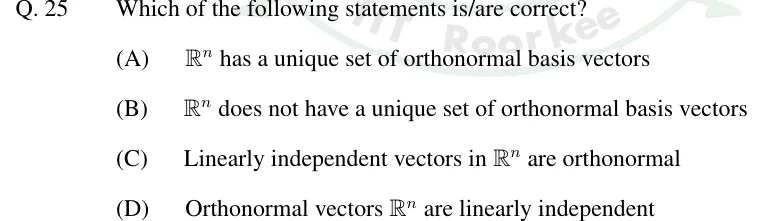
Which of the following statements is/are correct?
has a unique set of orthonormal basis vectors
does not have a unique set of orthonormal basis vectors
Linearly independent vectors in are orthonormal
Orthonormal vectors are linearly independent
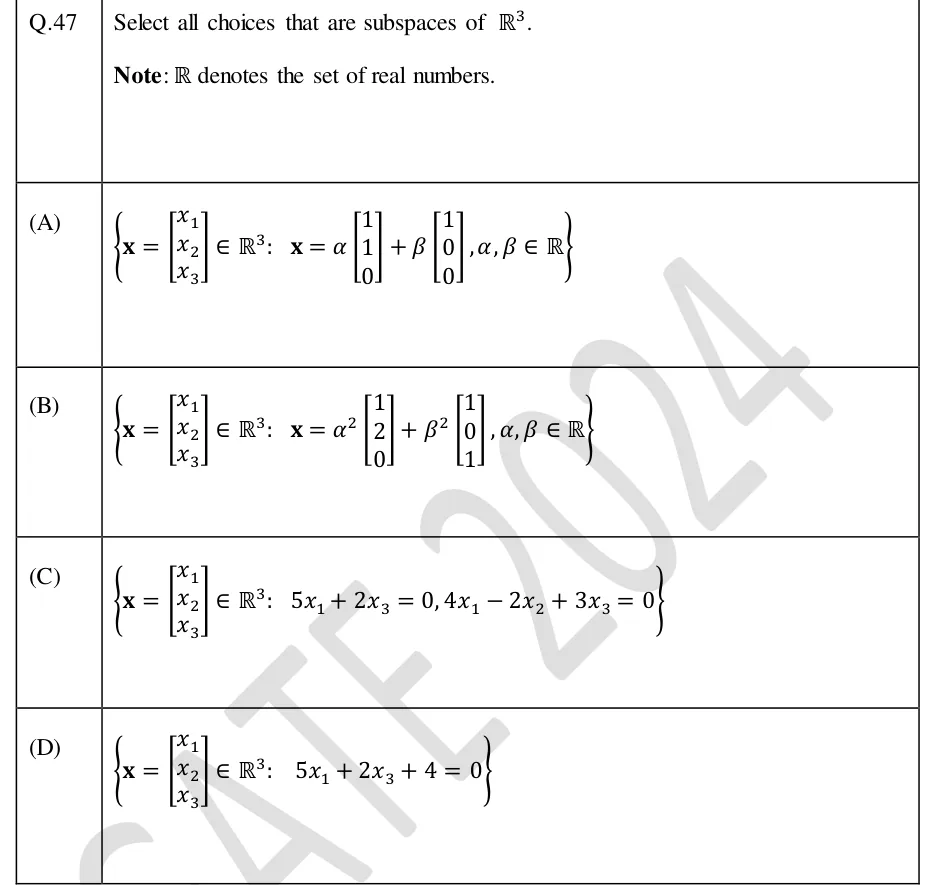
Select all choices that are subspaces of .
Note: denotes the set of real numbers.
PRACTICE
Which of the following is a subspace of (vectors written as )?
Answer: (B)
A: and are in the set but their sum has . Not closed under addition.
B: contains and is the solution set of a homogeneous linear equation, so it is closed under addition and scalar multiplication. Subspace.
C: gives , so the zero vector is missing.
D: is in the set but is not.
Answer: B.
Which of the following sets are subspaces of the vector space of all real matrices (with the usual addition and scalar multiplication)?
All symmetric matrices
All matrices with trace
All invertible matrices
All matrices with determinant
Answer: (A), (B)
A: the sum of symmetric matrices is symmetric, and so is a scalar multiple. Subspace.
B: and . Subspace.
C: the zero matrix is not invertible, so is missing.
D: and both have determinant 0, but their sum is with determinant 1. Not closed under addition.
Answer: A and B.
Let . Find .
Answer:
is the solution set of two homogeneous linear equations in 5 unknowns.
The equations and are not multiples of each other, so they are independent and the coefficient matrix has rank 2.
By rank-nullity, .
The vectors , and in are linearly dependent. Find .
Answer:
Dependent means the determinant of the rows is zero.
.
Setting gives .
Check: , so the third vector is a combination of the first two.
Let be a real matrix of rank . What is ?
2
3
4
8
Answer: (C)
has columns and rank , so .
is with rank 4 and 5 columns, so .
Sum .
Answer: C.
OFFICIAL GATE 2027 SYLLABUS WORDING
Copied from the GATE 2027 syllabus; see all 2027 syllabi.
GATE DA
Vector space, subspaces, linear dependence and independence of vectors
Preparing in Kolkata? IAE Academy's course for GATE DA.