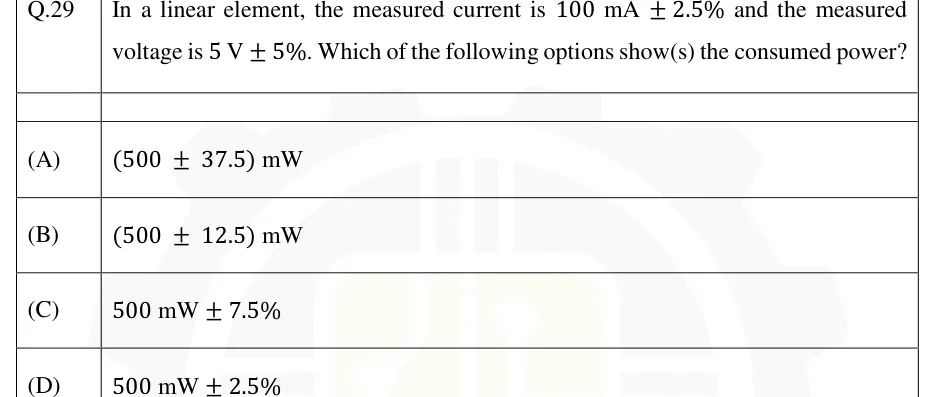
In a linear element, the measured current is and the measured voltage is . Which of the following options show(s) the consumed power?
- (A)
- (B)
- (C)
- (D)

In a linear element, the measured current is and the measured voltage is . Which of the following options show(s) the consumed power?
ANSWER
Options (A) and (C) are correct. The consumed power is , which is the same as .
Official answer: A, CSource: Official answer key, GATE 2026 IN (IIT Guwahati)
Nominal power: .
Rule for a product: taking logarithms, , so . A limiting (guaranteed) error assumes the worst case, where both errors push the same way, so the relative limiting errors add in magnitude: .
Substituting: , so . Option (C) is correct.
In absolute terms: , so . This is the same result as (C) written as an absolute error, so option (A) is also correct.
Check by extremes: (that is ) and (that is ). The exact extremes differ from only by the cross-product term of , which is . For small errors this second-order term is neglected, which is why the standard limiting error is , i.e. .
Options (B) and (D) say the same thing: . That equals the current's error alone, or the difference . It is not the sum of the errors, so both options are wrong. (The root-sum-square value, , is not offered either.)
KEY IDEA
When quantities are multiplied or divided, their limiting (worst-case) relative errors add in magnitude. For : of , which is . An MSQ can list the same result twice, once as a percentage and once as an absolute error, and then both options are correct.
WATCH OUT FOR
Picking only one of (A) and (C) when they state the same error in two forms. Another mistake is subtracting the relative errors (, giving (B)/(D)) or taking the root-sum-square (). A limiting error is worst-case, so the magnitudes add.
From the GATE 2026 IN paper. Every question of this paper · Download the full paper · All 11 Errors & standards questions, with notes