
IAE Academy

GATE 2024 EE Q.23: solution and answer

GATE 2024 · EEQ.23 · 1 mark · MCQ

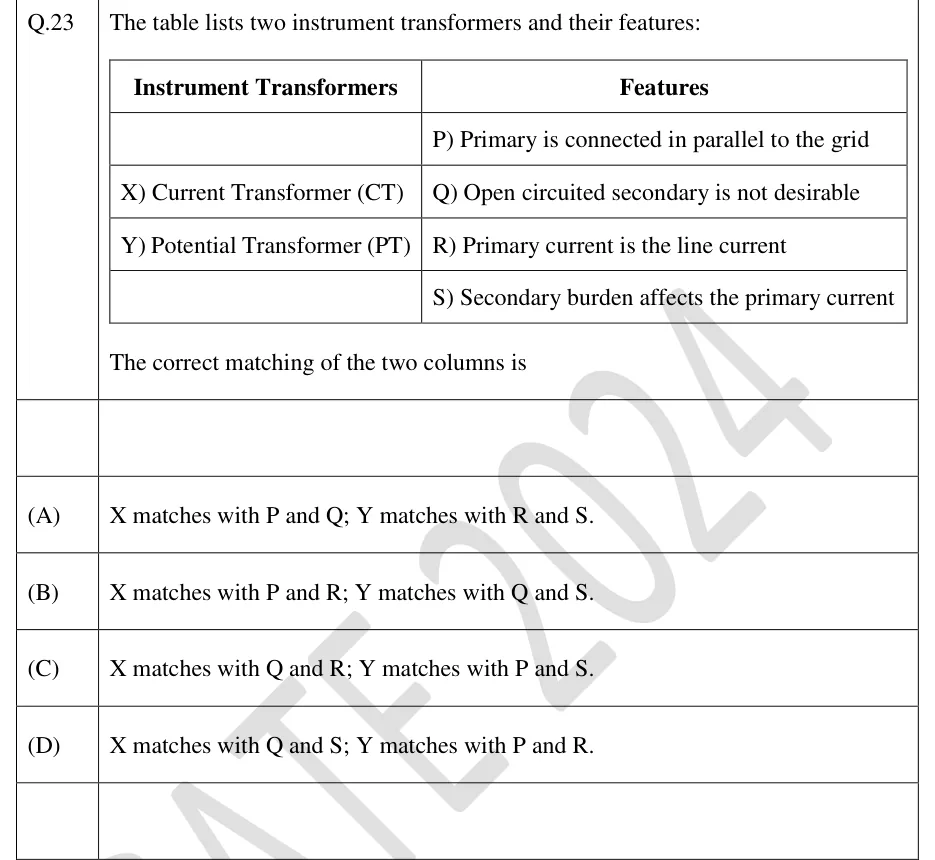
The table lists two instrument transformers and their features:

| Instrument Transformers | Features |
|---|---|
| | P) Primary is connected in parallel to the grid |
| X) Current Transformer (CT) | Q) Open circuited secondary is not desirable |
| Y) Potential Transformer (PT) | R) Primary current is the line current |
| | S) Secondary burden affects the primary current |

The correct matching of the two columns is

  1. (A)

    X matches with P and Q; Y matches with R and S.

  2. (B)

    X matches with P and R; Y matches with Q and S.

  3. (C)

    X matches with Q and R; Y matches with P and S.

  4. (D)

    X matches with Q and S; Y matches with P and R.
See the question in the paper

Answer and solution

ANSWER

(C) X matches with Q and R; Y matches with P and S.

Official answer: CSource: Official answer key, GATE 2024 EE (IISc Bengaluru)

  1. How each is connected. A CT's primary is in series with the line. A PT's primary is connected in parallel across the grid, either line to line or line to neutral. So P goes with Y (PT). It cannot go with the CT.

  2. CT primary current. The CT primary is in series with the line, so its primary current is simply the line current. The load on the system sets it, not the CT. So R goes with X (CT). A PT's primary current is only a small exciting current plus a reflected secondary current, not the line current.

  3. CT with an open secondary. The primary current keeps flowing. With no secondary ampere-turns to oppose it, the whole primary MMF magnetises the core. The flux rises and the core saturates, a dangerously high voltage appears across the secondary terminals, the core overheats, and it can keep residual magnetism. The secondary must therefore be kept short-circuited or loaded. So Q goes with X (CT). For a PT, an open secondary is close to its normal condition, because its burden is a high-impedance voltmeter or relay coil. So Q is not a PT feature.

  4. PT primary current. A PT works like an ordinary power transformer fed from a fixed voltage. Its primary current is the phasor sum of the no-load (exciting) current and the secondary current reflected to the primary: , where is the turns ratio. A larger secondary burden draws more , so is larger. So S goes with Y (PT).

  5. Why S is not a CT feature. In a CT the line fixes the primary current. Changing the burden changes the secondary voltage and the exciting current, which is where ratio and phase-angle errors come from, but it does not change .

  6. Result. X (CT): Q and R. Y (PT): P and S. This is option (C).

KEY IDEA

The two transformers are connected differently, and that decides everything. A CT is in series with the line, so the line fixes its primary current, and an open secondary drives the core into saturation and puts a dangerous voltage on the secondary. A PT is in parallel across the grid, so its primary current is set by what the secondary draws, and a larger burden means a larger primary current.

WATCH OUT FOR

Giving S to the CT on the grounds that 'secondary burden affects accuracy'. The burden does change a CT's ratio and phase-angle errors, but it cannot change the CT's primary current, because the line fixes that. Only in the PT does the burden change the primary current. A second slip is thinking 'open secondary not desirable' applies to both. It is the CT that must never be open-circuited. A PT's secondary normally feeds a high-impedance load.

From the GATE 2024 EE paper. Every question of this paper · Download the full paper · All 3 Instrument transformers questions, with notes

More Instrument transformers questions