IAE Academy

GATE 2025 IN Q.26: solution and answer

GATE 2025 · INQ.26 · 1 mark · MCQ

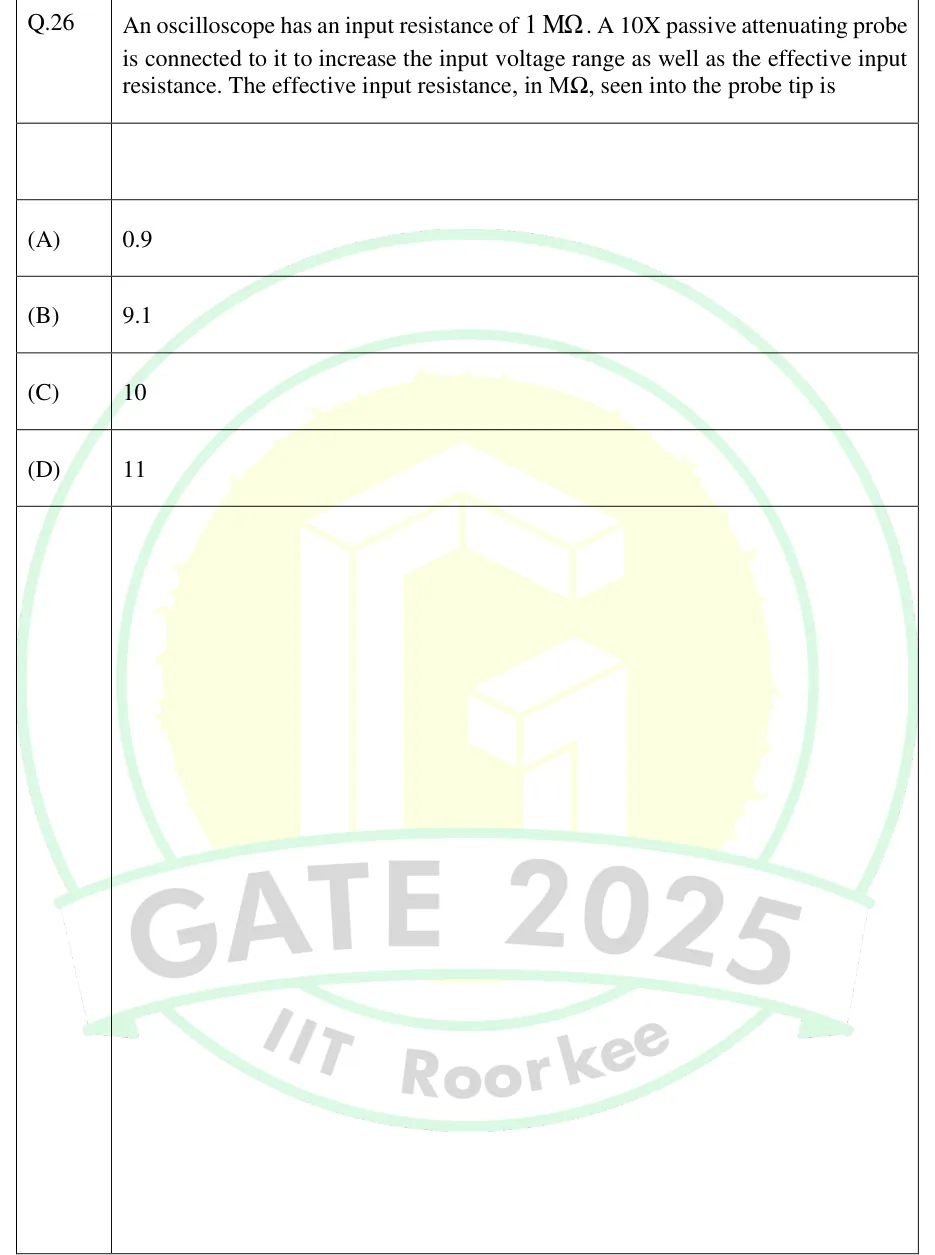
An oscilloscope has an input resistance of . A 10X passive attenuating probe is connected to it to increase the input voltage range as well as the effective input resistance. The effective input resistance, in , seen into the probe tip is

  1. (A)

    0.9

  2. (B)

    9.1

  3. (C)

    10

  4. (D)

    11

See the question in the paper

Answer and solution

ANSWER

The effective input resistance seen into the probe tip is , which is option (C).

Official answer: CSource: Official answer key, GATE 2025 IN (IIT Roorkee)

  1. A passive 10X probe puts a resistor in series with the oscilloscope's input resistance . The two resistors form a voltage divider, and the oscilloscope sees only the voltage across .

  2. The attenuation equals the divider ratio:

  3. Solve for the probe resistor, working in : .

  4. Looking into the probe tip, the two resistors are in series, not in parallel:

  5. Check: the oscilloscope sees , so the usable input voltage range goes up by a factor of 10. The resistance loading the circuit under test also goes up by a factor of 10, so the probe draws less current. These are the two effects the question describes. The probe's compensation capacitor is trimmed so that . It sets the frequency response and does not change the dc resistance.

  6. Effective input resistance , which is option (C).

KEY IDEA

A 10X passive probe is a series resistor that forms a 10:1 divider with the oscilloscope's input resistance. At the tip, and are in series, so the tip resistance is . The attenuation factor and the factor by which the input resistance rises are the same number.

WATCH OUT FOR

One mistake is to combine and in parallel, which gives (option A). The other is to report only the probe resistor, , or to guess . The current from the tip passes through and then through , so the two resistors are in series and the total is .

From the GATE 2025 IN paper. Every question of this paper · Download the full paper · All 5 Time, frequency & scopes questions, with notes

More Time, frequency & scopes questions