
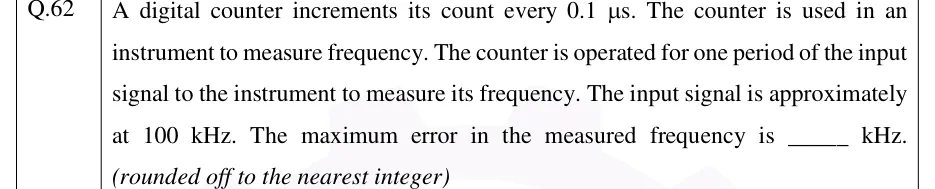
A digital counter increments its count every 0.1 s. The counter is used in an instrument to measure frequency. The counter is operated for one period of the input signal to the instrument to measure its frequency. The input signal is approximately at 100 kHz. The maximum error in the measured frequency is ______ kHz. (rounded off to the nearest integer)
GATE 2026 IN Q.62: solution and answer
Answer and solution
ANSWER
The maximum error in the measured frequency is about (exactly , which rounds to ).
Official answer: 1Source: Official answer key, GATE 2026 IN (IIT Guwahati)
Period (reciprocal) mode. One period of the input signal opens the counter gate. During that period the counter counts clock ticks, one every , and the frequency is taken as .
Number of counts. The input period is , so the counter records counts.
The count error. The gate is not synchronised with the clock, so the count can be off by one either way. The measured period is therefore uncertain by . That is a relative error of .
Carry it to frequency. Since , to first order the relative error in equals the relative error in :
Exact check. The measured period lies between and , so the measured frequency lies between and . The largest deviation from is , which rounds to .
KEY IDEA
When a counter measures over one input period, it counts clock ticks and carries the usual count error. That makes the relative error , and because the frequency has the same relative error: .
WATCH OUT FOR
Using the frequency-mode formula (error with a 0.1 μs gate), which gives an absurd . Another slip is writing the error as and never converting it from time to frequency. Here the counter counts the clock during one input period, so the count is a error on , and so on .
From the GATE 2026 IN paper. Every question of this paper · Download the full paper · All 5 Time, frequency & scopes questions, with notes