
IAE Academy

GATE 2018 IN Q.6: solution and answer

GATE 2018 · INQ.6 · 1 mark · MCQ

A series R-C circuit is excited by a sinusoidal ac voltage source. The locus diagram of the phasor current , when is varied, while keeping fixed, is
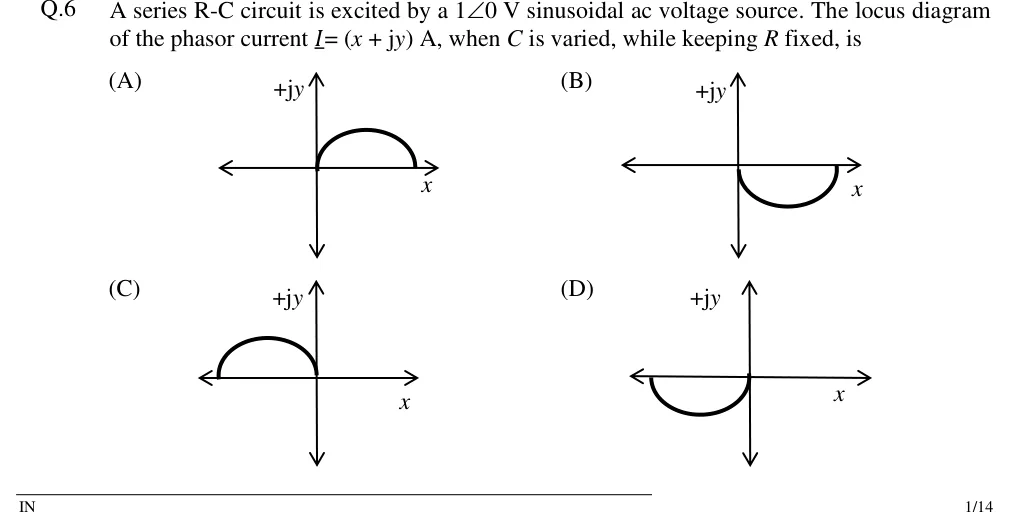
GATE 2018 IN question 6: Each option is a sketch on complex-plane axes: horizontal axis labelled x (arrows both ways), vertical axis labelled +jy…Tap to open full size
Figure from the GATE 2018 IN paper. It is part of the question.
Figure description

Each option is a sketch on complex-plane axes: horizontal axis labelled x (arrows both ways), vertical axis labelled +jy (arrows both ways). Each shows a semicircle with one end at the origin and the other end on the real axis. (A) semicircle above the positive x-axis (first quadrant), from the origin to a point on the positive x-axis. (B) semicircle below the positive x-axis (fourth quadrant), from the origin to a point on the positive x-axis. (C) semicircle above the negative x-axis (second quadrant), from a point on the negative x-axis to the origin. (D) semicircle below the negative x-axis (third quadrant), from a point on the negative x-axis to the origin.

  1. (A)

    Figure — semicircle in the first quadrant: starts at the origin, bulges upward (+jy), ends on the positive x-axis.

  2. (B)

    Figure — semicircle in the fourth quadrant: starts at the origin, bulges downward (−jy), ends on the positive x-axis.

  3. (C)

    Figure — semicircle in the second quadrant: from a point on the negative x-axis, bulges upward (+jy), ends at the origin.

  4. (D)

    Figure — semicircle in the third quadrant: from a point on the negative x-axis, bulges downward (−jy), ends at the origin.

Answer and solution

ANSWER

(A): the current phasor traces the upper semicircle of diameter on the positive real axis, from the origin (as ) to (as ).

Official answer: ASource: Official answer key, GATE 2018 IN (IIT Guwahati)

  1. Impedance of the series R-C branch: , where . As goes from to , falls from to .

  2. Ohm's law in phasor form with : so and .

  3. Signs: and , so and . The current leads the voltage (the circuit is capacitive), so the whole locus lies in the first quadrant. That rules out (B), (C) and (D).

  4. Shape: . Completing the square gives This is a circle with centre and radius , so it passes through the origin.

  5. End points: as (), , the origin. As (), , a point on the positive x-axis. The top of the arc is at , where .

  6. So the locus is the upper semicircle of diameter standing on the positive real axis, running from the origin to . That is option (A).

KEY IDEA

With fixed and varied, the impedance moves along the vertical half-line below the real axis. Inverting a straight line that does not pass through the origin gives a circle that does pass through the origin, so traces a circle through the origin with diameter on the real axis. Because the circuit is capacitive, the current leads the voltage, so only the upper half () is traced.

WATCH OUT FOR

Picking (B) by mixing up leading and lagging. The fourth-quadrant semicircle is the current locus of a series R-L circuit with varied, where the current lags. A related slip is to sketch the impedance locus, which for R-C lies below the real axis, and take it for the current locus: inverting flips the sign of the angle. Options (C) and (D) need a negative real part of the current, which a positive resistance cannot give.

From the GATE 2018 IN paper. Every question of this paper · Download the full paper · All 34 AC, power & resonance questions, with notes

More AC, power & resonance questions