IAE Academy

GATE 2026 DA Q.28: solution and answer

GATE 2026 · DAQ.28 · 1 mark · MSQ

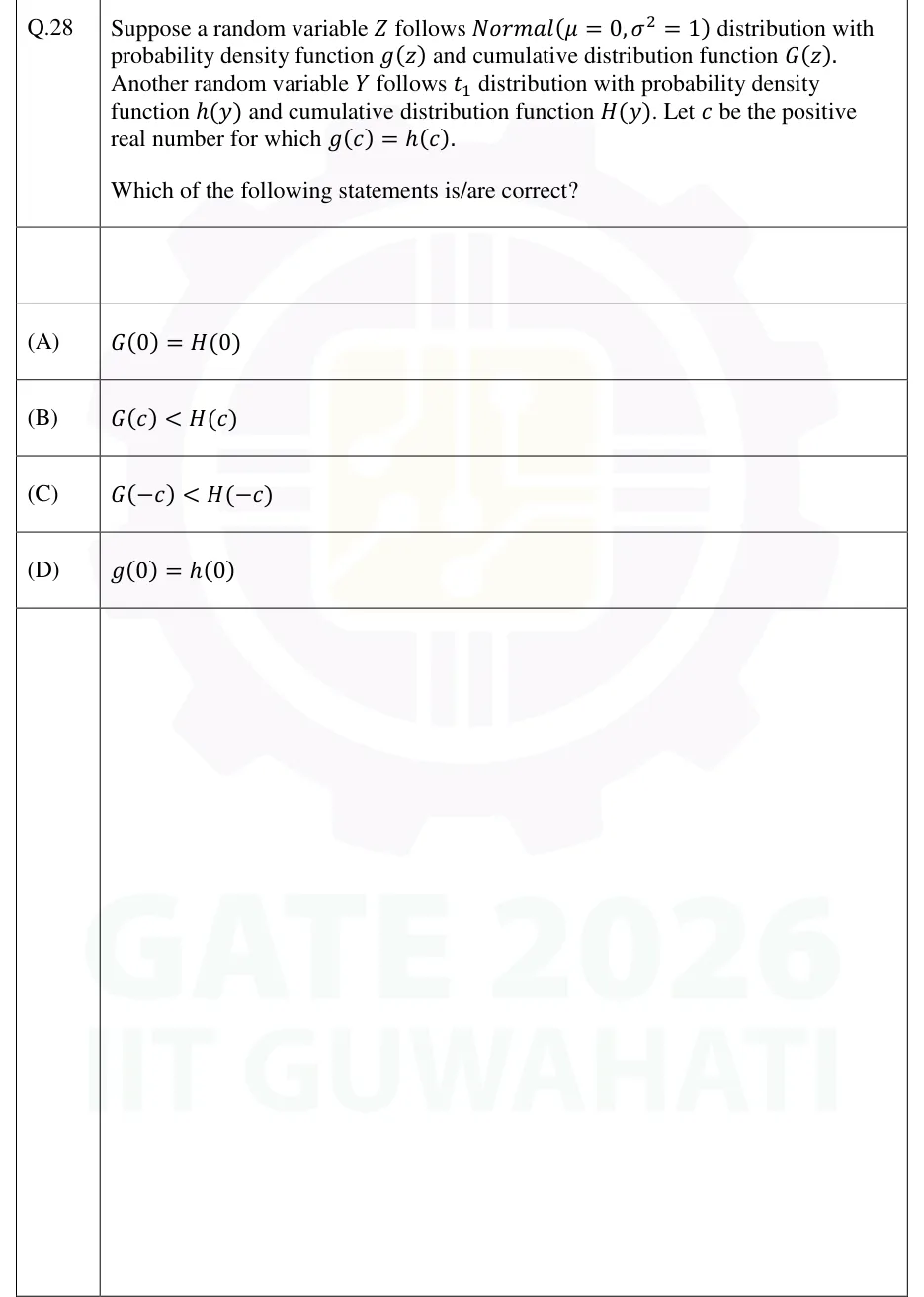
Suppose a random variable follows distribution with probability density function and cumulative distribution function . Another random variable follows distribution with probability density function and cumulative distribution function . Let be the positive real number for which .

Which of the following statements is/are correct?

  1. (A)

  2. (B)

  3. (C)

  4. (D)

See the question in the paper

Answer and solution

ANSWER

The correct statements are (A) and (C).

Official answer: A, CSource: Official answer key, GATE 2026 DA (IIT Guwahati)

  1. A distribution is the standard Cauchy distribution: and . The normal density is .

  2. (A) Both densities are symmetric about , so each CDF equals at : . True.

  3. (D) while . They differ, so (D) is false.

  4. Locate . The condition is equivalent to . The left side equals at , rises to about at , then decreases to , so it meets exactly once for . At we have and at we have , so . Solving numerically gives , where and . For the Cauchy density stays larger, because its tail decays polynomially while the normal tail decays like .

  5. (B) , while . So and (B) is false. Equivalently, the Cauchy has more mass in the tail , so less mass below .

  6. (C) By symmetry and . So and (C) is true. This is the same tail comparison, seen on the left.

  7. Correct statements: (A) and (C).

KEY IDEA

A distribution is the standard Cauchy distribution, whose tails are heavier than the normal's. The two densities cross once for , at . Beyond that point the Cauchy has more tail mass, so and . At , both CDFs equal by symmetry, but the peak densities differ.

WATCH OUT FOR

Assuming that because the CDFs must also be ordered the same way at and . Both curves are symmetric, so the lower-tail comparison is the opposite of the comparison at . Another slip is to think because both bells are centred at .

From the GATE 2026 DA paper. Every question of this paper · Download the full paper · All 10 Continuous distributions questions, with notes

More Continuous distributions questions