IAE Academy

GATE DA

Continuous random variables and the named distributions

Exponential, Poisson, normal, t and chi-squared

A continuous random variable is described by a density whose areas are probabilities. A small family of named distributions (uniform, exponential, Poisson, normal, t and chi-squared) covers the models in this part of the GATE DA syllabus. Knowing each one's formula, its parameters, its conditions, and how the t and chi-squared distributions arise from normal samples lets you turn a word problem into a table lookup or a line of algebra.

10 previous-year questions · 10 solved · 5 practice questions

Continuous random variables: PDF, CDF and conditional PDF

A continuous random variable takes values in an interval (or a union of intervals) and has a probability density function (PDF) . Probabilities are areas under , not heights of . Because the area at a single point is zero, for every , so for a continuous variable , and are all equal.

CONDITIONS ON A PDF

Use the total area equal to 1 to find an unknown constant in a given density.

CUMULATIVE DISTRIBUTION FUNCTION (CDF)

F is non-decreasing and, for a continuous X, continuous. Its limits are 0 as x goes to -infinity and 1 as x goes to +infinity. The PDF is the derivative of the CDF wherever the derivative exists.

INTERVAL PROBABILITY

Valid for any continuous X. Also P(X > a) = 1 - F(a).

PERCENTILE AND MEDIAN

Solve F(x) = p for x. The p-th percentile (p as a fraction) is x_p; the median is the 50th percentile.

MEAN AND VARIANCE

E[X] exists only when the integral of |x| f(x) converges. Some distributions have no mean, for example t with 1 degree of freedom. Convention used throughout: E[X^2] = integral of x^2 f(x) dx, and SD = sqrt(Var(X)).

LINEAR TRANSFORMATION

Holds for any constants a and b. Adding a constant shifts the mean and leaves the variance unchanged. SD(aX + b) = |a| SD(X).

CONDITIONAL PDF GIVEN X > A

Requires P(X > a) > 0, and the conditional PDF is zero for x <= a. In general, conditioning on an event A with P(X in A) > 0 gives f(x)/P(X in A) for x in A. The result integrates to 1 over the conditioning region.

CONDITIONAL PDF FROM A JOINT DENSITY

Defined only where f_Y(y) > 0. For a fixed y it is a density in x and integrates to 1. If X and Y are independent, f_{X|Y}(x | y) = f_X(x).

WORKED EXAMPLE

A continuous random variable has density for and otherwise. Find , the CDF, , the median, and .

Solution
  1. Total area: , so .

  2. CDF for : . It is 0 for and 1 for .

  3. .

  4. Median: , so and .

  5. .

Answer: ; on ; ; median ; .

WORKED EXAMPLE

and have joint density for , , and zero elsewhere. Find the conditional PDF of given , and .

Solution
  1. Marginal of : for .

  2. Conditional PDF: for . Check: it integrates to .

  3. At : .

  4. .

Answer: on ; .

Uniform and exponential distributions

The continuous uniform distribution spreads probability evenly over . The exponential distribution models a waiting time with a constant 'hazard'. Its single parameter is the rate, so the mean is . Always check whether a question gives the rate or the mean .

UNIFORM(A, B): PDF AND CDF

Zero density outside [a, b]; F is 0 below a and 1 above b. For a sub-interval inside [a, b], probability = length / (b - a).

UNIFORM(A, B): MEAN AND VARIANCE

The median equals the mean for the uniform distribution.

EXPONENTIAL(RATE LAMBDA): PDF AND CDF

Support is x >= 0; lambda is the rate. P(X > x) is the survival function.

EXPONENTIAL: MEAN, VARIANCE, MEDIAN, PERCENTILE

Mean and SD are equal. The median (about 0.693/lambda) is smaller than the mean 1/lambda, and the distribution is right-skewed. ln is the natural logarithm.

MEMORYLESS PROPERTY

Holds for all s, t >= 0. The exponential is the only continuous distribution with this property. Time already waited does not change the distribution of the remaining wait.

MINIMUM OF TWO INDEPENDENT EXPONENTIALS (RATES LAMBDA1, LAMBDA2)

Requires X1 and X2 independent. Reason: P(min > x) = P(X1 > x) P(X2 > x) = e^{-(lambda1 + lambda2) x}. The same holds for more than two: the rates add.

EXAM TIP

For the exponential distribution, a conditional probability of the form needs no integration at all: it equals . The uniform distribution is not memoryless, so for it you must divide by the conditioning probability.

The Poisson distribution and the Poisson process

The syllabus lists the Poisson distribution among the continuous distributions, but Poisson is a discrete distribution: it counts events and takes the values , with a PMF (probability mass function), not a PDF. Its natural partner is the exponential distribution, through the Poisson process.

POISSON PMF

lambda > 0 is the average number of events in the interval considered. P(X >= 1) = 1 - e^{-lambda}.

POISSON MEAN AND VARIANCE

Mean equals variance. If X1 ~ Poisson(l1) and X2 ~ Poisson(l2) are independent, then X1 + X2 ~ Poisson(l1 + l2).

POISSON PROCESS WITH RATE LAMBDA PER UNIT TIME

Events occur independently at a constant average rate. The count in a window of length t has mean lambda*t, and the gaps between successive events are exponential with mean 1/lambda.

POISSON APPROXIMATION TO THE BINOMIAL

Use when n is large and p is small, so that np is moderate. The binomial's variance np(1-p) is close to np only when p is small.

WORKED EXAMPLE

Calls reach a help desk as a Poisson process at an average of 3 per hour. Find (i) the probability of no call in 30 minutes, (ii) the probability that the wait for the next call exceeds 20 minutes, and (iii) the probability that the wait exceeds a further 20 minutes given that 20 minutes have already passed with no call.

Solution
  1. Rate per hour. For 30 minutes, h, so the count is Poisson with mean .

  2. (i) .

  3. (ii) The wait is exponential with rate 3 per hour. 20 minutes is h, so .

  4. (iii) By the memoryless property the answer is the same as (ii): .

Answer: (i) ; (ii) ; (iii) .

EXAM TIP

Keep the units consistent. If the rate is 'per hour', convert minutes to hours before forming . A Poisson count and an exponential wait always share the same (rate), never .

Normal and standard normal distributions

The normal distribution is the bell curve, symmetric about its mean . Convention: the second parameter is the variance , so has standard deviation 4. The standard normal has CDF , which is read from a table. Every normal probability is reduced to by standardising.

NORMAL PDF

Mean = median = mode = mu; variance sigma^2; symmetric about mu.

STANDARDISATION

Divide by the standard deviation sigma, not the variance. P(X > a) = 1 - Phi((a - mu)/sigma).

SYMMETRY OF THE STANDARD NORMAL

Phi(0) = 0.5. Use this to turn negative z into positive z when reading a table.

z

(4 decimals)

0.5

0.6915

1

0.8413

1.645

0.9500

1.96

0.9750

2

0.9772

3

0.9987

THE 68-95-99.7 RULE

Applies to every normal distribution, whatever mu and sigma are.

LINEAR COMBINATION OF INDEPENDENT NORMALS

Requires X and Y independent and each normal, with a and b not both zero. Variances add with squared coefficients, even for a difference: Var(X - Y) = sigma_X^2 + sigma_Y^2.

SAMPLE MEAN OF A NORMAL SAMPLE

Exact for a normal population. The standard deviation of X-bar (its standard error) is sigma/sqrt(n).

CENTRAL LIMIT THEOREM

For X_1, ..., X_n i.i.d. from any population with mean mu and finite variance sigma^2. One consequence: Binomial(n, p) is approximately N(np, np(1-p)) when np and n(1-p) are both large. For integer counts, a continuity correction of 0.5 improves the approximation.

WORKED EXAMPLE

. Using and , find .

Solution
  1. The variance is 16, so .

  2. Standardise: and .

  3. .

Answer:

EXAM TIP

When a question writes with a number such as 16 or 25 in the second slot, take its square root before standardising. Dividing by 16 instead of 4 gives a wrong z-value.

The chi-squared and t distributions

These two distributions are built from normal variables and are used for inference on samples drawn from a normal population. Both have a single parameter, the degrees of freedom (df), written or .

CHI-SQUARED DISTRIBUTION: DEFINITION

Takes only values >= 0. It is right-skewed and becomes more symmetric as k grows. The sum of independent chi-squared variables with k1 and k2 df is chi-squared with k1 + k2 df.

CHI-SQUARED: MEAN AND VARIANCE

Follows from E[Z^2] = 1 and Var(Z^2) = 2 for one standard normal, together with the independence of the Z_i.

CHI-SQUARED FOR THE SAMPLE VARIANCE

For a random sample of size n from N(mu, sigma^2). Here S^2 is the sample variance, which divides by n - 1. One df is lost because the sample mean is estimated from the data.

T DISTRIBUTION: DEFINITION

Symmetric about 0 and bell-shaped, with heavier tails than N(0,1). As k grows, t_k approaches N(0,1).

T: MEAN AND VARIANCE

For k = 1 the mean does not exist; for k = 2 the variance is infinite. For k > 2 the variance exceeds 1, reflecting the heavier tails, and it tends to 1 as k grows.

T STATISTIC FOR THE SAMPLE MEAN

For a random sample of size n from a normal population with unknown sigma, where S is the sample standard deviation (divisor n - 1). If sigma is known, use (X-bar - mu)/(sigma/sqrt(n)) ~ N(0,1) instead.

Normal

Support

all real numbers

all real numbers

Shape

symmetric bell

symmetric, heavier tails

right-skewed

Mean

0 (for )

Variance

(for )

Typical use

known- mean, models of noise

mean with unknown

variance of a normal sample

EXAM TIP

Count degrees of freedom as (not ) for both the statistic and the statistic of a single sample whose mean is estimated from the data. A with a very large df is practically standard normal.

Choosing the distribution: quick reference

Distribution

Type

Parameter(s)

Mean

Variance

Uniform

continuous

Exponential (rate )

continuous

Poisson

discrete

Normal

continuous

Chi-squared

continuous

continuous

0 (for )

(for )

  1. Waiting time until the next event, or a lifetime with constant failure rate: exponential.

  2. Number of events in a fixed interval at a steady rate: Poisson with mean .

  3. Sum or average of many independent observations (central limit theorem), or a quantity stated to be normal: normal.

  4. Probability of a range of a quantity known only to lie uniformly between two limits: uniform.

  5. Spread (variance) of a normal sample: chi-squared; mean of a normal sample with unknown : .

EXAM TIP

Before computing, write down three things: whether the variable is discrete or continuous, which parameter you were given (rate or mean, variance or SD), and which table value you need.

PREVIOUS-YEAR QUESTIONS

10 questions from the DA papers

Try each question first, then open the answer. We placed each question under a topic ourselves; the exam paper does not label topics.

See these papers in full: GATE DA 2026 · GATE DA 2025 · GATE DA 2024

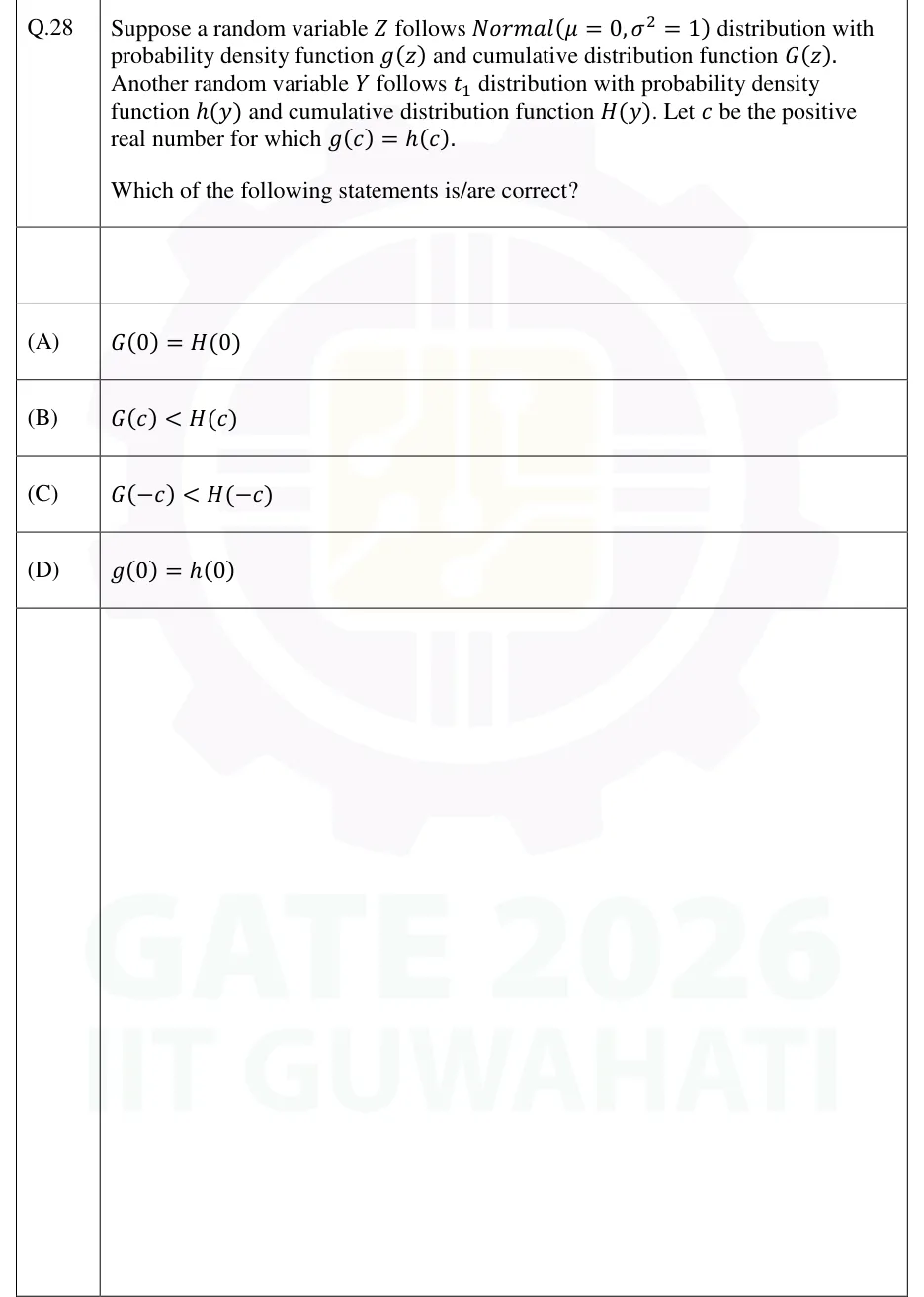
GATE 2026 DA Q.28

GATE 2026 · DAQ.28 · 1 mark · MSQ

Suppose a random variable follows distribution with probability density function and cumulative distribution function . Another random variable follows distribution with probability density function and cumulative distribution function . Let be the positive real number for which .

Which of the following statements is/are correct?

  1. (A)

  2. (B)

  3. (C)

  4. (D)

Answer and solution
See the question in the paper
GATE 2026 DA Q.28: answer and solution

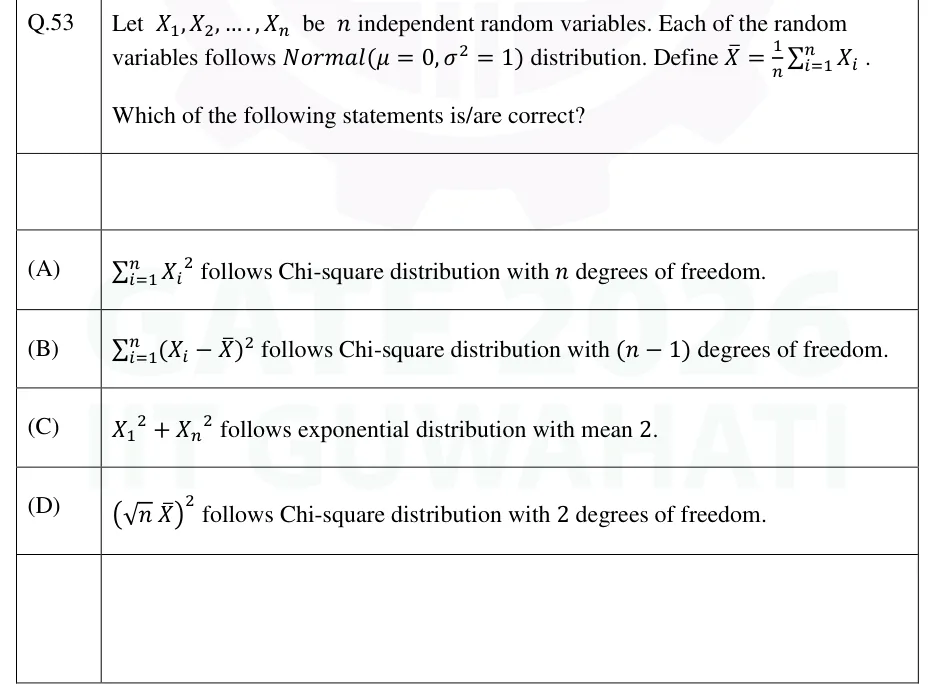
GATE 2026 DA Q.53

GATE 2026 · DAQ.53 · 2 marks · MSQ

Let be independent random variables. Each of the random variables follows distribution. Define .

Which of the following statements is/are correct?

  1. (A)

    follows Chi-square distribution with degrees of freedom.

  2. (B)

    follows Chi-square distribution with degrees of freedom.

  3. (C)

    follows exponential distribution with mean 2.

  4. (D)

    follows Chi-square distribution with 2 degrees of freedom.

Answer and solution
See the question in the paper
GATE 2026 DA Q.53: answer and solution

GATE 2025 DA Q.41

GATE 2025 · DAQ.41 · 2 marks · MCQ

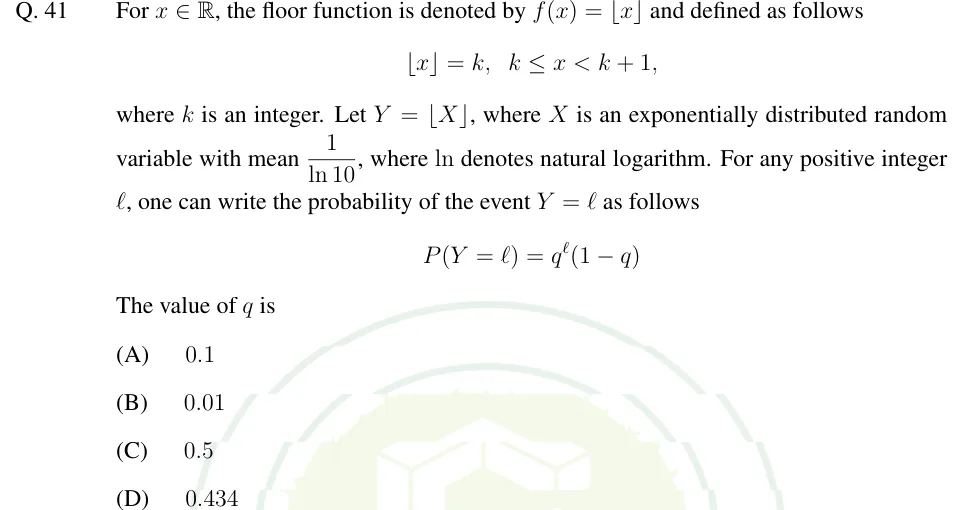
For , the floor function is denoted by and defined as follows

where is an integer. Let , where is an exponentially distributed random variable with mean , where denotes natural logarithm. For any positive integer , one can write the probability of the event as follows

The value of is

  1. (A)

    0.1

  2. (B)

    0.01

  3. (C)

    0.5

  4. (D)

    0.434

Answer and solution
See the question in the paper
GATE 2025 DA Q.41: answer and solution

GATE 2024 DA Q.11

GATE 2024 · DAQ.11 · 1 mark · MCQ

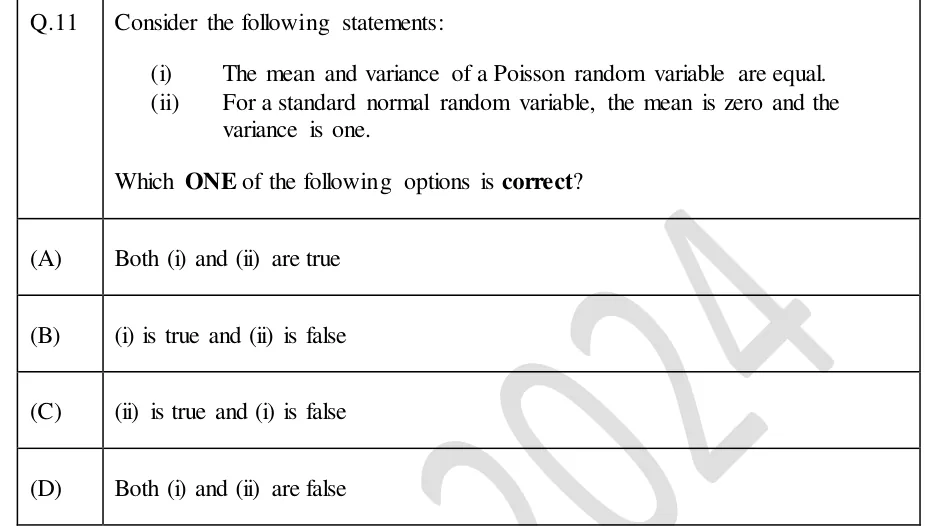
Consider the following statements:
(i) The mean and variance of a Poisson random variable are equal.
(ii) For a standard normal random variable, the mean is zero and the variance is one.

Which ONE of the following options is correct?

  1. (A)

    Both (i) and (ii) are true

  2. (B)

    (i) is true and (ii) is false

  3. (C)

    (ii) is true and (i) is false

  4. (D)

    Both (i) and (ii) are false

Answer and solution
See the question in the paper
GATE 2024 DA Q.11: answer and solution

GATE 2024 DA Q.57

GATE 2024 · DAQ.57 · 2 marks · NAT

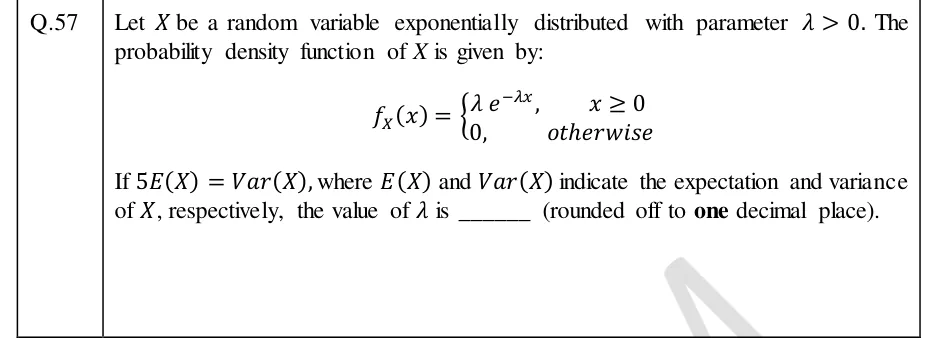
Let be a random variable exponentially distributed with parameter . The probability density function of is given by:

If , where and indicate the expectation and variance of , respectively, the value of is ______ (rounded off to one decimal place).

Answer and solution
See the question in the paper
GATE 2024 DA Q.57: answer and solution

PRACTICE

5 questions to test yourself

PRACTICE 11 mark · NAT

The lifetime (in years) of a component is exponentially distributed with mean 5 years. Given that the component has already worked for 4 years, what is the probability that it works for more than 6 further years? Give the answer to 3 decimal places.

Answer and solution

Answer: (accepted range )

  1. Mean 5 means the rate is per year.

  2. By the memoryless property, .

  3. .

PRACTICE 21 mark · MCQ

The number of defects on a metre of cable is Poisson with mean 2. Using , what is the probability that a metre has at least one defect?

  1. (A)

    0.1353

  2. (B)

    0.8647

  3. (C)

    0.2707

  4. (D)

    0.5940

Answer and solution

Answer: (B)

  1. .

  2. .

  3. Option C is and option D is ; neither is asked.

PRACTICE 32 marks · MSQ

and are independent, where the second parameter is the variance. Which of the following statements are correct?

  1. (A)

  2. (B)

  3. (C)

  4. (D)

    , where is the standard normal CDF

Answer and solution

Answer: (A), (C)

  1. A: mean , variance . Correct.

  2. B: mean is but the variance is , not 5. Incorrect.

  3. C: mean , variance . Correct.

  4. D: is the mean, so , which is not . Incorrect.

PRACTICE 42 marks · NAT

The marks of a test are modelled as , where the second parameter is the variance. Using and , find correct to 3 decimal places.

Answer and solution

Answer: (accepted range )

  1. .

  2. , .

  3. .

  4. To 3 decimal places: .

PRACTICE 52 marks · MCQ

A random sample of size 9 is drawn from a normal population . Let be the sample mean and the sample variance with divisor . Which statement is correct?

  1. (A)

    follows a chi-squared distribution with 8 degrees of freedom

  2. (B)

    follows a chi-squared distribution with 9 degrees of freedom

  3. (C)

    follows a distribution with 9 degrees of freedom

  4. (D)

    follows a distribution with 8 degrees of freedom

Answer and solution

Answer: (A)

  1. For a normal sample, ; with this is , so A is correct.

  2. B uses the wrong multiplier and the wrong df.

  3. C: the statistic with has df, not 9.

  4. D: with known the statistic is standard normal, not .

OFFICIAL GATE 2027 SYLLABUS WORDING

Copied from the GATE 2027 syllabus; see all 2027 syllabi.

GATE DA

Continuous random variables and probability distribution function, uniform, exponential, Poisson, normal, standard normal, t- distribution, chi-squared distributions, cumulative distribution function, Conditional PDF

Preparing in Kolkata? IAE Academy's course for GATE DA.