IAE Academy

GATE DA

Discrete distributions

Uniform, Bernoulli and binomial

The discrete uniform, Bernoulli and binomial distributions model, in turn, one equally likely choice among n consecutive integers, a single yes/no trial, and the number of successes in n independent identical trials. This topic covers their PMFs, means, variances, the binomial mode, sums of independent binomials and the closely related geometric distribution (trials to the first success). Convention throughout: E[X] is the expectation, Var(X) = E[(X - E[X])^2] is the population variance of the distribution, SD = sqrt(Var(X)), and probabilities are given as fractions or decimals as the question asks.


2 previous-year questions · 2 solved · 5 practice questions

Discrete uniform distribution

A random variable is discrete uniform on the integers when every value is equally likely. The number of values is . A fair die is the case . Convention: (the variance of the distribution, not a sample variance) and .

DISCRETE UNIFORM PMF

Applies when each of the n consecutive integers is equally likely; zero elsewhere.

DISCRETE UNIFORM CDF

P(X <= x) = 0 for x < a and 1 for x >= b.

MEAN AND VARIANCE (UNIFORM ON A TO B)

Here n = b - a + 1 and the values are consecutive integers. The variance depends only on n, not on where the block starts.

UNIFORM ON 1 TO N

Special case a = 1, b = n. For a fair die (n = 6): mean 3.5, variance 35/12.

EXAM TIP

Shifting by a constant leaves the variance unchanged, and scaling multiplies it by the square of the scale: . So a uniform on has the same variance as a uniform on .

EXAM TIP

Do not mix this up with the continuous uniform on , whose variance is . For the discrete uniform on consecutive integers the variance is with . For a fair die this gives , not .

Bernoulli distribution

A Bernoulli trial has two outcomes, success and failure. Let for success and for failure, with and . We write .

BERNOULLI PMF

One trial, success probability p, 0 <= p <= 1.

BERNOULLI MEAN AND VARIANCE

Because X^2 = X for a 0/1 variable, E[X^2] = p, so Var(X) = p - p^2. The variance is largest at p = 1/2, where it equals 1/4.

The Bernoulli is the building block of the binomial: it is the special case , and an indicator variable of any event is Bernoulli with .

Binomial distribution

Let be the number of successes in trials, where (i) is fixed, (ii) the trials are independent and (iii) every trial has the same success probability . Then . Equivalently with the independent Bernoulli() variables.

BINOMIAL PMF

Requires fixed n, independent trials and the same p on every trial. The probabilities sum to 1 by the binomial theorem.

BINOMIAL MEAN AND VARIANCE

Follows by adding n independent Bernoulli(p) variables: means add, and variances add because of independence. When 0 < p < 1 the variance is always less than the mean.

SECOND MOMENTS OF THE BINOMIAL

E[X^2] = Var(X) + (E[X])^2. Useful when a question asks for E[X^2] or the expectation of a quadratic in X.

BINOMIAL MGF

The product of n identical Bernoulli MGFs (1 - p + pe^t), by independence.

USEFUL PROBABILITIES

'At least one success' is easiest to compute through the complement.

RATIO OF CONSECUTIVE TERMS

Use it to compute successive probabilities quickly and to locate the mode.

SYMMETRY IN FAILURES

So if Y ~ Bin(n, 1 - p), then P(X = k) = P(Y = n - k). In particular Bin(n, 1/2) is symmetric about n/2.

WORKED EXAMPLE

X is binomial with n = 5 and p = 0.4. Find P(X >= 4).

Solution
  1. P(X >= 4) = P(X = 4) + P(X = 5).

  2. P(X = 4) = C(5,4) (0.4)^4 (0.6) = 5 x 0.0256 x 0.6 = 0.0768.

  3. P(X = 5) = (0.4)^5 = 0.01024.

  4. Sum = 0.0768 + 0.01024 = 0.08704.

Answer: 0.08704

Shape, mode and sums of independent variables

For , the ratio formula shows exactly when , that is, when . So the probabilities rise up to the mode and then fall. When is an integer, two adjacent values tie at the top.

MODE OF THE BINOMIAL

Valid for 0 < p < 1. At the end points the distribution is degenerate: the mode is 0 when p = 0 and n when p = 1.

SUM OF INDEPENDENT BINOMIALS, SAME P

Both independence and the common p are essential. With different success probabilities the sum is in general not binomial, although means still add, and variances still add because of independence.

Distribution

Parameters

Mean

Variance

Discrete uniform on {1,...,n}

n

(n+1)/2

(n^2 - 1)/12

Bernoulli

p

p

p(1-p)

Binomial

n, p

np

np(1-p)

Geometric (trials to first success, support 1, 2, ...)

p

1/p

(1-p)/p^2

Geometric (failures before first success, support 0, 1, ...)

p

(1-p)/p

(1-p)/p^2

EXAM TIP

The mode of a binomial is near its mean but is not always the mean rounded. For the mean is , but the mode is . Always apply the floor formula rather than rounding the mean.

Recognising the distribution in a word problem

  1. One trial with two outcomes, or an indicator of an event: Bernoulli().

  2. One equally likely choice among consecutive integers (a fair die, a random label from 1 to ): discrete uniform.

  3. Count of successes in a fixed number of independent trials with the same : binomial().

  4. Number of trials needed until the first success, with independent trials and constant : geometric().

  5. Sampling without replacement from a finite population breaks independence, so the count of successes is not binomial (it is hypergeometric). Sampling with replacement keeps the trials independent with constant , so the count is binomial.

GEOMETRIC PMF (TRIALS TO FIRST SUCCESS)

Independent trials, constant p with 0 < p <= 1. X counts the trial on which the first success occurs, so X >= 1. Mean 1/p and variance (1-p)/p^2. If instead the count is the number of failures before the first success, the PMF is (1-p)^k p for k = 0, 1, 2, ..., the mean is (1-p)/p and the variance is still (1-p)/p^2.

GEOMETRIC TAIL

For the trials-to-first-success form: the first k trials are all failures. The geometric distribution is memoryless: P(X > m + k | X > m) = P(X > k).

WORKED EXAMPLE

A binomial random variable has mean 12 and variance 7.2. Find n and p, and the mode.

Solution
  1. Mean np = 12 and variance np(1-p) = 7.2.

  2. Dividing, 1 - p = 7.2 / 12 = 0.6, so p = 0.4.

  3. Then n = 12 / 0.4 = 30.

  4. (n+1)p = 31 x 0.4 = 12.4, not an integer, so the mode is floor(12.4) = 12.

Answer: n = 30, p = 0.4, mode = 12

EXAM TIP

Check the conditions before using the binomial. If the success probability changes from trial to trial, or the trials influence each other, the count is not binomial. Also check whether the question asks for 'at least', 'exactly' or 'at most', and which side of the complement is shorter to compute.

PREVIOUS-YEAR QUESTIONS

2 questions from the DA papers

Try each question first, then open the answer. We placed each question under a topic ourselves; the exam paper does not label topics.

See these papers in full: GATE DA 2026 · GATE DA 2025

GATE 2025 DA Q.61

GATE 2025 · DAQ.61 · 2 marks · NAT

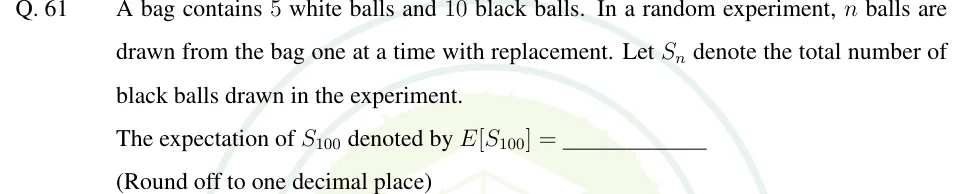
A bag contains 5 white balls and 10 black balls. In a random experiment, balls are drawn from the bag one at a time with replacement. Let denote the total number of black balls drawn in the experiment.

The expectation of denoted by ______

(Round off to one decimal place)

Answer and solution
See the question in the paper
GATE 2025 DA Q.61: answer and solution

PRACTICE

5 questions to test yourself

PRACTICE 12 marks · MCQ

A binomial random variable has mean and variance . The value of is

  1. (A)

    15

  2. (B)

    20

  3. (C)

    25

  4. (D)

    30

Answer and solution

Answer: (B)

  1. np = 6 and np(1-p) = 4.2, so 1 - p = 4.2/6 = 0.7 and p = 0.3.

  2. n = 6 / 0.3 = 20.

  3. Hence option B.

PRACTICE 22 marks · MSQ

Let . Which of the following statements are TRUE?

  1. (A)

  2. (B)

    The mode of is uniquely 3

  3. (C)

  4. (D)

Answer and solution

Answer: (A), (C)

  1. (n+1)p = 10 x 0.3 = 3 is an integer, so the modes are 2 and 3 with equal probability: A true, B false.

  2. Check by ratio: P(3)/P(2) = (9-2)(0.3) / (3 x 0.7) = 2.1/2.1 = 1.

  3. E[X] = np = 2.7: C true.

  4. Var(X) = np(1-p) = 9 x 0.3 x 0.7 = 1.89, not 2.7: D false.

PRACTICE 32 marks · NAT

is discrete uniform on and . Find .

Answer and solution

Answer: (accepted range )

  1. For uniform on 1..n with n = 10, Var(X) = (n^2 - 1)/12 = 99/12 = 8.25.

  2. Var(Y) = 2^2 Var(X) = 4 x 8.25 = 33.

PRACTICE 42 marks · NAT

and are independent. Find , giving the answer as a decimal.

Answer and solution

Answer: (accepted range )

  1. Same p and independent, so X + Y ~ Bin(8, 0.5).

  2. P(X + Y = 7) = C(8,7) (0.5)^7 (0.5)^1 = 8 / 256.

  3. 8/256 = 0.03125.

PRACTICE 51 mark · NAT

A fair coin is tossed 4 times independently. Let be the number of heads. Find , giving the answer as a decimal.

Answer and solution

Answer: (accepted range )

  1. X ~ Bin(4, 1/2).

  2. P(X = 2) = C(4,2) (1/2)^2 (1/2)^2 = 6/16.

  3. 6/16 = 0.375.

OFFICIAL GATE 2027 SYLLABUS WORDING

Copied from the GATE 2027 syllabus; see all 2027 syllabi.

GATE DA

uniform, Bernoulli, binomial distribution

Preparing in Kolkata? IAE Academy's course for GATE DA.