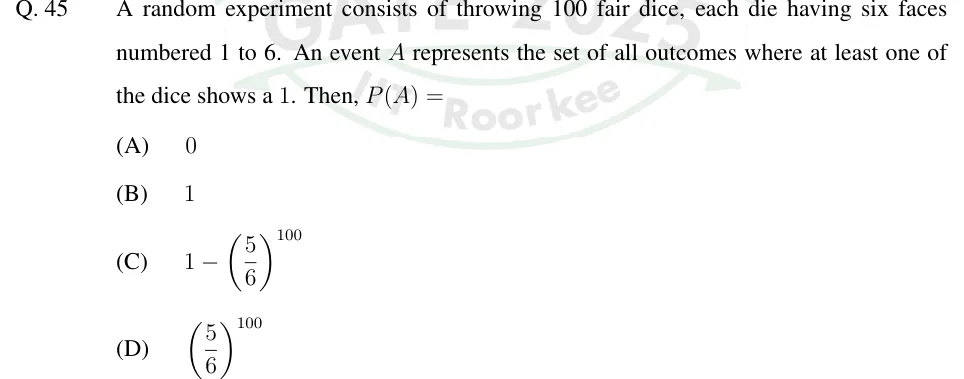
A random experiment consists of throwing 100 fair dice, each die having six faces numbered 1 to 6. An event represents the set of all outcomes where at least one of the dice shows a 1. Then,
- (A)
- (B)
- (C)
- (D)

A random experiment consists of throwing 100 fair dice, each die having six faces numbered 1 to 6. An event represents the set of all outcomes where at least one of the dice shows a 1. Then,
ANSWER
, which is option (C).
Official answer: CSource: Official answer key, GATE 2025 DA (IIT Roorkee)
The event is "at least one of the 100 dice shows a 1". Its complement is "none of the 100 dice shows a 1", so .
For one fair die, the faces 2, 3, 4, 5, 6 are not a 1, so .
The 100 dice are thrown independently, so the probabilities multiply: Equivalently, there are outcomes with no 1 out of equally likely outcomes.
Therefore
This value is strictly between 0 and 1, so options (A) and (B) are out. Option (D) is , not . The answer is (C).
KEY IDEA
For an "at least one" event over independent trials, use the complement: P(at least one) = 1 − P(none), and P(none) is the product of the per-trial "none" probabilities.
WATCH OUT FOR
Choosing (D), which is the probability that no die shows a 1 (the complement), or trying to add probabilities such as 100 × 1/6, which overcounts outcomes where several dice show a 1.
From the GATE 2025 DA paper. Every question of this paper · Download the full paper · All 5 Counting & axioms questions, with notes