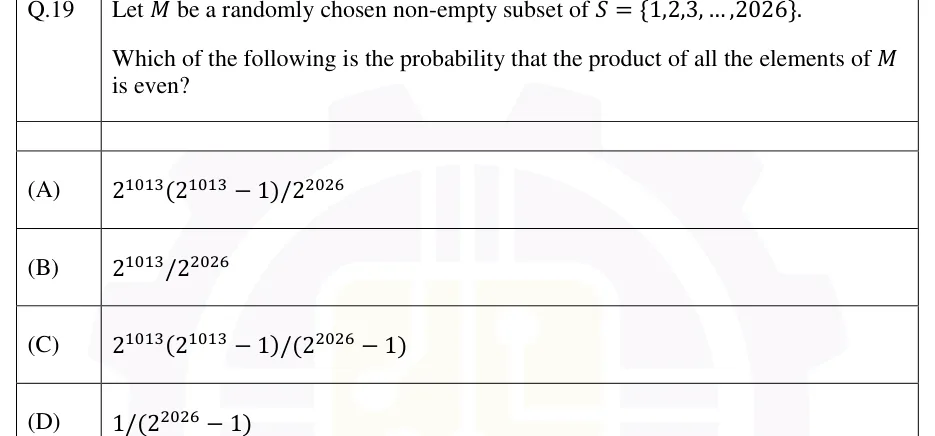
Let be a randomly chosen non-empty subset of . Which of the following is the probability that the product of all the elements of is even?
- (A)
- (B)
- (C)
- (D)

Let be a randomly chosen non-empty subset of . Which of the following is the probability that the product of all the elements of is even?
ANSWER
The probability that the product is even is , which is option (C).
Official answer: CSource: Official answer key, GATE 2026 DA (IIT Guwahati)
is chosen uniformly from the non-empty subsets of . has subsets and one of them is empty, so the sample space has equally likely outcomes.
A product of integers is even exactly when at least one factor is even. So the product is odd exactly when every element of is odd. Count the favourable outcomes through this complement.
Among there are odd numbers and even numbers.
The non-empty subsets of made only of odd numbers are the non-empty subsets of a -element set. There are of them.
The non-empty subsets with an even product number
Divide by the size of the sample space:
This is option (C). As a check, , so the ratio is slightly less than , as it should be. Option (A) wrongly divides by , which includes the empty set.
KEY IDEA
Use the complement. A product is odd only if every element is odd. Count non-empty subsets of the odd numbers, and divide by the number of non-empty subsets of .
WATCH OUT FOR
Dividing by (counting the empty set as an outcome) gives option (A). The question says is non-empty, so the denominator is . A second slip is to forget to remove the empty set from the all-odd count, which should be .
From the GATE 2026 DA paper. Every question of this paper · Download the full paper · All 5 Counting & axioms questions, with notes