IAE Academy

GATE 2020 BT Q.35: solution and answer

GATE 2020 · BTQ.35 · 2 marks · MCQ

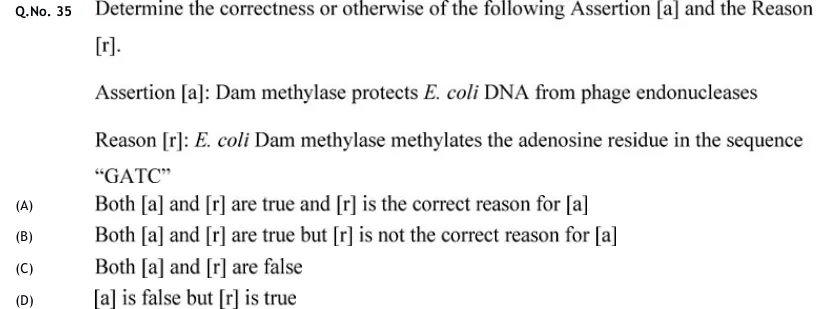
Determine the correctness or otherwise of the following Assertion [a] and the Reason [r].

Assertion [a]: Dam methylase protects E. coli DNA from phage endonucleases

Reason [r]: E. coli Dam methylase methylates the adenosine residue in the sequence "GATC"

  1. (A)

    Both [a] and [r] are true and [r] is the correct reason for [a]

  2. (B)

    Both [a] and [r] are true but [r] is not the correct reason for [a]

  3. (C)

    Both [a] and [r] are false

  4. (D)

    [a] is false but [r] is true

See the question in the paper

Answer and solution

ANSWER

(D): [a] is false but [r] is true.

Official answer: DSource: Official answer key, GATE 2020 BT (IIT Delhi)

  1. Reason [r] is a well-established fact: E. coli Dam (DNA adenine methyltransferase) is an orphan methyltransferase that adds a methyl group to the N6 position of adenine within every 5'-GATC-3' sequence in the genome. So [r] is TRUE.

  2. Dam-directed GATC methylation is the 'modification' half of a classic restriction–modification (R-M) system, and it also underlies MutH-directed mismatch repair (which nicks the unmethylated, newly synthesized strand). The corresponding restriction endonuclease in such a system recognizes unmethylated GATC sites and cleaves DNA lacking that methylation.

  3. Because E. coli's own chromosome is fully Dam-methylated on both strands, its own restriction endonuclease does not cut it. Unmethylated foreign DNA entering the cell (e.g., an invading plasmid, or phage DNA that has not been through the Dam system) lacks this protective methylation and is what gets targeted.

  4. The threat Dam methylation protects against is therefore the bacterium's OWN restriction endonuclease (part of its native R-M/self-vs-nonself defense), not an endonuclease carried and injected by the phage itself. Phages are not generally described as encoding endonucleases that specifically attack host chromosomal DNA via GATC recognition — if anything, unmethylated phage DNA is the target of the host's system, not the source of an attacking enzyme.

  5. So the causal claim in [a] misattributes the protective mechanism, naming 'phage endonucleases' as the threat when the actual threat is the host's own restriction endonuclease. [a] is therefore FALSE.

  6. Since [a] is false and [r] is true, only option (D) matches: '[a] is false but [r] is true'.

KEY IDEA

Dam methylase is the modification arm of a restriction–modification system: it methylates GATC on the host's own chromosome so the host's OWN restriction endonuclease (which cuts unmethylated GATC) does not degrade self DNA — the enzyme it protects against is native to E. coli, not phage-encoded.

WATCH OUT FOR

Choosing (A) or (B) by assuming that because [r] is textbook-correct, [a] must also be true (or true-but-unrelated) simply because Dam methylation and restriction protection are both real, related phenomena — without noticing that the assertion misidentifies WHOSE endonuclease is being evaded (the bacterium's own restriction enzyme, not a phage-encoded one).

From the GATE 2020 BT paper. Every question of this paper · Download the full paper · All 10 Enzymes & vectors questions, with notes

More Enzymes & vectors questions