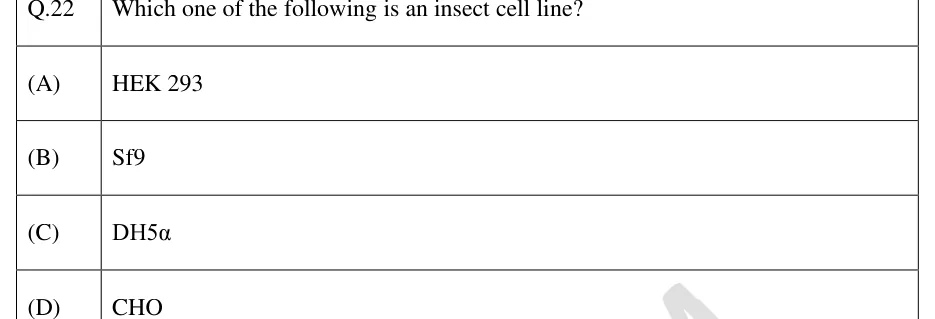
Which one of the following is an insect cell line?
- (A)
HEK 293
- (B)
Sf9
- (C)
DH5α
- (D)
CHO

Which one of the following is an insect cell line?
HEK 293
Sf9
DH5α
CHO
ANSWER
The correct option is (B) Sf9 — an insect (Spodoptera frugiperda ovarian) cell line used in the baculovirus expression system.
Official answer: BSource: Official answer key, GATE 2024 BT (IISc Bengaluru)
Q.22 asks which of the four listed items is an insect cell line.
(A) HEK 293 is the Human Embryonic Kidney 293 cell line — a mammalian (human) line widely used for transient and stable recombinant protein expression; it is not insect-derived.
(B) Sf9 is derived from the ovarian tissue of the fall armyworm, Spodoptera frugiperda, a lepidopteran insect. It is the standard cell line used with baculovirus expression vectors (BEVS) for producing recombinant proteins.
(C) DH5α is a laboratory strain of the bacterium Escherichia coli, used for plasmid cloning and propagation. It is prokaryotic and not a eukaryotic cell line at all.
(D) CHO (Chinese Hamster Ovary) is a mammalian (rodent) cell line widely used to produce therapeutic glycoproteins such as antibodies; it is not insect-derived.
Only Sf9 traces back to an insect species, so option (B) is the insect cell line.
KEY IDEA
Among common laboratory cell lines, Sf9 (from Spodoptera frugiperda, fall armyworm) is the standard insect cell line, used with the baculovirus expression vector system (BEVS) for recombinant protein production — distinct from mammalian lines (HEK 293, CHO) and bacterial strains (DH5α).
WATCH OUT FOR
Confusing DH5α (a bacterial, i.e. prokaryotic, E. coli strain) with a "cell line," or not knowing that HEK 293 and CHO are both mammalian lines used for recombinant protein expression, leading to a wrong pick among the two mammalian options.
From the GATE 2024 BT paper. Every question of this paper · Download the full paper · All 10 Enzymes & vectors questions, with notes