
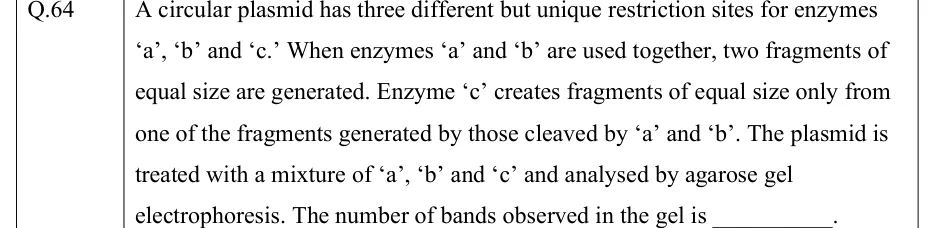
A circular plasmid has three different but unique restriction sites for enzymes 'a', 'b' and 'c.' When enzymes 'a' and 'b' are used together, two fragments of equal size are generated. Enzyme 'c' creates fragments of equal size only from one of the fragments generated by those cleaved by 'a' and 'b'. The plasmid is treated with a mixture of 'a', 'b' and 'c' and analysed by agarose gel electrophoresis. The number of bands observed in the gel is ___________.
GATE 2022 BT Q.64: solution and answer
Answer and solution
ANSWER
The number of bands observed in the gel is 2.
Official answer: 2Source: Official answer key, GATE 2022 BT (IIT Kharagpur)
Given: the plasmid is circular and has exactly one unique restriction site each for enzymes a, b and c (3 sites total, one copy of each).
Key rule: on a CIRCULAR DNA molecule, the number of linear fragments produced equals the number of cut sites used. (This differs from linear DNA, where n internal cuts give n+1 fragments — on a circle there are no free ends to begin with, so each additional cut simply adds one more piece to the ring you have already opened.)
Digesting with a + b (2 cuts on the circle) gives 2 fragments; the stem states these are of equal size, so let each fragment have size (plasmid total size ).
Since c has only ONE restriction site in total, and the stem says c produces equal-size fragments from only ONE of the two a+b fragments, c's single site must lie inside that one -sized fragment (not the other).
Digesting with a + b + c together: 3 cuts on the circular plasmid 3 linear fragments in total.
The fragment that c does not cut stays intact at its original size, .
The fragment that c does cut is split by c's one internal cut into two pieces; since the stem specifies these are of equal size, each piece is .
So the three fragments produced are , , — three fragments but only two distinct sizes.
On agarose gel electrophoresis, fragments of identical size co-migrate and appear as a single band, so the two fragments merge into one band.
Total distinct bands observed (one band at , one band at ).
KEY IDEA
On a circular DNA molecule, the number of linear fragments produced equals the number of cut sites used (not sites + 1, as it is for linear DNA); co-migrating fragments of identical size appear as a single band on the gel.
WATCH OUT FOR
Applying the linear-DNA rule (fragments = sites + 1) to a circular plasmid, which would wrongly give 4 fragments instead of 3; or forgetting that two fragments of identical size run as one band, over-counting the bands as 3 instead of 2.
From the GATE 2022 BT paper. Every question of this paper · Download the full paper · All 10 Enzymes & vectors questions, with notes
More Enzymes & vectors questions
- GATE 2020 BT Q.11 · MCQ · 1 markWhich one of the following statements about Agrobacterium Ti plasmid is CORRECT?
- GATE 2020 BT Q.35 · MCQ · 2 marksDetermine the correctness or otherwise of the following Assertion [a] and the Reason [r].
- GATE 2020 BT Q.43 · NAT · 2 marksThe sequence of a 1 Mb long DNA is random. This DNA has all four bases occurring in equal proportion.
- GATE 2024 BT Q.22 · MCQ · 1 markWhich one of the following is an insect cell line?