IAE Academy

GATE 2019 BT Q.32: solution and answer

GATE 2019 · BTQ.32 · 2 marks · MCQ

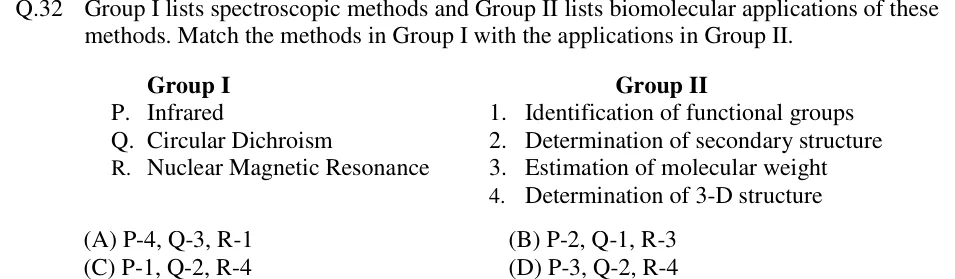
Group I lists spectroscopic methods and Group II lists biomolecular applications of these methods. Match the methods in Group I with the applications in Group II.

Group I
P. Infrared
Q. Circular Dichroism
R. Nuclear Magnetic Resonance

Group II
1. Identification of functional groups
2. Determination of secondary structure
3. Estimation of molecular weight
4. Determination of 3-D structure

  1. (A)

    P-4, Q-3, R-1

  2. (B)

    P-2, Q-1, R-3

  3. (C)

    P-1, Q-2, R-4

  4. (D)

    P-3, Q-2, R-4

See the question in the paper

Answer and solution

ANSWER

The correct answer is (C) P-1, Q-2, R-4.

Official answer: CSource: Official answer key, GATE 2019 BT (IIT Madras)

  1. Infrared (IR) spectroscopy measures vibrational absorption frequencies characteristic of specific chemical bonds and functional groups (C=O, N-H, O-H, etc.), making it the classical tool for identification of functional groups — so P matches 1.

  2. Circular Dichroism (CD) measures the differential absorption of left- and right-circularly polarized light by chiral chromophores in a molecule. The far-UV CD spectrum of a protein gives distinct, well-characterized band shapes for alpha-helix, beta-sheet and random-coil content, making CD the standard rapid tool for determination of secondary structure — so Q matches 2.

  3. Nuclear Magnetic Resonance (NMR), particularly multidimensional techniques such as COSY and NOESY, yields inter-proton distance restraints (from NOE cross-peaks) and torsion-angle information (from coupling constants) sufficient to compute a complete three-dimensional solution structure of a biomolecule — so R matches 4.

  4. Estimation of molecular weight (Group II, option 3) is not a function performed by IR, CD, or NMR in this context — that role belongs to techniques such as mass spectrometry, gel filtration, or SDS-PAGE — so option 3 is correctly left unused among P, Q, R.

  5. Combining the matches P-1, Q-2, R-4 gives exactly option (C).

KEY IDEA

Each spectroscopic method has one signature application: IR probes bond vibrations (functional groups), CD probes chiral secondary-structure content, and multidimensional NMR provides distance/angle restraints for full 3-D structure determination; molecular weight is estimated by other techniques (e.g., mass spectrometry), not by these three.

WATCH OUT FOR

Confusing CD with 3-D structure determination (since it is a "structural" technique) instead of secondary structure, or assuming NMR is used for molecular weight estimation because NMR-active nuclei are also used in mass-related contexts (e.g., MS), leading to a mismatch with option 3.

From the GATE 2019 BT paper. Every question of this paper · Download the full paper · All 8 Microscopy & spectroscopy questions, with notes

More Microscopy & spectroscopy questions