
IAE Academy

GATE 2024 BT Q.46: solution and answer

GATE 2024 · BTQ.46 · 2 marks · MSQ

Which of the following features help(s) in distinguishing alleles using restriction fragment length polymorphism (RFLP)?

  1. (A)

    Differences in the number of recognition sites for a given restriction enzyme

  2. (B)

    Differences in the ability of alleles to undergo recombination

  3. (C)

    Differences in the ability of alleles to undergo segregation

  4. (D)

    Differences in the number of tandem repeats
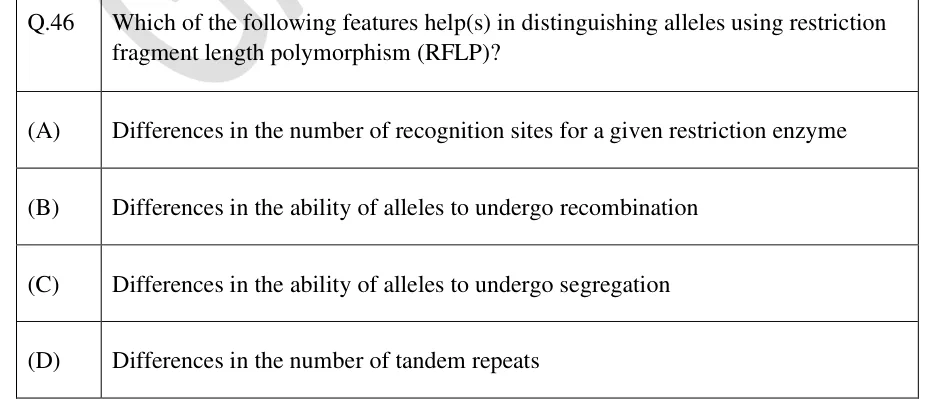
See the question in the paper

Answer and solution

ANSWER

The correct answer is (A) and (D): differences in the number of restriction-enzyme recognition sites, and differences in the number of tandem repeats between fixed restriction sites, both change fragment sizes and are valid bases for RFLP.

Official answer: A, DSource: Official answer key, GATE 2024 BT (IISc Bengaluru)

  1. RFLP (Restriction Fragment Length Polymorphism) distinguishes alleles by comparing the SIZES of DNA fragments produced when genomic DNA is cut with a restriction enzyme and the fragments are resolved (typically detected by Southern blotting/hybridization).

  2. Fragment size at a given locus changes whenever the sequence between two restriction sites differs between alleles — either because a cut site itself is gained/lost, or because the spacing between two fixed cut sites changes.

  3. Option (A): A sequence change (e.g., a point mutation) that creates or abolishes a restriction enzyme recognition site changes the number of cut sites in that stretch of DNA, so the resulting fragment sizes differ between alleles. This is the classical mutational basis of RFLP. CORRECT.

  4. Option (D): Tandem repeat regions (minisatellites/VNTRs) that lie between two fixed restriction sites vary in copy number between alleles, changing the distance between those sites and hence the fragment length (VNTR-RFLP). This is also a valid basis for RFLP. CORRECT.

  5. Option (B): Recombination frequency reflects genetic linkage/crossing-over between loci during meiosis; it does not itself alter a restriction site or a fragment's length, so it is not what RFLP detects. INCORRECT.

  6. Option (C): Segregation is the Mendelian separation of alleles into gametes during meiosis; it has no effect on restriction site presence or fragment length. INCORRECT.

  7. Hence the features that help distinguish alleles by RFLP are (A) and (D).

KEY IDEA

RFLP distinguishes alleles based on differences in the length of DNA fragments produced by restriction enzyme digestion; anything that changes the position or number of restriction sites (point mutations altering recognition sites, or variable-number tandem repeats lying between two fixed sites) changes fragment length and is detectable by RFLP.

WATCH OUT FOR

Confusing RFLP (a DNA-fragment-size-based marker technique) with genetics processes like recombination or segregation, which describe allele behaviour during meiosis but do not themselves alter restriction fragment sizes.

From the GATE 2024 BT paper. Every question of this paper · Download the full paper · All 8 PCR & sequencing questions, with notes

More PCR & sequencing questions