IAE Academy

GATE BT

PCR, sequencing, blotting and DNA fingerprinting

Tools for copying, labelling, reading and comparing specific nucleic-acid sequences: PCR and its variants (with the copy-number, Tm and qPCR relations), probe labelling, Sanger and next-generation sequencing, Southern and Northern blotting, in-situ hybridisation, and DNA fingerprinting by RFLP, RAPD and repeat-length markers. Each method is described with its conditions: what it detects, what it requires, and where its standard formulas stop being valid.

8 previous-year questions · 8 solved · 7 practice questions

PCR: Principle and Components

The polymerase chain reaction (PCR) is an in-vitro method that makes many copies of a chosen DNA segment by repeating three temperature steps — denaturation, primer annealing and extension — with a thermostable DNA polymerase. The segment amplified is the one lying between the 5' ends of the two primers, so the primers define both ends of the product.

The PCR programme

  1. Initial denaturation (once, about 94–98 °C for a few minutes): fully separates the template strands (and activates a hot-start enzyme, if one is used).

  2. Denaturation (about 94–98 °C, seconds to about 1 min): double-stranded DNA separates into single strands as the hydrogen bonds between base pairs break.

  3. Annealing (commonly 50–65 °C, usually set a few °C below the primers' Tm): the forward and reverse primers bind to complementary sequences on OPPOSITE strands flanking the target, with their 3' ends pointing towards each other.

  4. Extension (about 72 °C, the standard extension temperature for Taq): the polymerase adds dNTPs to the 3'-OH of each primer, synthesising the new strand 5'→3'. A common rule of thumb is about 1 min per kb of product for Taq.

  5. Denaturation–annealing–extension is repeated, typically 25–35 times, followed by a final extension (about 72 °C, 5–10 min) to complete partially extended products.

Essential components: template DNA, a pair of sequence-specific primers, a thermostable DNA polymerase (commonly Taq), the four dNTPs, Mg and a suitable buffer. Mg is an essential cofactor of the polymerase and also binds dNTPs, so its free concentration matters: too little lowers yield; too much lowers specificity by stabilising mismatched primer binding. Amplification is not exponential forever — it slows and reaches a plateau as primers and dNTPs are used up, the enzyme loses activity and product strands re-anneal to each other instead of to primers.

IDEAL PCR AMPLIFICATION

= starting number of double-stranded template molecules, = number of cycles, = double-stranded molecules containing the target after cycles. Valid ONLY for 100% efficiency in every cycle (no reagent limitation, no plateau).

PCR AMPLIFICATION WITH EFFICIENCY E

= fraction of molecules copied per cycle (); gives the ideal doubling.

DOUBLE-STRANDED PRODUCTS OF EXACTLY THE TARGET LENGTH

Starting from double-stranded templates much longer than the target, at 100% efficiency, for . Of the molecules per template, 2 still contain an original strand and pair an exact-length strand with a 'long' strand bounded by a primer at one end only; the rest have both ends defined by the primers. Exact-length duplexes first appear in cycle 3.

WORKED EXAMPLE

One double-stranded genomic DNA molecule (much longer than the target) is amplified for 4 cycles at 100% efficiency. How many double-stranded molecules of exactly the target length are present?

Solution
  1. Total double-stranded molecules after 4 cycles: .

  2. Molecules not of exact length: (2 containing an original strand, 6 containing a long strand made in an earlier cycle).

  3. Exact-length molecules: .

Answer: 8 double-stranded molecules of exactly the target length

EXAM TIP

Taq DNA polymerase has 5'→3' polymerase and 5'→3' exonuclease activity but NO 3'→5' (proofreading) exonuclease, so its error rate is higher than that of proofreading enzymes. It also tends to add a single non-templated A to the 3' ends of its products (the basis of TA cloning). Pfu polymerase (from the archaeon Pyrococcus furiosus) has 3'→5' proofreading, gives higher fidelity and blunt-ended products, and is chosen when sequence accuracy matters, e.g. for cloning.

Primer Design, Melting Temperature and Specificity

Primers are typically 18–25 nt long — long enough to be unique in the template — with balanced GC content and no significant self- or cross-complementarity (which causes hairpins or primer-dimers). The two primers bind opposite strands: the forward primer is identical to the 5' end of the top-strand target sequence, and the reverse primer is the reverse complement of its 3' end.

WALLACE (2 + 4) RULE

and are COUNTS of bases in the primer, not percentages; in °C. A quick approximation for short oligonucleotides (conventionally applied below about 14 nt) at standard salt. When a question states a rule, use that rule.

LENGTH-CORRECTED RULE (PRIMERS OF ABOUT 14 NT OR LONGER)

= primer length in nucleotides; = COUNT of G and C bases; in °C. Used where the 2 + 4 rule becomes inaccurate for longer primers.

Whatever rule is used, of a duplex rises with GC content (a G·C pair has three hydrogen bonds against two for A·T, and stacks more strongly) and with salt concentration (cations shield the repulsion between phosphate backbones). It falls with denaturants such as formamide or urea, and with mismatches between the strands.

Good primer-design practice

  1. Keep the of the forward and reverse primers close (within about 5 °C) so both anneal well at one annealing temperature.

  2. Aim for a GC content of about 40–60%.

  3. Have 1–2 G or C bases at the 3' end (a 'GC clamp') for stable priming, but avoid more than about 3 G/C in the last five bases, which encourages mispriming; avoid runs of one base.

  4. Avoid self-complementarity within a primer (hairpins) and complementarity between the two primers, especially at their 3' ends (primer-dimers).

WORKED EXAMPLE

A candidate primer 5'-GCGCATGCATGC-3' (12 nt) is checked with the 2 + 4 (Wallace) rule. Compute its Tm.

Solution
  1. List the bases: G, C, G, C, A, T, G, C, A, T, G, C.

  2. G = 4, C = 4, so .

  3. A = 2, T = 2, so .

  4. °C.

Answer: Tm = 40 °C

EXAM TIP

Annealing temperature controls specificity. Too low, and primers tolerate mismatches and bind at extra sites, giving extra, non-specific bands; too high, and primers barely bind, giving little or no product. Primer-dimers appear as a short band near the bottom of the gel, because the primers have primed on each other.

PCR Variants: RT-PCR, qPCR, Nested and Multiplex PCR

PCR variants adapt the basic cycle to a different starting material or goal: amplifying from RNA, measuring the starting amount of template, raising specificity with two rounds of primers, or detecting several targets in one tube.

Variant

Starting material / key modification

Primary purpose

RT-PCR (reverse-transcription PCR)

RNA is first copied into cDNA by reverse transcriptase (primed by oligo(dT), random primers or a gene-specific primer); the cDNA is then PCR-amplified

Detects or amplifies RNA targets such as mRNA, since the polymerases used in standard PCR need a DNA template

qPCR (real-time / quantitative PCR)

Standard PCR with a fluorescent reporter read in every cycle

Quantifies the starting template from the cycle threshold at which fluorescence crosses a set level

Nested PCR

Two sequential PCRs: an outer primer pair, then an inner pair lying within the first product

Raises specificity and sensitivity; a non-specific first-round product is unlikely to carry both inner primer sites

Multiplex PCR

Several primer pairs for different targets in one tube, designed to give products of distinguishable sizes (or labels)

Amplifies and detects several targets simultaneously

Two common qPCR detection chemistries: (i) a dye that fluoresces when bound to double-stranded DNA — it reports ANY double-stranded product, including primer-dimers, so product identity is checked with a melting curve; (ii) a sequence-specific hydrolysis probe carrying a reporter dye and a quencher — during extension, Taq's 5'→3' exonuclease cleaves the bound probe, separating reporter from quencher, so fluorescence rises only when the intended target is amplified.

RELATIVE QUANTIFICATION IN QPCR (ΔΔCT METHOD)

Valid when target and reference (housekeeping) genes both amplify with close to 100% and equal efficiency. Fold change is expression in the sample relative to the control, normalised to the reference gene.

PCR EFFICIENCY FROM A QPCR STANDARD CURVE

Slope of plotted against (starting quantity). (100%) corresponds to a slope of about : a 10-fold dilution raises by about 3.32 cycles.

WORKED EXAMPLE

In a qPCR experiment, the target gene has Ct = 24 and the reference gene Ct = 18 in treated cells; in control cells the target has Ct = 27 and the reference Ct = 18. Assuming 100% and equal efficiencies, what is the fold change of the target in treated cells?

Solution
  1. .

  2. .

  3. .

  4. Fold change : the target is 8-fold higher in treated cells.

Answer: 8-fold increase

EXAM TIP

is INVERSELY related to the starting amount of template: more starting copies make fluorescence cross the threshold earlier (lower ). At 100% efficiency, a lower by 1 cycle means twice the starting template, and lower by about 3.32 cycles means ten times as much.

EXAM TIP

'RT-PCR' means reverse-transcription PCR, not real-time PCR; real-time PCR is qPCR. Measuring an mRNA in real time combines both: RT-qPCR.

DNA/RNA Labelling and Sanger Sequencing

A probe, or a newly synthesised strand, is made detectable by giving it a label: a radioactive isotope (commonly P), a fluorophore, or a hapten such as biotin or digoxigenin. Biotin is detected with streptavidin (or avidin), and digoxigenin with an anti-digoxigenin antibody; either detector can be coupled to an enzyme that produces a colour or chemiluminescent signal. A label can be built in throughout the strand by a polymerase, or added at one end.

Method

Enzyme(s)

Where the label ends up

Nick translation

DNase I makes nicks; E. coli DNA polymerase I removes nucleotides ahead of each nick (5'→3' exonuclease) while adding labelled ones behind it

Throughout a double-stranded DNA probe

Random priming

Random hexamers anneal to denatured template and are extended by the Klenow fragment (no 5'→3' exonuclease), incorporating a labelled dNTP

Throughout newly made DNA

PCR labelling

Thermostable polymerase with a labelled dNTP or labelled primer

Throughout the product, or at the primer end

5' end labelling

T4 polynucleotide kinase transfers the γ-phosphate of [-P]ATP to a free 5'-OH (DNA is first dephosphorylated with alkaline phosphatase)

5' end

3' end labelling

Terminal deoxynucleotidyl transferase adds nucleotides to a 3'-OH without a template; or the Klenow fragment fills in a recessed 3' end

3' end

In-vitro transcription

A phage RNA polymerase (SP6, T7 or T3) transcribes from its promoter in a vector with a labelled NTP

Throughout a single-stranded RNA probe (riboprobe)

EXAM TIP

A polymerase builds the α-phosphate of each incoming nucleotide into the backbone and releases the β and γ phosphates as pyrophosphate. Internal labelling by a polymerase therefore uses an [-P]dNTP. Polynucleotide kinase transfers only the terminal γ-phosphate, so 5' end labelling uses [-P]ATP.

Sanger (dideoxy chain-termination) sequencing

  1. Combine a single-stranded (or denatured double-stranded) DNA template, a sequencing primer, a DNA polymerase (classically the Klenow fragment of E. coli DNA polymerase I; automated sequencing uses engineered thermostable polymerases), all four dNTPs, and a small proportion of a 2',3'-dideoxynucleotide (ddNTP).

  2. In the classic manual method there are four separate reactions, one per ddNTP (ddATP, ddCTP, ddGTP, ddTTP), and the label is on the primer or on a dNTP. In automated dye-terminator sequencing, all four ddNTPs are in one tube, each carrying a different fluorescent dye.

  3. Whenever the polymerase incorporates a ddNTP instead of the matching dNTP, the chain stops, because a ddNTP has no 3'-OH for the next phosphodiester bond.

  4. This gives a nested set of fragments, one ending at each position where that base occurs. The ddNTP:dNTP ratio sets how often chains stop, and so the spread of fragment lengths.

  5. Fragments are separated by size with single-nucleotide resolution (a denaturing polyacrylamide gel in the manual method, capillary electrophoresis in automated sequencers).

  6. The sequence of the NEW strand is read 5'→3' from the shortest fragment (next to the primer) to the longest: lane by lane up the gel, or peak by coloured peak in the electropherogram. The template sequence is its complement.

WORKED EXAMPLE

In a manual four-lane Sanger gel, the bands read from smallest (bottom) to largest (top) fall in the lanes ddATP, ddATP, ddGTP, ddCTP, ddTTP, ddGTP. Give the newly synthesised strand 5'→3' and the corresponding template strand 5'→3'.

Solution
  1. The smallest fragment ends at the first base added after the primer, i.e. nearest the 5' end of the new strand.

  2. Reading smallest to largest gives the bases in order of addition: A, A, G, C, T, G, so the new strand is 5'-AAGCTG-3'.

  3. The template is complementary and antiparallel to the new strand: 3'-TTCGAC-5', which written 5'→3' is 5'-CAGCTT-3'.

Answer: New strand 5'-AAGCTG-3'; template 5'-CAGCTT-3'

EXAM TIP

A ddNTP stops chain growth because its sugar is 2',3'-dideoxyribose: it has H instead of OH at the 3' carbon, so no phosphodiester bond can be made to the next nucleotide. The base itself is normal and still pairs correctly; only the sugar is modified.

Next-Generation Sequencing (NGS)

Next-generation sequencing (NGS) sequences millions of DNA fragments in parallel. Sanger sequencing, by contrast, reads one template per reaction or capillary. Short-read NGS gives up read length for enormous throughput and a low cost per base.

General short-read NGS workflow

  1. DNA (or cDNA made from RNA) is fragmented and platform-specific adaptors are ligated to both ends of the fragments, making a sequencing library.

  2. Each library fragment is clonally amplified in a fixed position — by bridge amplification on a flow cell, or by emulsion PCR on beads — so that each position holds many identical copies and gives a detectable signal.

  3. All clusters or beads are sequenced at once by synthesis, one cycle at a time, and the base added at each position is detected in every cycle (by one of the chemistries in the table below).

  4. The millions of short reads are computationally aligned to a reference genome, or assembled de novo, to reconstruct the sequence.

Chemistry

How the added base is identified

Clonal amplification

Characteristic limitation

Reversible-terminator sequencing by synthesis

All four nucleotides are supplied, each with a different fluorophore and a removable 3' block; one base is added per cycle, imaged, then the dye and block are removed

Bridge amplification (clusters on a flow cell)

Short reads

Pyrosequencing

One nucleotide type is supplied at a time; incorporation releases pyrophosphate, which ATP sulfurylase converts to ATP, driving a luciferase light flash in proportion to the number of bases added

Emulsion PCR on beads

Length of homopolymer runs is inferred from signal intensity, so errors occur there

Semiconductor (ion) sequencing

One nucleotide type at a time; incorporation releases H, detected as a pH change

Emulsion PCR on beads

Homopolymer-length errors

Single-molecule long-read sequencing

A single DNA molecule is read directly: fluorescent signals from one polymerase in real time, or changes in ionic current as the strand passes through a nanopore

None required

Long reads; raw single-pass accuracy has historically been lower than short-read methods

EXAM TIP

Sanger sequencing reads one region at a time, typically several hundred to about a thousand bases per read with high accuracy, so it is used to check a known variant or a cloned insert. Short-read NGS gives reads of roughly a few hundred bases or fewer, but millions of them at once, so it is used for whole genomes, transcriptomes (RNA-seq), resequencing and metagenomics. The core contrast is chain termination and size separation versus massively parallel sequencing by synthesis.

Southern Blotting, Northern Blotting and In-situ Hybridisation

Southern blotting, Northern blotting and in-situ hybridisation all find a specific nucleic-acid sequence with a labelled complementary probe. They differ in what they detect (DNA or RNA) and in whether the sample is size-separated on a gel and transferred to a membrane, or examined in place in cells, chromosomes or tissue.

Southern blotting (detects specific DNA fragments)

  1. Digest genomic DNA with one or more restriction enzymes.

  2. Separate the fragments by size by agarose gel electrophoresis.

  3. Optionally depurinate with dilute acid (to break large fragments so they transfer efficiently), then denature the DNA in the gel to single strands with alkali and neutralise.

  4. Transfer ('blot') the single-stranded fragments from the gel onto a nitrocellulose or nylon membrane (e.g. by capillary action), keeping their relative positions.

  5. Fix the DNA to the membrane (baking for nitrocellulose; UV cross-linking or baking for nylon), and block the membrane (prehybridisation) to reduce non-specific probe binding.

  6. Hybridise with a labelled single-stranded probe at a chosen stringency, wash away unbound and loosely bound probe, and detect the label (autoradiography for P; colour or chemiluminescence for non-radioactive labels). Each band marks a fragment carrying the target sequence, and its position gives the fragment's size.

Feature

Southern blotting

Northern blotting

In-situ hybridisation (incl. FISH)

Nucleic acid detected

DNA

RNA (usually mRNA)

DNA or RNA, inside fixed cells, chromosome spreads or tissue sections

Sample preparation

Restriction digestion, agarose gel, alkali denaturation

No restriction digestion; RNA run on a denaturing gel (e.g. formaldehyde or glyoxal) to remove secondary structure; no alkali, which would hydrolyse RNA

No gel; cells or tissue are fixed and permeabilised; the target is denatured in place for DNA targets

Where hybridisation happens

On a membrane after transfer

On a membrane after transfer

Within the fixed cell, chromosome or tissue

Typical readout

Presence and size of a specific DNA fragment (e.g. RFLP analysis, gene copy number)

Presence, size and relative abundance of a specific transcript

Location of the sequence: a gene on a chromosome, or the cells expressing an mRNA

Hybridisation stringency is set mainly by temperature and salt concentration during hybridisation and washing. Higher temperature, lower salt, or formamide in the buffer all raise stringency: only closely matched duplexes survive. Lower temperature or higher salt lower stringency, so more mismatches are tolerated, which is useful for detecting related but non-identical sequences.

EXAM TIP

'In situ' means 'in position': in-situ hybridisation (and FISH, its fluorescent form) detects the target inside intact cells, chromosome spreads or tissue sections, with no gel and no transfer to a membrane. A Western blot is different again: it detects PROTEINS with antibodies, not nucleic acids with a hybridising probe.

DNA Fingerprinting, RFLP and RAPD

DNA fingerprinting (DNA profiling) uses highly variable tandem-repeat regions of the genome, whose number of repeat copies differs between individuals. These are minisatellites (also called VNTRs; repeat units of roughly 10–100 bp) and microsatellites (short tandem repeats, STRs; repeat units of about 1–6 bp). Classic fingerprinting detected minisatellite length differences by RFLP analysis: restriction digestion, then Southern blotting with a repeat probe. Current forensic profiling amplifies several STR loci together by multiplex PCR with fluorescently labelled primers and sizes the products by capillary electrophoresis. RFLP and RAPD are two different ways of revealing DNA polymorphism: RFLP is based on restriction digestion and hybridisation, RAPD on PCR.

RFLP (restriction fragment length polymorphism)

  1. Digest genomic DNA with a chosen restriction enzyme. Fragment lengths differ between individuals if (i) a point change creates or destroys a recognition site, or (ii) an insertion, deletion or change in repeat number alters the distance between two sites.

  2. Separate the fragments by gel electrophoresis and transfer them to a membrane (Southern blotting).

  3. Hybridise with a labelled probe for the locus of interest (a cloned DNA fragment from that locus, which may be a VNTR region).

  4. Different lengths of the hybridising fragment between individuals show up as different band patterns. Both alleles of a heterozygote are seen.

RAPD (randomly amplified polymorphic DNA)

  1. Use a single short primer (about 10 nt) of arbitrary sequence; no prior sequence information about the genome is needed.

  2. Run PCR at low annealing stringency so the primer binds at many sites. A product forms wherever two binding sites lie on opposite strands, with their 3' ends facing each other, within an amplifiable distance.

  3. Separate the products by gel electrophoresis and stain them directly with a DNA-binding dye. No restriction digestion and no hybridisation probe are needed.

  4. A band present in one sample and absent in another reflects a change at a primer-binding site, or an insertion or deletion that alters the distance between sites.

Feature

RFLP

RAPD

Prior sequence knowledge / probe

Needs a locus-specific probe (a cloned or synthesised fragment of the locus)

No: one arbitrary primer, no prior sequence information

Restriction digestion

Yes

No

Hybridisation probe

Yes

No

PCR

Not in the classic method

Yes, at low stringency

Polymorphism seen as

Different length of the probe-detected restriction fragment

Presence or absence of an amplified band

Inheritance of the marker

Co-dominant: heterozygotes show both alleles

Dominant: a band present cannot distinguish homozygote from heterozygote

DNA needed

Microgram amounts of high-molecular-weight DNA

Nanogram amounts; quality less critical

Reproducibility

High (defined enzyme sites and probe)

Lower: sensitive to exact PCR conditions such as annealing temperature, Mg and template quality

EXAM TIP

RAPD needs neither a restriction enzyme nor a probe, only one short arbitrary primer and low-stringency PCR. Classic RFLP needs no PCR: it relies on restriction digestion followed by probe hybridisation on a Southern blot. RFLP markers are co-dominant; RAPD markers are dominant.

PREVIOUS-YEAR QUESTIONS

8 questions from the BT papers

Try each question first, then open the answer. We placed each question under a topic ourselves; the exam paper does not label topics.

See these papers in full: GATE BT 2024 · GATE BT 2023 · GATE BT 2022 · GATE BT 2020 · GATE BT 2019

GATE 2024 BT Q.23

GATE 2024 · BTQ.23 · 1 mark · MCQ

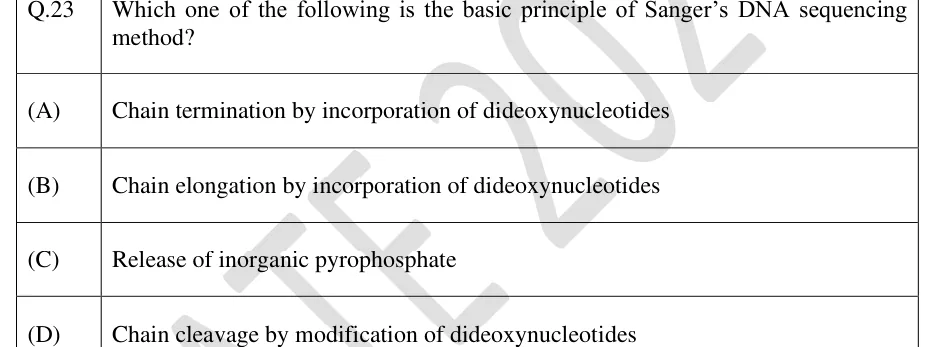
Which one of the following is the basic principle of Sanger's DNA sequencing method?

  1. (A)

    Chain termination by incorporation of dideoxynucleotides

  2. (B)

    Chain elongation by incorporation of dideoxynucleotides

  3. (C)

    Release of inorganic pyrophosphate

  4. (D)

    Chain cleavage by modification of dideoxynucleotides
Answer and solution
See the question in the paper
GATE 2024 BT Q.23: answer and solution

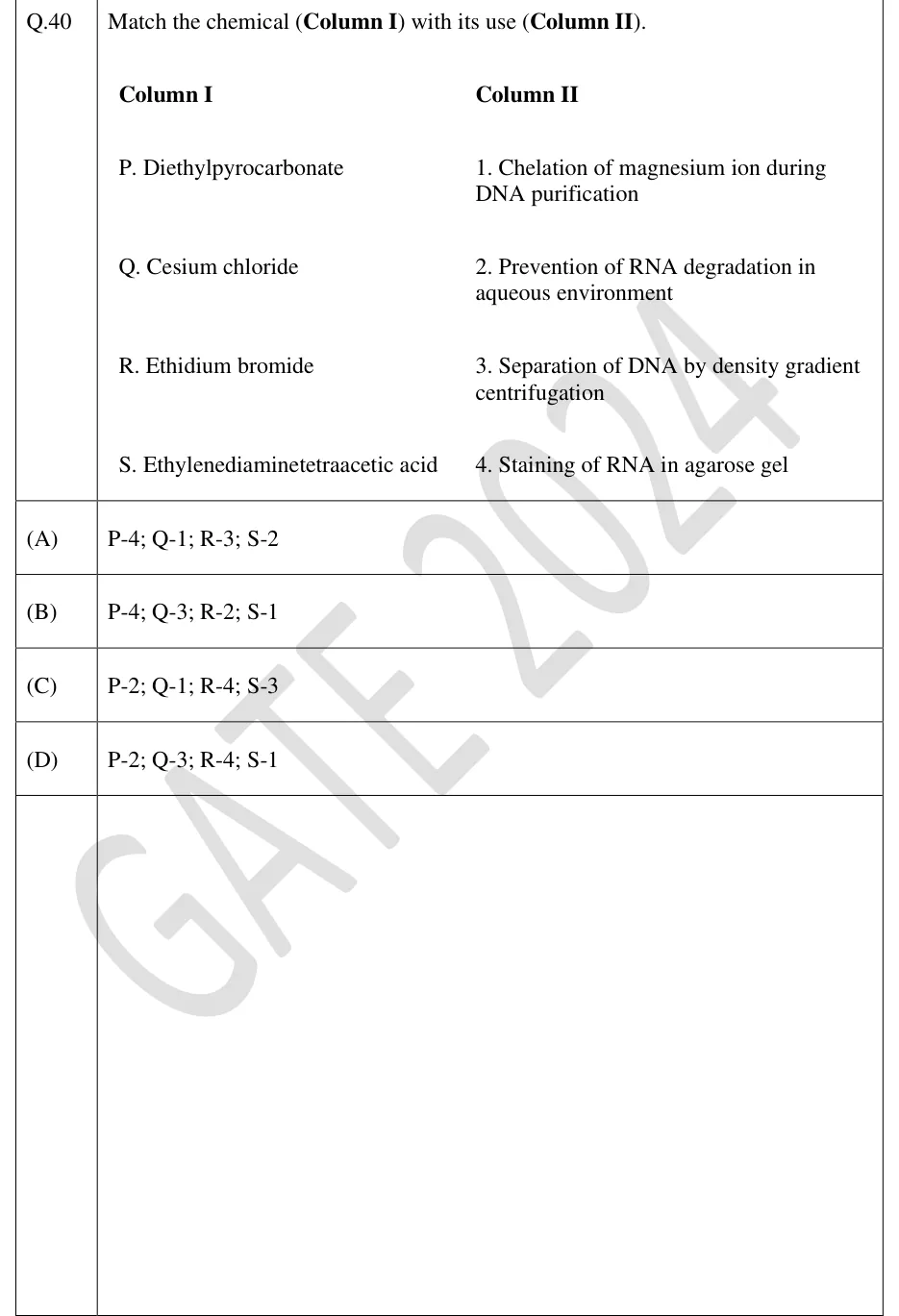
GATE 2024 BT Q.40

GATE 2024 · BTQ.40 · 2 marks · MCQ

Match the chemical (Column I) with its use (Column II).

Column I
P. Diethylpyrocarbonate
Q. Cesium chloride
R. Ethidium bromide
S. Ethylenediaminetetraacetic acid

Column II
1. Chelation of magnesium ion during DNA purification
2. Prevention of RNA degradation in aqueous environment
3. Separation of DNA by density gradient centrifugation
4. Staining of RNA in agarose gel

  1. (A)

    P-4; Q-1; R-3; S-2

  2. (B)

    P-4; Q-3; R-2; S-1

  3. (C)

    P-2; Q-1; R-4; S-3

  4. (D)

    P-2; Q-3; R-4; S-1

Answer and solution
See the question in the paper
GATE 2024 BT Q.40: answer and solution

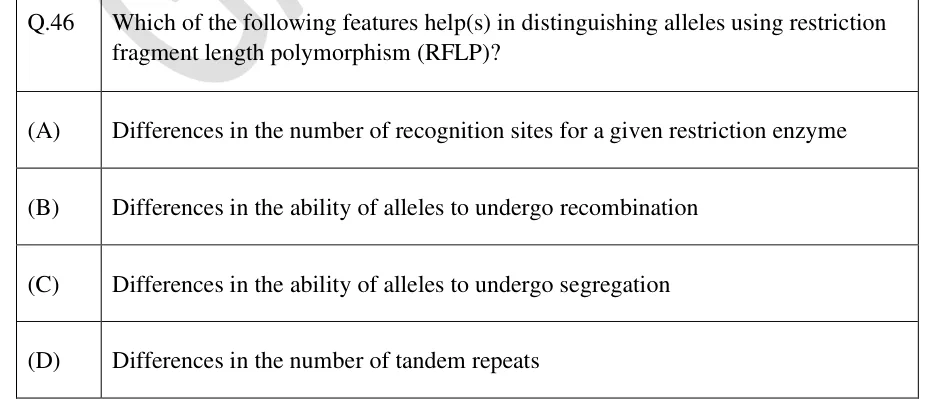
GATE 2024 BT Q.46

GATE 2024 · BTQ.46 · 2 marks · MSQ

Which of the following features help(s) in distinguishing alleles using restriction fragment length polymorphism (RFLP)?

  1. (A)

    Differences in the number of recognition sites for a given restriction enzyme

  2. (B)

    Differences in the ability of alleles to undergo recombination

  3. (C)

    Differences in the ability of alleles to undergo segregation

  4. (D)

    Differences in the number of tandem repeats

Answer and solution
See the question in the paper
GATE 2024 BT Q.46: answer and solution

GATE 2022 BT Q.26

GATE 2022 · BTQ.26 · 1 mark · MCQ

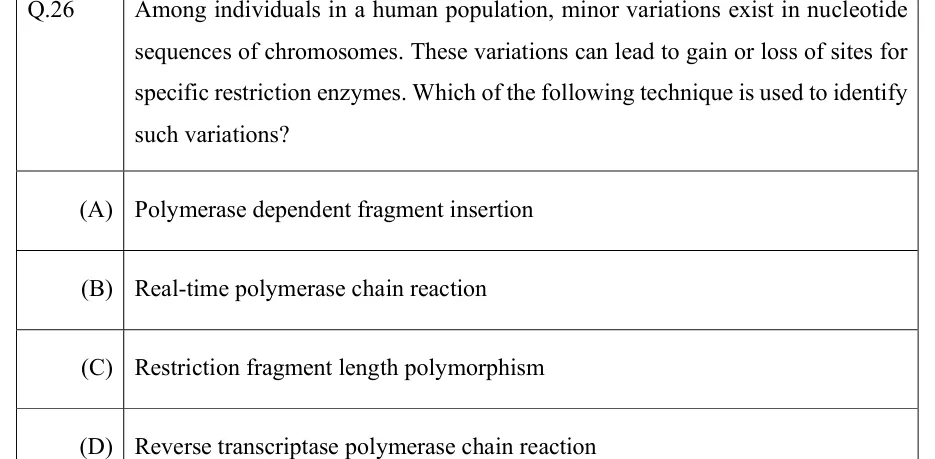
Among individuals in a human population, minor variations exist in nucleotide sequences of chromosomes. These variations can lead to gain or loss of sites for specific restriction enzymes. Which of the following technique is used to identify such variations?

  1. (A)

    Polymerase dependent fragment insertion

  2. (B)

    Real-time polymerase chain reaction

  3. (C)

    Restriction fragment length polymorphism

  4. (D)

    Reverse transcriptase polymerase chain reaction

Answer and solution
See the question in the paper
GATE 2022 BT Q.26: answer and solution

GATE 2020 BT Q.27

GATE 2020 · BTQ.27 · 2 marks · MCQ

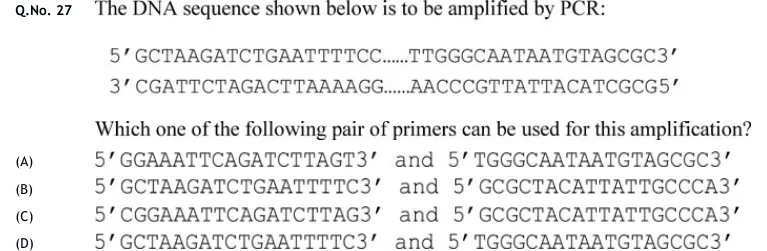
The DNA sequence shown below is to be amplified by PCR:
5'GCTAAGATCTGAATTTTCC......TTGGGCAATAATGTAGCGC3'
3'CGATTCTAGACTTAAAAGG......AACCCGTTATTACATCGCG5'
Which one of the following pair of primers can be used for this amplification?

  1. (A)

    5'GGAAATTCAGATCTTAGT3' and 5'TGGGCAATAATGTAGCGC3'

  2. (B)

    5'GCTAAGATCTGAATTTTC3' and 5'GCGCTACATTATTGCCCA3'

  3. (C)

    5'CGGAAATTCAGATCTTAG3' and 5'GCGCTACATTATTGCCCA3'

  4. (D)

    5'GCTAAGATCTGAATTTTC3' and 5'TGGGCAATAATGTAGCGC3'

Answer and solution
See the question in the paper
GATE 2020 BT Q.27: answer and solution

PRACTICE

7 questions to test yourself

PRACTICE 11 mark · MCQ

Which one of the following DNA polymerases LACKS 3'→5' (proofreading) exonuclease activity?

  1. (A)

    Taq DNA polymerase

  2. (B)

    Pfu DNA polymerase

  3. (C)

    T4 DNA polymerase

  4. (D)

    Klenow fragment of E. coli DNA polymerase I

Answer and solution

Answer: (A)

  1. Taq DNA polymerase (from Thermus aquaticus) has 5'→3' polymerase and 5'→3' exonuclease activities but no 3'→5' exonuclease, so it cannot proofread.

  2. Pfu DNA polymerase (from Pyrococcus furiosus) has 3'→5' proofreading activity; it is used for high-fidelity PCR.

  3. T4 DNA polymerase has a strong 3'→5' exonuclease activity.

  4. The Klenow fragment keeps the polymerase and 3'→5' exonuclease domains of DNA polymerase I and lacks only the 5'→3' exonuclease.

  5. Only Taq lacks proofreading, so the answer is A.

PRACTICE 21 mark · NAT

A PCR is started with 3 double-stranded template molecules. Assuming 100% amplification efficiency in every cycle, what is the total number of double-stranded DNA molecules containing the target sequence (including the original templates) after 5 cycles?

Answer and solution

Answer:

  1. At 100% efficiency every double-stranded molecule containing the target is copied once per cycle, so the number doubles each cycle.

  2. with and .

  3. .

PRACTICE 31 mark · MCQ

A dephosphorylated DNA fragment is to be radiolabelled at its 5' ends using T4 polynucleotide kinase. Which labelled nucleotide should be supplied?

  1. (A)

    [-P]dATP

  2. (B)

    [-P]ATP

  3. (C)

    [-P]ddATP

  4. (D)

    [-P]ATP

Answer and solution

Answer: (B)

  1. T4 polynucleotide kinase transfers the terminal (γ) phosphate of ATP to a free 5'-OH on DNA or RNA.

  2. So the radioactive phosphorus must be in the γ position: [-P]ATP.

  3. An α-labelled nucleotide (A or C) is used when a polymerase builds the label into the backbone; the β phosphate (D) is never transferred by the kinase.

  4. The answer is B.

PRACTICE 42 marks · MSQ

Which of the following statements about Southern and Northern blotting are correct?

  1. (A)

    Southern blotting is used to detect specific DNA fragments, while Northern blotting is used to detect specific RNA molecules.

  2. (B)

    In Southern blotting, DNA fragments are transferred onto a membrane before hybridisation with a labelled probe.

  3. (C)

    Northern blotting requires restriction enzyme digestion of RNA prior to gel electrophoresis.

  4. (D)

    Both techniques rely on complementary base pairing between a labelled probe and the target nucleic acid immobilised on the membrane.

Answer and solution

Answer: (A), (B), (D)

  1. A is correct: Southern blotting detects DNA, and Northern blotting detects RNA (usually mRNA).

  2. B is correct: in Southern blotting the separated, denatured DNA is transferred to a membrane and fixed there, and only then hybridised with a labelled probe.

  3. C is incorrect: restriction enzymes cut DNA, not RNA. In Northern blotting the RNA is separated directly on a denaturing gel (e.g. with formaldehyde or glyoxal).

  4. D is correct: both techniques detect the target by complementary base pairing with a labelled probe on the membrane.

  5. The correct options are A, B and D.

PRACTICE 51 mark · MCQ

Which one of the following statements correctly distinguishes RAPD from RFLP?

  1. (A)

    RAPD requires prior sequence information to design primers, whereas RFLP does not.

  2. (B)

    RAPD uses a single short arbitrary primer and requires no restriction enzyme or hybridisation probe, whereas RFLP is based on restriction digestion of DNA followed by probe hybridisation.

  3. (C)

    RFLP amplifies genomic DNA using PCR with arbitrary primers.

  4. (D)

    RAPD detects polymorphisms as differences in restriction-fragment length after enzyme digestion.

Answer and solution

Answer: (B)

  1. RAPD uses one short (about 10 nt) arbitrary primer in low-stringency PCR. It needs no prior sequence information, no restriction enzyme and no probe, and polymorphisms appear as bands present or absent.

  2. RFLP digests genomic DNA with a restriction enzyme, separates the fragments, and detects the locus with a labelled probe on a Southern blot; polymorphisms appear as fragments of different length.

  3. A reverses the facts: RAPD needs no sequence information, while RFLP needs a locus-specific probe.

  4. C describes RAPD, not RFLP; classic RFLP uses no PCR.

  5. D describes RFLP, not RAPD.

  6. Only B describes both methods correctly.

PRACTICE 61 mark · NAT

A primer has the sequence 5'-ATGCGCATGCAT-3' (12 nt). Using the Wallace (2 + 4) rule, , where and are the NUMBERS of those bases in the primer, calculate its melting temperature in °C.

Answer and solution

Answer:

  1. Bases in order: A, T, G, C, G, C, A, T, G, C, A, T.

  2. G = 3 and C = 3, so .

  3. A = 3 and T = 3, so .

  4. °C.

PRACTICE 72 marks · NAT

In an RT-qPCR experiment (assume 100% and equal amplification efficiencies for all genes), a target gene gives Ct = 22 and the reference gene Ct = 17 in treated cells; in untreated control cells the target gives Ct = 25 and the reference Ct = 18. Using the method, calculate the fold change in target expression in treated cells relative to the control.

Answer and solution

Answer:

  1. .

  2. .

  3. .

  4. Fold change .

OFFICIAL GATE 2027 SYLLABUS WORDING

Copied from the GATE 2027 syllabus; see all 2027 syllabi.

GATE BT

Polymerase chain reaction; DNA/RNA labelling and Sangers and next generation sequencing; Southern and northern blotting; In-situ hybridization; DNA fingerprinting, RAPD, RFLP

Preparing in Kolkata? IAE Academy's course for GATE BT.