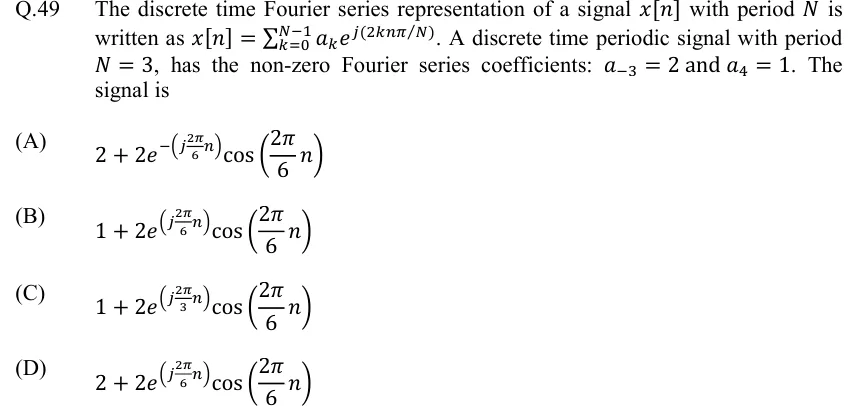
The discrete time Fourier series representation of a signal with period is written as . A discrete time periodic signal with period , has the non-zero Fourier series coefficients: and . The signal is
- (A)
- (B)
- (C)
- (D)

The discrete time Fourier series representation of a signal with period is written as . A discrete time periodic signal with period , has the non-zero Fourier series coefficients: and . The signal is
ANSWER
The signal is , which is option (B).
Official answer: BSource: Official answer key, GATE 2022 EE (IIT Kharagpur)
DTFS coefficients repeat with period : . With : and . No other coefficient is non-zero, so in the fundamental range .
Synthesis equation over one period, , with :
Rewrite to match the options. Split the exponent in half, so that and :
Result: which is option (B).
Check the other options with the same identity: (D) expands to and (A) to . Both give at , but . (C) expands to , which also gives at . At , though, it gives , while . (C) is not even periodic with period . Only (B) matches.
KEY IDEA
DTFS coefficients are periodic in with period , so an index outside to maps back into that range: and . The half-angle factorisation then turns into the form used in the options.
WATCH OUT FOR
Treating and as harmonics at and that are separate from and . A common slip is to add as the DC term, or to read as one term instead of . Either way the constant comes out as , which leads to option (D). Expand each option back into exponentials and check it at one or two values of .
From the GATE 2022 EE paper. Every question of this paper · Download the full paper · All 11 Fourier series questions, with notes