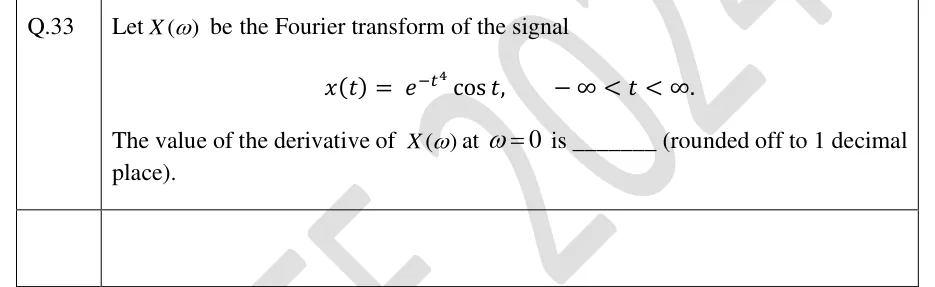
Let be the Fourier transform of the signal
The value of the derivative of at is ________ (rounded off to 1 decimal place).

Let be the Fourier transform of the signal
The value of the derivative of at is ________ (rounded off to 1 decimal place).
ANSWER
The derivative of at is .
Official answer: 0.0Source: Official answer key, GATE 2024 EE (IISc Bengaluru)
Check the symmetry of the signal. is even, because , and is even. So is real and even: .
Symmetry property of the Fourier transform. A real, even signal has a real, even transform: .
The derivative exists. , so is differentiable and we can differentiate under the integral sign.
The derivative of an even function is odd. Differentiate to get . At this reads , so .
Check with the frequency-differentiation property. , so
Odd integrand, symmetric limits. is odd (odd even even). The integral converges absolutely because decays so fast. An odd function integrated over gives , so .
Same answer from modulation. Let , which is real and even. Then , and because is odd.
Rounded to 1 decimal place: .
KEY IDEA
is real and even, so is real and even. The derivative of an even function is odd, and an odd function is zero at the origin. Equivalently, , which is the integral of an odd function over a symmetric range, so it is . You never need to compute the transform of , which has no closed form.
WATCH OUT FOR
Trying to find explicitly, which has no elementary closed form, or treating it as a Gaussian . Another mistake is to answer with the value , which is not zero, when the question asks for the derivative . A third is to think the modulation by destroys the symmetry: the spectrum shifts to , but it shifts symmetrically, so stays even.
From the GATE 2024 EE paper. Every question of this paper · Download the full paper · All 22 Fourier transform questions, with notes