
IAE Academy

GATE 2018 EE Q.38: solution and answer

GATE 2018 · EEQ.38 · 2 marks · MCQ

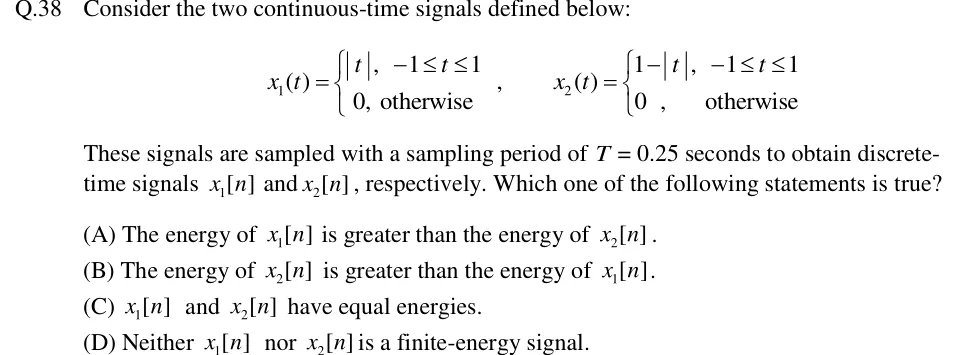
Consider the two continuous-time signals defined below:

These signals are sampled with a sampling period of seconds to obtain discrete-time signals and , respectively. Which one of the following statements is true?

  1. (A)

    The energy of is greater than the energy of .

  2. (B)

    The energy of is greater than the energy of .

  3. (C)

    and have equal energies.

  4. (D)

    Neither nor is a finite-energy signal.
See the question in the paper

Answer and solution

ANSWER

(A) The energy of is greater than the energy of : and .

Official answer: ASource: Official answer key, GATE 2018 EE (IIT Guwahati)

  1. Sampling: . Both signals are nonzero only for , so only can give nonzero samples. Both are finite-length sequences with finite values, so both have finite energy, which rules out (D).

  2. for . At the values are . The endpoints lie inside the closed interval , so .

  3. for . At the values are .

  4. Discrete-time energy is . For :

  5. For :

  6. . The two sequences take the same set of values, but the largest value occurs twice in (at ) and only once in (at ), while the value occurs once in and twice in . So the energy of is greater, which is option (A).

KEY IDEA

Sample at , list the finite set of samples (including the endpoints , which are inside the closed interval), and add their squares: . Here for . Both sequences take the values , but reaches the peak value at two samples () and at only one ().

WATCH OUT FOR

Choosing (C) by reasoning from the continuous-time signals. Their energies are equal, , but sampling does not keep that equality: the samples at the interval edges are where is largest and is zero, so gets two peak samples and only one. Dropping the endpoint samples (treating the interval as open) gives the same kind of miscount, with against , which points to (B).

From the GATE 2018 EE paper. Every question of this paper · Download the full paper · All 18 Signals basics questions, with notes

More Signals basics questions