
IAE Academy

GATE 2026 EE Q.12: solution and answer

GATE 2026 · EEQ.12 · 1 mark · MCQ

Let be any continuous-time periodic signal with period . It is sampled uniformly with a sampling period where , resulting in the discrete sequence

Which one of the following statements is correct about ?

  1. (A)

    will always be periodic with period for all values of

  2. (B)

    will always be periodic with period for all values of

  3. (C)

    will never be periodic

  4. (D)

    will be periodic if and only if is a rational number
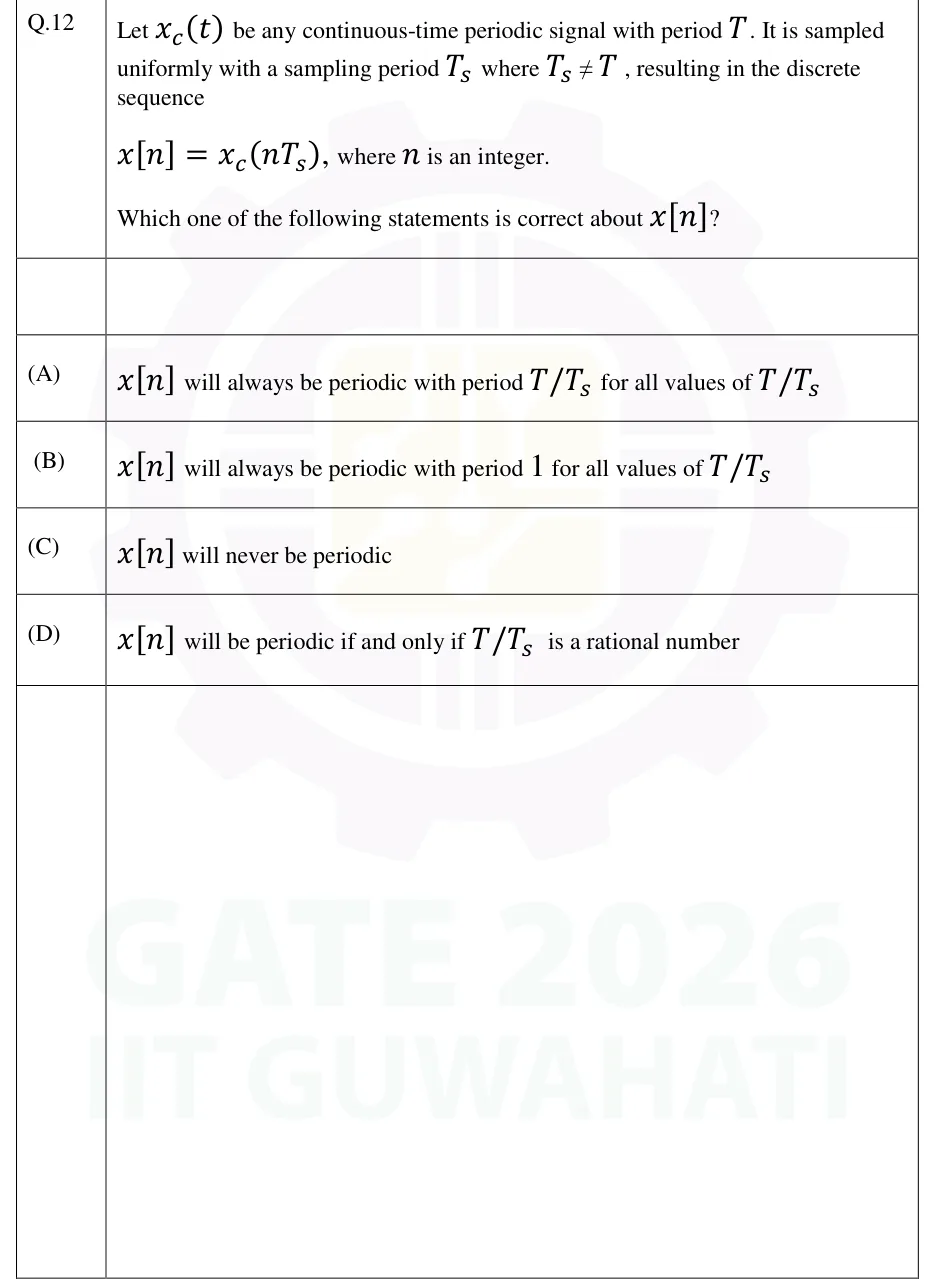
See the question in the paper

Answer and solution

ANSWER

Option D: will be periodic if and only if is a rational number.

Official answer: DSource: Official answer key, GATE 2026 EE (IIT Guwahati)

  1. What discrete-time periodicity needs. is periodic if some positive integer satisfies for every integer , that is, . This holds for every of period whenever is a whole number of periods: for some positive integer .

  2. The "if" part. Suppose with positive integers in lowest terms. Then , so So is periodic, and samples is a period. It is always an integer. For a particular signal the fundamental period can be a divisor of .

  3. The "only if" part (DT sinusoid rule). Take , which has period . Then with . If this has a period , put : , so for some integer . That gives , which is rational, so is rational too. If , for example, the samples never repeat. Some special signals, such as a constant, give a periodic for any . So "only if" means that periodicity is guaranteed for every signal of period only when is rational.

  4. Option A is false. If , a period of samples is impossible, because a discrete-time period must be an integer. By step 2 (, ) the true period is . If is irrational, the cosine of step 3 has no period at all.

  5. Option B is false. A period of would make constant. But with the cosine gives , which is not constant.

  6. Option C is false. The same example, (allowed, since ), gives a periodic sequence with .

  7. Only option D holds in general: is periodic for every signal of period exactly when is rational.

KEY IDEA

A discrete-time period must be a whole number of samples. So repeats only when some integer number of samples spans a whole number of continuous-time periods: , which means is rational. If in lowest terms, then samples is a period.

WATCH OUT FOR

Picking A because the samples per period looks like the discrete period. That ratio need not be an integer. For the period is samples, not , and for an irrational ratio (for example ) a sampled sinusoid never repeats. Another trap is to think sampling a periodic signal always gives a periodic sequence.

From the GATE 2026 EE paper. Every question of this paper · Download the full paper · All 18 Signals basics questions, with notes

More Signals basics questions