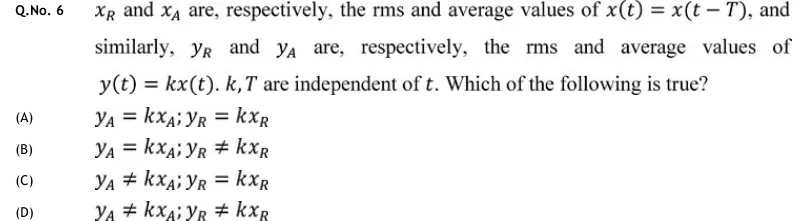
and are, respectively, the rms and average values of , and similarly, and are, respectively, the rms and average values of . are independent of . Which of the following is true?
- (A)
- (B)
- (C)
- (D)

and are, respectively, the rms and average values of , and similarly, and are, respectively, the rms and average values of . are independent of . Which of the following is true?
ANSWER
(A): and . Scaling a periodic signal by a constant gain scales both its average and its rms value by . (Strictly, the rms scales by .)
Official answer: ASource: Official answer key, GATE 2020 EE (IIT Delhi)
Periodicity. says is periodic with period . Its average and rms values are therefore taken over one period. , with a constant, has the same period .
Average value (linearity of the integral). This holds for any constant , positive, negative or zero. That rules out (C) and (D).
RMS value (definition). Squaring inside the rms does not stop it scaling with . The constant comes out of the integral, and its square root comes out of the radical.
Pick the option. is a constant scale factor (a gain). For , , so . Both relations in (A) hold. Option (B) needs , which is false for every .
A caveat on the sign. Strictly, , because an rms value can never be negative. If were negative (and ), then , and the statement in (B) would be the true one. The question treats as a plain non-negative scaling constant, and the official key (A) is the answer on that reading.
KEY IDEA
The average is a linear operation, so it scales by exactly . The rms is the square root of a mean square: comes out of the integral and comes out of the radical, so the rms scales by . That equals for a non-negative gain. The rms is not additive, in general, but it does scale with a constant multiplier.
WATCH OUT FOR
Reasoning that the rms is 'nonlinear because of the squaring' and so cannot scale by , which leads to (B). The rms fails additivity, not scaling: multiplying the signal by multiplies the rms by . The opposite slip is forgetting that the rms is never negative, so and not when . The question takes as a non-negative gain.
From the GATE 2020 EE paper. Every question of this paper · Download the full paper · All 18 Signals basics questions, with notes