
IAE Academy

GATE 2020 EC Q.8: solution and answer

GATE 2020 · ECQ.8 · 1 mark · MCQ

The components in the circuit shown below are ideal. If the op-amp is in positive feedback and the input voltage is a sine wave of amplitude 1 V, the output voltage is
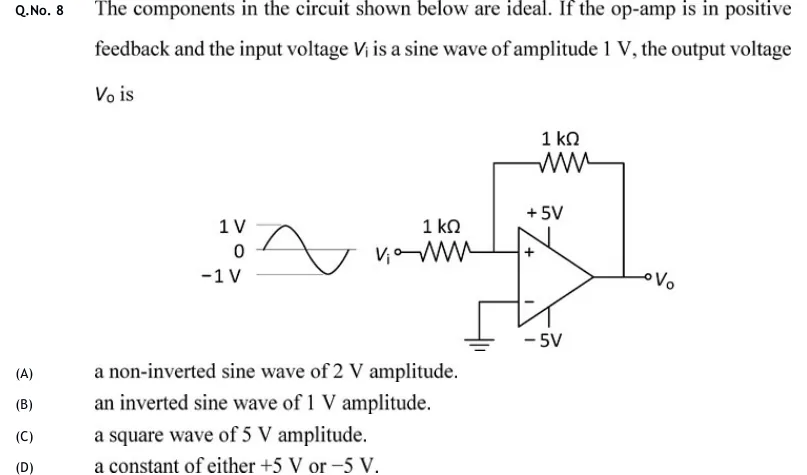
GATE 2020 EC question 8: An op-amp with supply rails +5 V (top) and −5 V (bottom).Tap to open full size
Figure from the GATE 2020 EC paper. It is part of the question.
Figure description

An op-amp with supply rails +5 V (top) and −5 V (bottom). The input V_i is connected through a 1 kΩ resistor to the non-inverting (+) input, which is the upper input terminal. The inverting (−) input, the lower terminal, is connected to ground. A 1 kΩ feedback resistor runs from the output V_o back to the non-inverting (+) input node. To the left of V_i, a sketch shows the input waveform: a sine wave that swings between +1 V and −1 V about 0, with levels labelled 1 V, 0 and −1 V.

  1. (A)

    a non-inverted sine wave of 2 V amplitude.

  2. (B)

    an inverted sine wave of 1 V amplitude.

  3. (C)

    a square wave of 5 V amplitude.

  4. (D)

    a constant of either +5 V or −5 V.

Answer and solution

ANSWER

(D) The output is a constant of either +5 V or −5 V. The Schmitt trigger's thresholds are ±5 V, and a 1 V sine never reaches them, so the output never switches.

Official answer: DSource: Official answer key, GATE 2020 EC (IIT Delhi)

  1. Identify the circuit. The 1 kΩ feedback resistor returns the output to the input and the input is grounded, so this is a non-inverting Schmitt trigger (a comparator with hysteresis). With positive feedback there is no virtual short: in general, and the ideal op-amp output sits at one supply rail, or (ideal op-amp, output saturates at the supply, no current into the input terminals).

  2. Find the voltage at the input by superposition on the two equal 1 kΩ resistors (no current flows into the ideal op-amp input):

  3. Switching condition: the output changes state only when crosses , that is when , or .

  4. Thresholds: while , goes negative only if , so the lower threshold is . While , goes positive only if , so the upper threshold is . The hysteresis width is .

  5. Compare with the input: swings only between and , well inside the band from to , so it never reaches either threshold. (Check: with , stays between and , always positive; with , stays between and , always negative.)

  6. So the output never switches. It stays at whichever rail it started on: a constant or . Option (D).

KEY IDEA

With positive feedback the op-amp acts as a comparator with hysteresis: the output is always at a rail, and it switches only when the input crosses a threshold. For this non-inverting Schmitt trigger, gives thresholds . A input stays inside the hysteresis band, so the output is latched at or .

WATCH OUT FOR

Treating the circuit as a linear amplifier. Assuming a virtual short () gives a gain of and leads to option (B), and misreading it as a non-inverting amplifier gives option (A); neither is valid under positive feedback. A second trap is picking (C) because "a comparator turns a sine into a square wave". That only happens if the input amplitude exceeds the thresholds (here ), and a 1 V sine does not.

From the GATE 2020 EC paper. Every question of this paper · Download the full paper · All 13 Filters & waveforms questions, with notes

More Filters & waveforms questions