
IAE Academy

GATE 2018 EE Q.41: solution and answer

GATE 2018 · EEQ.41 · 2 marks · NAT

In the circuit shown in the figure, the bipolar junction transistor (BJT) has a current gain . The base-emitter voltage drop is a constant, . The value of the Thevenin equivalent resistance (in ) as shown in the figure is ______ (up to 2 decimal places).
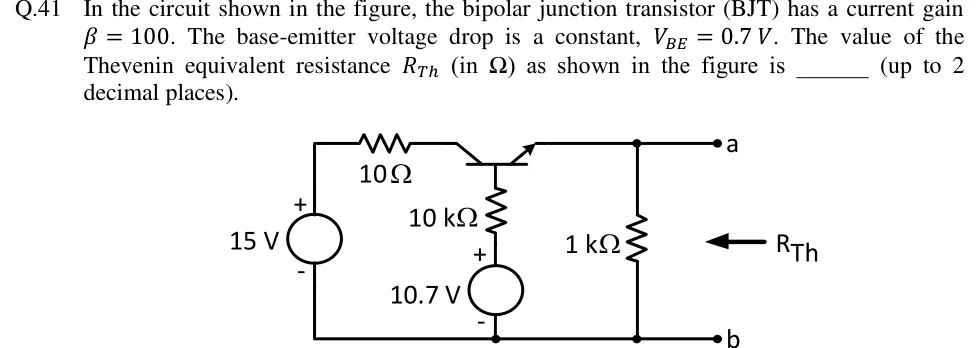
GATE 2018 EE question 41: An npn BJT is drawn on its side along the top wire.Tap to open full size
Figure from the GATE 2018 EE paper. It is part of the question.
Figure description

An npn BJT is drawn on its side along the top wire. Its collector (left lead) goes through a 10 Ω resistor to the + terminal of a 15 V DC source. The source's − terminal is on the bottom (ground) wire. The emitter (right lead, arrow pointing outward, so npn) connects to node a. The base lead points down and goes through a 10 kΩ resistor to the + terminal of a 10.7 V DC source, whose − terminal is on the ground wire. A 1 kΩ resistor runs from node a to the ground wire, which is node b. An arrow marked R_Th points into terminals a–b from the right.

Answer and solution

ANSWER

.

Official answer: 89.0 to 91.5Source: Official answer key, GATE 2018 EE (IIT Guwahati)

  1. Identify the terminals. The emitter is node and ground is node . The base is fed from through . The collector goes to through . The resistor across – is .

  2. Check the active region (KVL around the base-emitter loop). So , and . Then , so . The transistor is in the active region, where (with constant and constant ) the circuit is linear, so a Thevenin equivalent exists.

  3. Small-signal model with a constant . A constant means the base-emitter junction has no incremental resistance (): the base and emitter move together. The collector acts as a controlled current source ( neglected), so the collector resistor and the source have no effect on the emitter. Both DC sources are set to zero.

  4. Resistance looking into the emitter (resistance reflection). Apply a test voltage at the emitter. Since , the base is also at , so a current flows out of the base into ; the base current into the transistor is . The current flowing into the emitter from the test source is . So

  5. Combine with the 1 kΩ resistor across –.

  6. Cross-check with . Open circuit: (step 2). Short –: the emitter is grounded, so , and (the shorted carries nothing). Then , so the transistor is still active.

KEY IDEA

Because is constant, the base-emitter junction has zero incremental resistance (). Looking into the emitter you therefore see only the base resistance divided by , which is . The collector branch is a current source and drops out. is this value in parallel with the across –. Dividing the open-circuit voltage by the short-circuit current gives the same answer, because the circuit is linear while the BJT stays active.

WATCH OUT FOR

Common mistakes: (1) Taking and ignoring the transistor. (2) Multiplying by instead of dividing: that is the rule for looking into the base, not the emitter. (3) Including the collector resistor, which sits behind an ideal current source ( neglected). (4) Adding a nonzero , when the question says is constant.

From the GATE 2018 EE paper. Every question of this paper · Download the full paper · All 13 Biasing questions, with notes

More Biasing questions