IAE Academy

GATE 2022 BT Q.41: solution and answer

GATE 2022 · BTQ.41 · 2 marks · MCQ

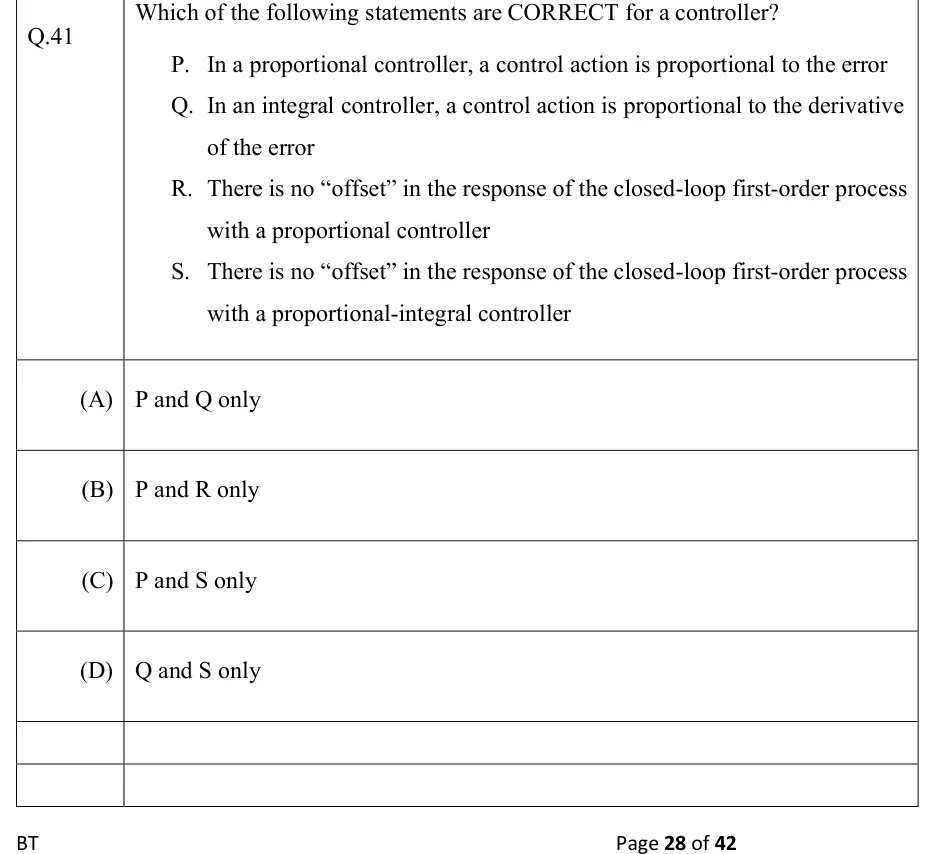
Which of the following statements are CORRECT for a controller?

P. In a proportional controller, a control action is proportional to the error

Q. In an integral controller, a control action is proportional to the derivative of the error

R. There is no "offset" in the response of the closed-loop first-order process with a proportional controller

S. There is no "offset" in the response of the closed-loop first-order process with a proportional-integral controller

  1. (A)

    P and Q only

  2. (B)

    P and R only

  3. (C)

    P and S only

  4. (D)

    Q and S only

See the question in the paper

Answer and solution

ANSWER

(C) P and S only. A proportional controller's action is proportional to the error (P). Integral action is proportional to the integral of the error, not its derivative, so Q is false. A P controller on a first-order process leaves an offset of , so R is false. A PI controller removes the offset, so S is true.

Official answer: CSource: Official answer key, GATE 2022 BT (IIT Kharagpur)

  1. P: true. Proportional control: , where is the controller output, its bias (the output when the error is zero), the error between set point and measured output , and the controller gain. The action is proportional to the error.

  2. Q: false. Integral control: , with the integral (reset) time. The action is proportional to the integral of the error. Derivative action is the one proportional to .

  3. Now test R and S. Take a first-order process (process gain , time constant ) in a unity-feedback loop with controller , and apply a unit step in set point: . The closed-loop response is . Take (the controller acts in the correct direction), so the loop is stable and the final value theorem applies.

  4. R: false. With a P controller, , so .

  5. Final value theorem: . So the offset is for any finite . A P controller always leaves an offset.

  6. S: true. With a PI controller, . The loop now contains a pure integrator (), and The characteristic equation has all coefficients positive, so this second-order loop is stable.

  7. Final value theorem: . The offset is zero, because the integral term keeps changing the output for as long as any error remains.

  8. Only P and S are correct, which is option (C).

KEY IDEA

Offset is set by the loop's gain at . With P control, is finite, so . Integral action puts a in the loop, so as , , and the offset disappears.

WATCH OUT FOR

Mixing up integral and derivative action. Q describes derivative control (), not integral control. The other common slip is thinking a large enough removes the P-controller offset. It only shrinks it, as , and never reaches zero at any finite gain.

From the GATE 2022 BT paper. Every question of this paper · Download the full paper · All 9 Process control questions, with notes

More Process control questions