
IAE Academy

GATE 2026 BT Q.15: solution and answer

GATE 2026 · BTQ.15 · 1 mark · MCQ

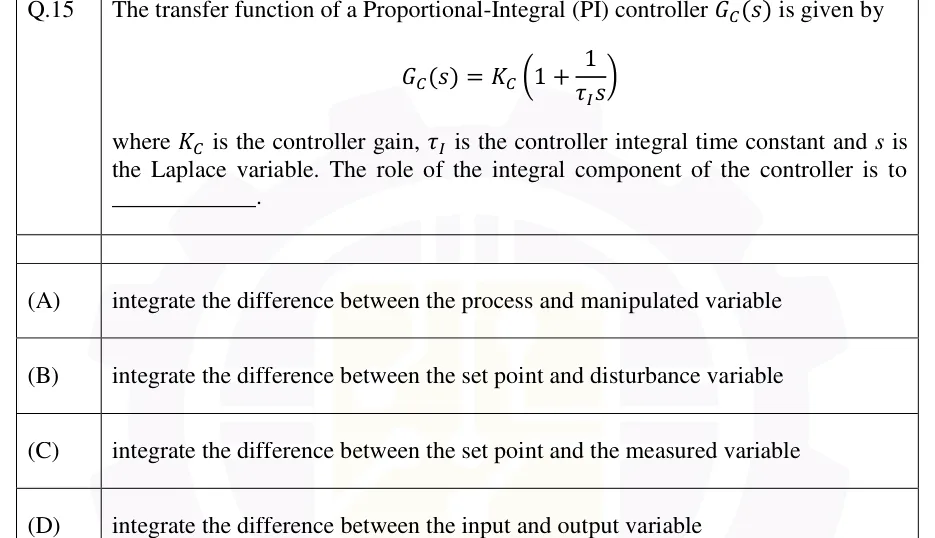
The transfer function of a Proportional-Integral (PI) controller is given by

where is the controller gain, is the controller integral time constant and is the Laplace variable. The role of the integral component of the controller is to ____________.

  1. (A)

    integrate the difference between the process and manipulated variable

  2. (B)

    integrate the difference between the set point and disturbance variable

  3. (C)

    integrate the difference between the set point and the measured variable

  4. (D)

    integrate the difference between the input and output variable
See the question in the paper

Answer and solution

ANSWER

(C) The integral component integrates the difference between the set point and the measured variable, which is the error signal .

Official answer: CSource: Official answer key, GATE 2026 BT (IIT Guwahati)

  1. A feedback controller acts on the error signal, which the comparator forms as . Here is the set point and is the measured value of the controlled variable, meaning the sensor/transmitter output.

  2. The controller transfer function relates the controller output to the error: , where is the Laplace transform of the deviation in controller output and is the Laplace transform of the error.

  3. Invert to get the PI law in the time domain, with the controller gain, the integral time, the controller's bias (steady-state output) and a dummy integration variable:

  4. The factor is an integrator: for deviation variables with zero initial value, dividing by in the Laplace domain is integration in time. It multiplies , so the integral action integrates , the set point minus the measured variable.

  5. This is why integral action removes offset. As long as the integral keeps changing, so keeps changing. If the closed loop is stable and settles, can only become constant when , which means .

  6. Check the other options. (A): the manipulated variable is what the controller output adjusts. The controller never subtracts it from the process variable, and the two usually have different physical meanings and units. (B): the controller does not measure the disturbance or subtract it from the set point. The disturbance only affects the loop through its effect on . (D): 'input minus output' does not identify the error signal. The controller's input minus its output means nothing physically, and neither does the process's input minus its output.

  7. Only (C) names the error signal, set point minus measured variable, which the integral term accumulates. Answer: (C)

KEY IDEA

A controller transfer function always acts on the error , and means integrate in time. So the integral term adds up , the set point minus the measured variable. It keeps changing the controller output until that error is zero, and that is how PI control removes steady-state offset.

WATCH OUT FOR

Picking (A) because 'manipulated variable' is confused with 'measured variable'. The manipulated variable is what the controller adjusts, not what it compares with the set point. Picking (D) because 'input minus output' sounds like an error. The error is specifically set point minus measured value, not the difference between any input and output.

From the GATE 2026 BT paper. Every question of this paper · Download the full paper · All 9 Process control questions, with notes

More Process control questions