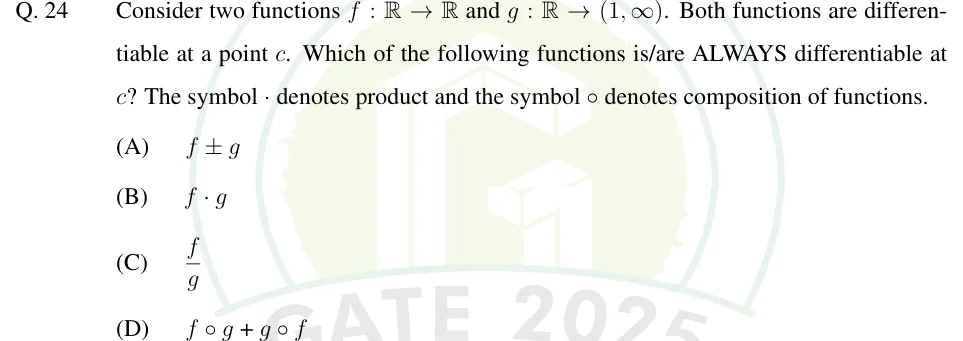
Consider two functions and . Both functions are differentiable at a point . Which of the following functions is/are ALWAYS differentiable at ? The symbol denotes product and the symbol denotes composition of functions.
- (A)
- (B)
- (C)
- (D)

Consider two functions and . Both functions are differentiable at a point . Which of the following functions is/are ALWAYS differentiable at ? The symbol denotes product and the symbol denotes composition of functions.
ANSWER
Options (A), (B) and (C) are always differentiable at ; (D) is not.
Official answer: A, B, CSource: Official answer key, GATE 2025 DA (IIT Roorkee)
Sum, difference and product rules: if and are differentiable at , then so are and . So (A) and (B) are always differentiable at .
Quotient rule: is differentiable at when and are differentiable at and . Since takes values in , , so and never vanishes anywhere. Hence (C) is always differentiable at .
Chain rule: is differentiable at when is differentiable at AND is differentiable at the point . We are told only that is differentiable at , not at . Likewise needs differentiable at , which is not given. So (D) can fail, and we need one counterexample.
Counterexample for (D): take , and . Here is differentiable at because for . Also is differentiable everywhere (the denominator never vanishes), and since , we get . So both functions meet the hypotheses at .
Compute the two compositions. First, , so . Its right-hand slope at is and its left-hand slope is , so it is NOT differentiable at .
Second, near we have , so , which is differentiable at because is differentiable everywhere.
A function that is not differentiable at , plus one that is differentiable at , is not differentiable at (otherwise the difference of the sum and the second function would be differentiable). Hence is not differentiable at , and (D) is not always differentiable.
Therefore the functions that are always differentiable at are (A), (B) and (C).
KEY IDEA
Sum, product and quotient rules need differentiability only at (with a non-zero denominator, guaranteed here because ). The chain rule for a composition needs the outer function to be differentiable at the inner function's value, which is not given.
WATCH OUT FOR
Assuming a composition of differentiable-at- functions is differentiable at . The chain rule requires the outer function to be differentiable at (or ), not at . Another slip is forgetting that the range is what keeps the denominator of non-zero.
From the GATE 2025 DA paper. Every question of this paper · Download the full paper · All 6 Limits & continuity questions, with notes