IAE Academy

GATE 2025 DA Q.51: solution and answer

GATE 2025 · DAQ.51 · 2 marks · MSQ

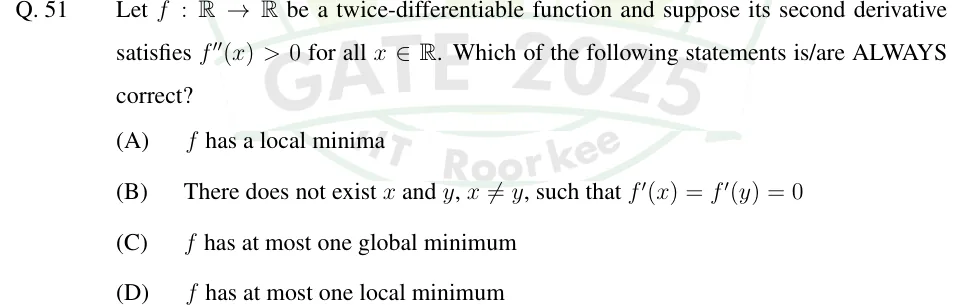
Let be a twice-differentiable function and suppose its second derivative satisfies for all . Which of the following statements is/are ALWAYS correct?

  1. (A)

    has a local minima

  2. (B)

    There does not exist and , , such that

  3. (C)

    has at most one global minimum

  4. (D)

    has at most one local minimum

See the question in the paper

Answer and solution

ANSWER

The always-correct statements are (B), (C) and (D).

Official answer: B, C, DSource: Official answer key, GATE 2025 DA (IIT Roorkee)

  1. Since for all , the derivative is strictly increasing, so is strictly convex.

  2. (A) Not always. Take . Then everywhere, but never vanishes, so has no stationary point and hence no local minimum. False.

  3. (B) A strictly increasing function is one-to-one, so forces . Hence two distinct points with cannot exist. True.

  4. (D) is differentiable, so at any local minimum we need . By (B) there is at most one such point, so there is at most one local minimum. True.

  5. (C) Suppose attained its global minimum value at two points , so . Strict convexity gives . This contradicts being the global minimum. So there is at most one global minimum point. True.

  6. The statements that always hold are (B), (C) and (D).

KEY IDEA

everywhere makes strictly increasing, so has at most one zero. That gives at most one stationary point, hence at most one local (and global) minimum. It does not guarantee that a minimum exists.

WATCH OUT FOR

Choosing (A) because a convex function "looks like a bowl". Strict convexity gives uniqueness of a minimum if one exists, not existence. is strictly convex yet has no minimum.

From the GATE 2025 DA paper. Every question of this paper · Download the full paper · All 5 Maxima & minima questions, with notes

More Maxima & minima questions