GATE 2026 DA Q.27
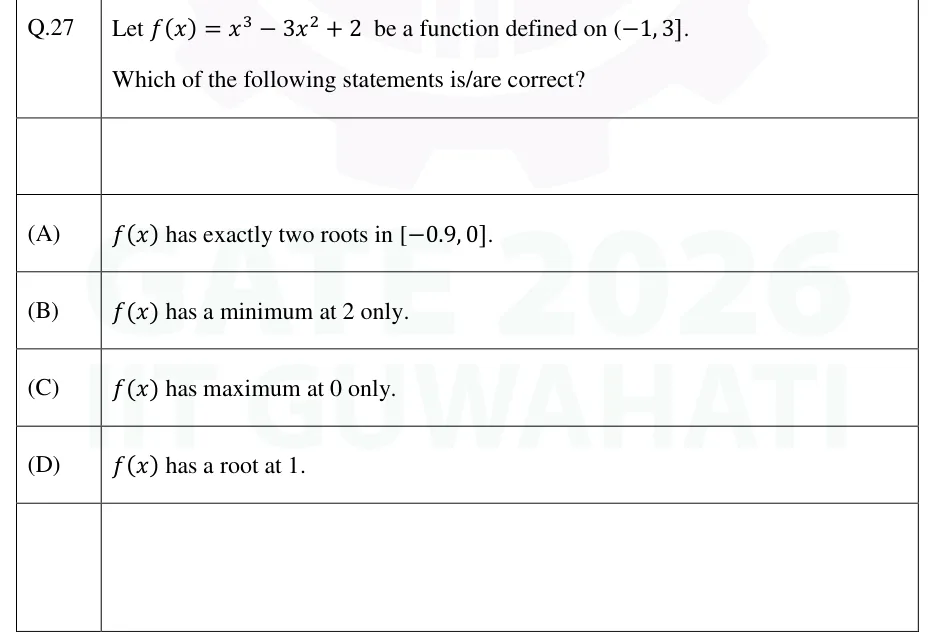
Let be a function defined on .
Which of the following statements is/are correct?
- (A)
has exactly two roots in .
- (B)
has a minimum at 2 only.
- (C)
has maximum at 0 only.
- (D)
has a root at 1.

GATE DA
Maxima and minima locate where a function of one variable turns from rising to falling or the reverse, and single-variable optimisation uses that to find the best value of a quantity. In GATE DA you apply it to find critical points, classify them with the first-, second- and higher-derivative tests, find global extrema on closed, open and unbounded intervals, read convexity and inflection points, and see gradient descent as a repeated step against the derivative.
5 previous-year questions · 5 solved · 6 practice questions
Convention for the whole note: is a real function of one real variable, differentiable where stated. A point is interior if some open interval around lies inside the domain (or inside the interval under discussion). has a local maximum at if for every in the domain that lies in some open interval around , and a global maximum on a set at if for every . Minima are defined the same way with , and an extremum is a maximum or a minimum. A global extremum attained at an interior point is also a local extremum there.
CRITICAL POINT
Necessary condition: if has a local extremum at an interior point and exists, then . So every interior local extremum is a critical point. The converse is false: has but no extremum at .
MONOTONICITY FROM THE SIGN OF THE DERIVATIVE
is an interval, is continuous on and differentiable at its interior points. on gives non-decreasing; if in addition only at isolated points, is still strictly increasing. The converse of the first implication fails: is strictly increasing on although .
EXAM TIP
Check where does not exist as well as where it is zero. For the derivative does not exist at , and is the global minimum. Solving only misses it.
First-derivative test (for a critical point $c$ where $f$ is continuous, and $f$ is differentiable near $c$ except possibly at $c$)
Find a such that has one constant sign on and one constant sign on .
If changes from positive to negative across , is a local maximum.
If changes from negative to positive across , is a local minimum.
If has the same sign on both sides, is not an extremum.
The test works even where does not exist, for example at .
SECOND-DERIVATIVE TEST
Needs and to exist, so it cannot be used at a critical point where does not exist. If the test is inconclusive and you must use the first-derivative test or higher derivatives.
HIGHER-ORDER DERIVATIVE TEST
Here and is times differentiable at . For odd the point is a point of inflection with a horizontal tangent. Example: at has and , so a local minimum; at has , so no extremum.
Function at | Behaviour at | ||
|---|---|---|---|
local (and global) minimum | |||
local (and global) maximum | |||
local (and global) minimum; second-derivative test fails | |||
neither; does not change sign (a point of inflection) | |||
does not exist | does not exist | local (and global) minimum; found only as a non-differentiable critical point |
EXAM TIP
When do not say "no extremum". and both have , and only one of them has an extremum at .
EXTREME VALUE THEOREM
Both conditions matter: continuity, and a closed bounded interval. On an open interval an extremum may not exist, for example on has neither. A discontinuous function on a closed interval may also fail, for example for with has no maximum on .
Procedure for the global maximum and minimum of a continuous $f$ on $[a,b]$
Find all critical points of in the open interval : points where and points where does not exist.
Evaluate at each of those critical points and at both endpoints and .
The largest of these values is the global maximum on and the smallest is the global minimum.
No derivative test is needed for this step; only the comparison of values.
WORKED EXAMPLE
Find the global maximum and global minimum of on , and classify its local extrema.
, so the critical points are and , both inside .
: so is a local maximum; so is a local minimum.
Values: , , , .
Largest is at the endpoint ; smallest is at the endpoint .
Answer: Global maximum at , global minimum at on . The local maximum at () and local minimum at () are not global.
Open or unbounded intervals (for continuous $f$ with finitely many critical points, and the limits of $f$ at the excluded or infinite ends existing, possibly $\pm\infty$)
A global maximum or minimum may not exist.
Compute at every critical point and at every endpoint that belongs to the interval, and the limit of at every endpoint that does not belong to it (including ).
If the largest attained value is at least every end limit, it is the global maximum; if some end limit is strictly larger, there is no global maximum.
The global minimum is found the same way with smallest in place of largest.
WORKED EXAMPLE
Find the global maximum and global minimum, if they exist, of on .
, which is zero only at .
Values: and ; end limit .
The largest attained value exceeds the end limit , so it is the global maximum.
The smallest attained value is at , and the end limit is not smaller, so is the global minimum.
Answer: Global maximum at ; global minimum at on .
EXAM TIP
A local maximum can be smaller than the function value at an endpoint. In the first example above the local maximum loses to the endpoint value . Always include the endpoints.
CONVEX AND CONCAVE FUNCTIONS (TWICE DIFFERENTIABLE ON AN INTERVAL $I$)
Convex (also called concave up) means for all and . For differentiable this is equivalent to the graph lying on or above every tangent line: for all . on makes strictly convex, but not conversely: is strictly convex although .
POINT OF INFLECTION
A point of inflection is a point where is continuous and the graph changes from convex to concave or the reverse. If exists at an inflection point then . The converse is false: has but on both sides, so is not an inflection point. An inflection point can also occur where does not exist: has for and for , with undefined.
For a convex function on an interval , any local minimum is a global minimum on . If is also differentiable, every point with is a global minimum on , because the tangent-line inequality with gives for all ; no endpoint comparison is needed there. A strictly convex function has at most one minimiser, and possibly none: is strictly convex on and has no minimum. A concave function behaves the same way with maximum in place of minimum.
EXAM TIP
To count inflection points, list the zeros of and the points where does not exist (but is continuous), and keep only those where the sign of actually changes. An inflection point need not be a critical point: has an inflection point at with .
Procedure for an optimisation word problem
Name the quantity to be maximised or minimised and write it in terms of the variables.
Use the stated constraint to eliminate all but one variable.
Write the domain of the remaining variable from the physical meaning (lengths positive, and so on).
Differentiate and find the critical points in the domain.
Confirm the optimum is global: compare values with the endpoints (or end limits) of the domain, or use the single-critical-point rule below. A second-derivative test on its own shows only a local extremum.
Answer the question that was asked (the optimal value, or where it occurs).
SINGLE CRITICAL POINT ON AN INTERVAL
The same holds with min in place of max. Reason: if some had , would have a local minimum strictly between and , which would be a second critical point.
WORKED EXAMPLE
A farmer has m of fencing to enclose a rectangular plot on three sides; the fourth side is an existing wall and needs no fence. Find the largest possible area.
Let each of the two sides perpendicular to the wall be m, so the side parallel to the wall is m, with domain .
Area .
gives , which lies in the domain.
for every , so is concave and the critical point is the global maximum on the domain.
The parallel side is m, so .
Answer: Maximum area with sides m and m.
EXAM TIP
A quadratic with has its only extremum, global over all real , at , with value : a minimum if , a maximum if . If the domain is restricted and lies outside it, the optimum on the domain is at an endpoint.
Gradient descent looks for a minimum of a differentiable by repeatedly stepping against the derivative. The sign of tells which way rises, so when a small enough step the opposite way lowers . Here is the step size (learning rate).
GRADIENT DESCENT UPDATE (ONE VARIABLE)
The iterate stays put exactly when , that is at a critical point. That point need not be a minimum if the iterate lands on it exactly. On a non-convex the iteration can settle at a local minimum that is not global; which one depends on and .
GRADIENT DESCENT ON A QUADRATIC
Converges to from every starting point if and only if , that is . With it reaches in one step. For the iterates alternate sides of while converging. At they bounce between and forever, and for they diverge (whenever ). Here , the constant curvature.
EXAM TIP
For we have and the update is . With the iterate reaches in one step; with it just flips sign forever (); with it diverges (for ).
PREVIOUS-YEAR QUESTIONS
Try each question first, then open the answer. We placed each question under a topic ourselves; the exam paper does not label topics.
See these papers in full: GATE DA 2026 · GATE DA 2025 · GATE DA 2024
Let be a function defined on .
Which of the following statements is/are correct?
has exactly two roots in .
has a minimum at 2 only.
has maximum at 0 only.
has a root at 1.
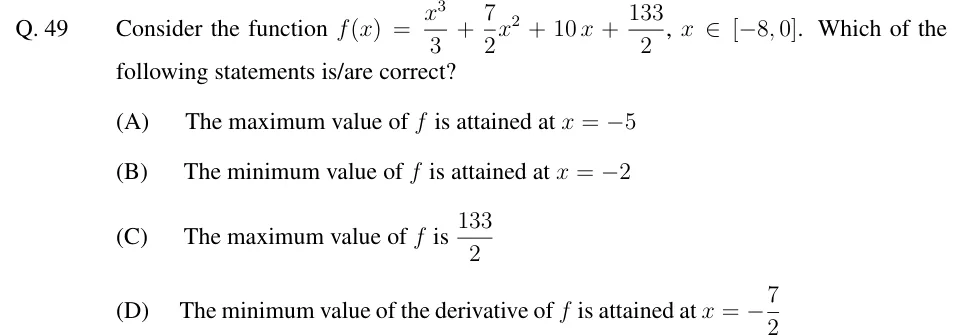
Consider the function , . Which of the following statements is/are correct?
The maximum value of is attained at
The minimum value of is attained at
The maximum value of is
The minimum value of the derivative of is attained at
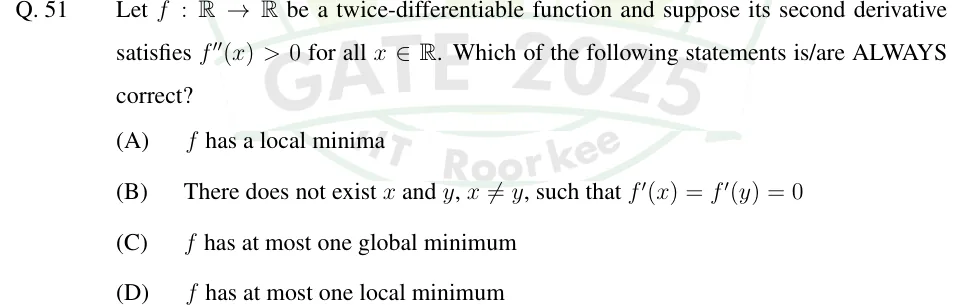
Let be a twice-differentiable function and suppose its second derivative satisfies for all . Which of the following statements is/are ALWAYS correct?
has a local minima
There does not exist and , , such that
has at most one global minimum
has at most one local minimum
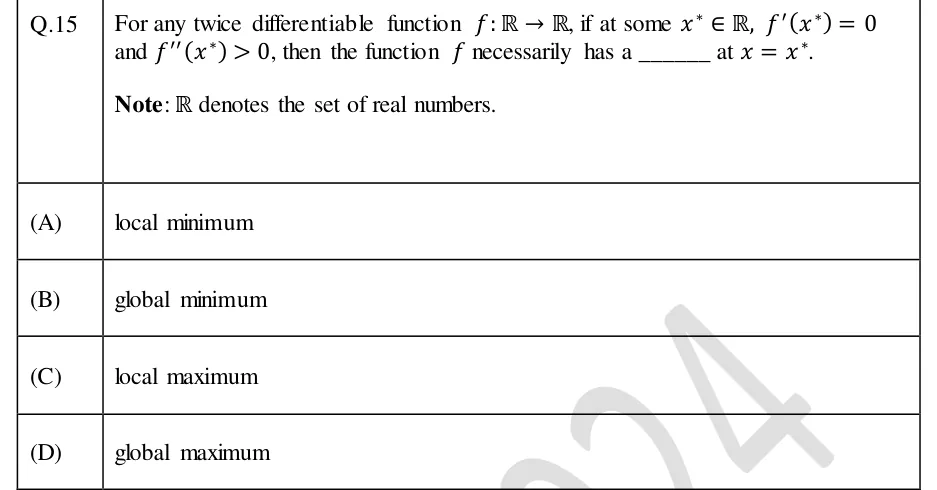
For any twice differentiable function , if at some , and , then the function necessarily has a ______ at .
Note: denotes the set of real numbers.
local minimum
global minimum
local maximum
global maximum
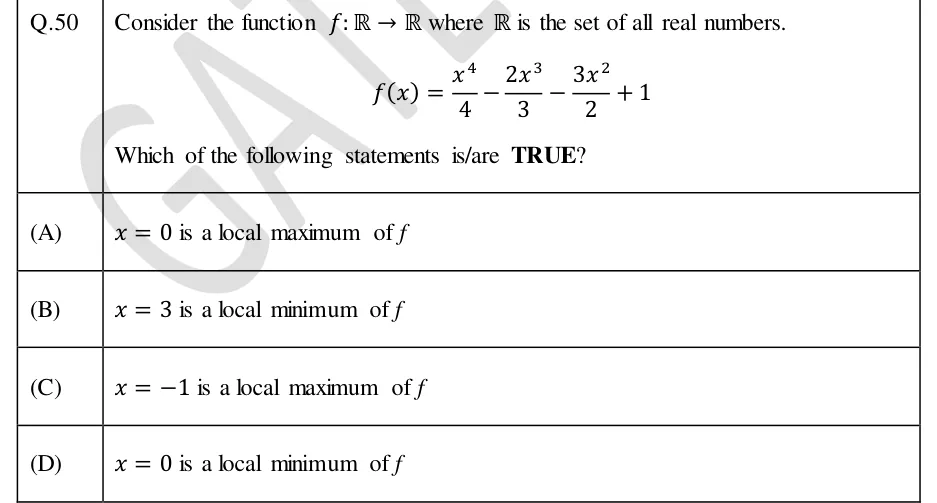
Consider the function where is the set of all real numbers.
Which of the following statements is/are TRUE?
is a local maximum of
is a local minimum of
is a local maximum of
is a local minimum of
PRACTICE
Let for real . What is the value of at its local minimum?
Answer: (A)
, so critical points are and .
: (local maximum) and (local minimum).
. (For reference, the local maximum is .)
Let on the closed interval . Find (global maximum of ) minus (global minimum of ) on this interval.
Answer:
gives , both inside .
Evaluate: , , , .
Global maximum is and global minimum is , so the difference is .
For real , consider , , and . For which of these functions does give a local extremum (a local maximum or a local minimum)?
Answer: (A), (C), (D)
for all , so is a minimum, even though .
is negative for and positive for , so has no extremum at .
, so is a minimum, although does not exist.
, so is a maximum.
Gradient descent is applied to with and step size , using . Find .
Answer: (accepted range )
, so , which gives .
, so and .
Hence .
The number of points of inflection of on the real line is
Answer: (C)
and .
is positive for , negative for and positive for , so it changes sign at both and .
exists everywhere, so there are no other candidates. Hence there are exactly two points of inflection, and .
Gradient descent with step size is applied to . For which values of does it converge to from every starting point ?
Answer: (B)
, so and .
This tends to for every if and only if , that is .
At the iterates flip sign forever, and above it they diverge, so the range is .
OFFICIAL GATE 2027 SYLLABUS WORDING
Copied from the GATE 2027 syllabus; see all 2027 syllabi.
GATE DA
maxima and minima, optimization involving a single variable
Preparing in Kolkata? IAE Academy's course for GATE DA.