GATE 2026 DA Q.35
The value of is ______________. (Answer in integer)

GATE DA
A Taylor series writes a smooth function of one real variable as an infinite polynomial in powers of (x - a), built from its derivatives at the point a. For GATE it turns hard limits, coefficient-finding, approximation and local-extremum questions into short polynomial arithmetic, provided you know the standard series and where each is valid.
2 previous-year questions · 2 solved · 6 practice questions
Convention: all functions here are real-valued functions of one real variable, angles are in radians, and is the natural logarithm. If has derivatives of every order at , its Taylor series about is built from the values . The special case is the Maclaurin series.
TAYLOR SERIES ABOUT X = A
Valid for those where the series converges to ; convergence is not automatic, so state the range of .
MACLAURIN SERIES (A = 0)
The coefficient of is , so .
The degree- Taylor polynomial keeps the terms up to ; it matches and its first derivatives at . Uniqueness: if a power series equals on an open interval containing , then for every , so that power series is the Taylor series of about . This is why a series obtained from the standard series by substitution, multiplication or term-by-term integration (inside their ranges) can be used to read off coefficients and derivatives.
EXPONENTIAL
Converges for all real .
SINE
Converges for all real ; only odd powers appear.
COSINE
Converges for all real ; only even powers appear.
NATURAL LOGARITHM
Valid for . At it gives ; at it diverges.
BINOMIAL SERIES
For any real it is valid for and diverges for (radius 1) unless is a non-negative integer, in which case the series stops and is exact for all . At convergence depends on (for example, for it also converges at both endpoints).
GEOMETRIC SERIES
Valid for . Replace by for .
INVERSE TANGENT
Valid for ; obtained by integrating from to . At it gives .
TANGENT (FIRST TERMS)
Valid for ; only odd powers appear. The first two terms are usually enough for limits as .
RADIUS OF CONVERGENCE (RATIO TEST)
When this limit exists (it may be ), the series converges absolutely for and diverges for ; the endpoints must be checked separately. For a series with only odd or only even powers, apply the ratio test to consecutive non-zero terms instead.
Function | Range of validity | Terms present |
|---|---|---|
all real | all powers | |
all real | odd powers | |
all real | even powers | |
all powers | ||
, not a non-negative integer | (endpoints depend on ) | all powers |
all powers | ||
odd powers | ||
odd powers |
Procedure to get the coefficient of a given power
Do not differentiate repeatedly unless forced; rewrite the function using the standard series.
Substitute: replace by the inner expression, e.g. and .
For a product, multiply the two truncated series and collect only the terms of the wanted power; keep terms up to that power and no further.
For a quotient, write as a series (often geometric or binomial) first, then multiply.
Inside the open interval of convergence , a power series may be differentiated or integrated term by term, and the radius stays the same (this is how follows from , and from ).
If is the coefficient of , then .
To expand about a point , set and expand in . For example, about , , valid for .
WORKED EXAMPLE
Find the coefficient of in the Maclaurin series of .
and .
Terms giving : and .
Sum of coefficients: .
Answer:
TAYLOR'S THEOREM WITH LAGRANGE REMAINDER
Needs continuous on the closed interval between and and to exist on the open interval (having continuous derivatives is enough). Hence , where is the largest value of on that interval.
ALTERNATING SERIES ERROR BOUND
Applies when, from the first omitted term on, the terms alternate in sign and decrease in magnitude to 0; the error then has the same sign as the first omitted term. Examples: for ; , and for .
A first-order approximation is and a second-order one adds . For small : , , , , . When is bounded near , the Lagrange form shows the error of the degree- approximation is of order , so it shrinks fast as .
EXAM TIP
For the error after the term in is at most for every real , because (the term is zero, so the remainder starts at order ). For on use in the Lagrange remainder.
For a limit as of a form, expand numerator and denominator until the first non-cancelling terms appear, then compare lowest powers. This is often shorter than repeated L'Hôpital steps.
Limit procedure
Expand each function with the standard series, writing explicit terms up to a safe order.
Cancel the terms that match; let the lowest surviving term of the numerator be and that of the denominator , with .
If the limit is ; if it is ; if the limit is not finite (the one-sided limits are infinite, with opposite signs when is odd).
Expand the numerator at least up to ; if every term up to cancels, the limit is . Stopping before the cancellation ends gives a wrong answer.
Limit as | Value |
|---|---|
WORKED EXAMPLE
Evaluate .
.
Numerator: .
Divide by : .
Answer:
EXAM TIP
Do not quote the range of as all real : it is . The series of needs , and a binomial series with not a non-negative integer has radius 1 (it diverges for ), while , , converge for every real .
EXAM TIP
When substituting, the range changes too: is valid for , and the series of only for , even though the function itself is defined for every real .
EXAM TIP
Parity check: is odd so only odd powers appear; is even so only even powers appear. A product of an odd and an even function has only odd powers.
EXAM TIP
The coefficient of is , not . Forgetting the is a common slip in coefficient questions.
EXAM TIP
A function can have a Taylor series that converges but not to the function (for example for , , has all derivatives 0 at 0, so its Maclaurin series is identically 0). The standard series in Section 2 do converge to their functions in the ranges stated there.
Convention: is a function of one real variable and is an interior point of its domain; a local maximum or minimum compares only with values on some open interval around . At a critical point () the expansion shows the shape of near : the first non-zero term decides whether keeps one sign for small .
HIGHER-ORDER DERIVATIVE TEST
Assume is continuous near . If is even: local minimum when , local maximum when . If is odd: no local extremum at . For this is the second-derivative test.
WORKED EXAMPLE
Does have a local extremum at ?
From the exponential series, .
So and .
The first non-zero derivative has odd order 3, so there is no local extremum: for small and for small , while .
Answer: No local extremum at .
EXAM TIP
alone decides nothing: (local minimum), (local maximum) and (neither) all have . Go to the first non-zero derivative.
PREVIOUS-YEAR QUESTIONS
Try each question first, then open the answer. We placed each question under a topic ourselves; the exam paper does not label topics.
See these papers in full: GATE DA 2026 · GATE DA 2025
The value of is ______________. (Answer in integer)
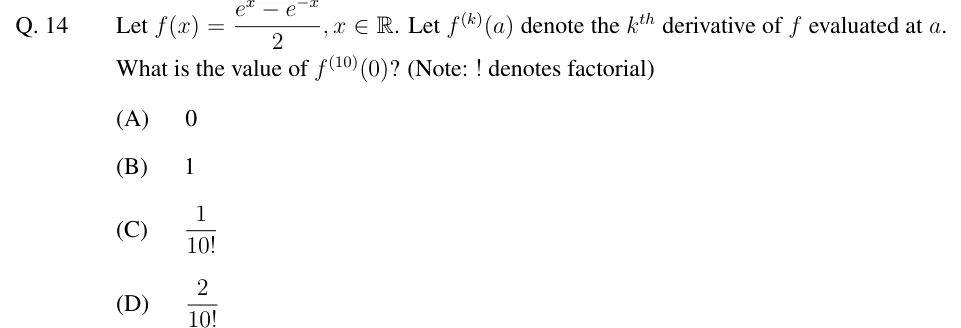
Let , . Let denote the derivative of evaluated at . What is the value of ? (Note: ! denotes factorial)
PRACTICE
Evaluate . Give your answer rounded to three decimal places.
Answer: (accepted range )
and .
.
Divide by : .
The coefficient of in the Maclaurin series of is
Answer: (A)
with .
The term is .
The coefficient is (positive, since the term has sign ).
Consider real and the Maclaurin series of the functions below. Which statements are correct?
The series of converges at .
The series of converges for every real .
The series of converges for every real .
The series of converges at .
Answer: (A), (B)
A is true: at the series is the alternating series , which converges (to ).
B is true: the sine series converges for all real .
C is false: the binomial series with non-integer exponent has radius of convergence 1, so it diverges for (for example at ).
D is false: at the series becomes , the negative of the divergent harmonic series.
Let . Find the coefficient of in its Maclaurin series. Give your answer as a decimal rounded to four places.
Answer: (accepted range )
and .
Terms giving : , and .
Sum: .
Using the Taylor polynomial of degree 2 of about , approximate . Give your answer to four decimal places.
Answer: (accepted range )
, so .
so .
With : .
.
Check: on , so the error is at most ; indeed , about above the approximation.
For , the point is
a local minimum of
a local maximum of
neither a local maximum nor a local minimum of
not a critical point of
Answer: (A)
, so .
Hence and .
The first non-zero derivative has even order and is positive, so is a local minimum.
OFFICIAL GATE 2027 SYLLABUS WORDING
Copied from the GATE 2027 syllabus; see all 2027 syllabi.
GATE DA
Taylor series
Preparing in Kolkata? IAE Academy's course for GATE DA.