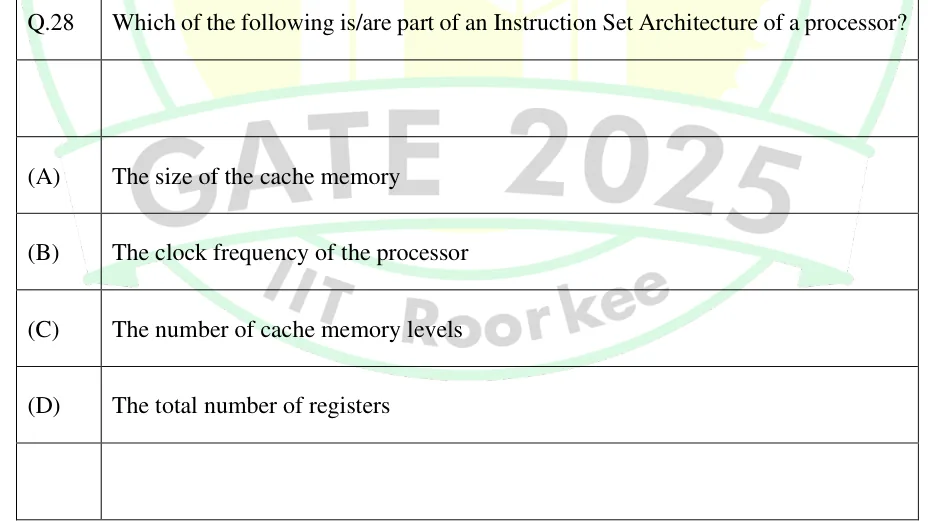
Which of the following is/are part of an Instruction Set Architecture of a processor?
- (A)
The size of the cache memory
- (B)
The clock frequency of the processor
- (C)
The number of cache memory levels
- (D)
The total number of registers

Which of the following is/are part of an Instruction Set Architecture of a processor?
The size of the cache memory
The clock frequency of the processor
The number of cache memory levels
The total number of registers
ANSWER
Only option D is correct.
Official answer: DSource: Official answer key, GATE 2025 CS2 (IIT Roorkee)
ISA (Instruction Set Architecture) is the abstract interface between hardware and software that is visible to the programmer/compiler: the instruction set, the addressing modes, and the architecturally visible register set (how many registers exist and how they are named/encoded).
Cache memory size (A) and the number of cache levels (C) are microarchitectural implementation choices, not part of the ISA — the ISA does not expose or specify cache organization at all, and two processors implementing the identical ISA (e.g., different processors in the x86 family) can have completely different cache hierarchies.
Clock frequency (B) is a physical/implementation parameter of a specific chip, not part of the ISA — different speed grades of the same processor, all implementing the same ISA, run at different clock frequencies.
The total number of (architectural) registers (D) is fixed by the ISA specification itself, since machine instructions must reference these registers by a fixed-width encoding/name defined in the ISA (e.g., x86-64 defines 16 general-purpose registers, MIPS defines 32) — this is a software-visible property, unlike microarchitectural resources such as physical register files or reorder buffers.
Hence only option D is part of the Instruction Set Architecture; A, B, and C are microarchitecture/implementation details.
KEY IDEA
The Instruction Set Architecture (ISA) is the programmer/compiler-visible contract between hardware and software: the instruction set, addressing modes, and the architecturally visible register set (how many registers a program can name and how they're encoded). Everything about how that contract is physically realized — cache size, number of cache levels, clock frequency — is microarchitecture/implementation, and can differ across chips that implement the identical ISA.
WATCH OUT FOR
Treating any processor specification listed in a datasheet (clock speed, cache size, cache levels) as part of the "architecture," when ISA specifically means the software-visible contract, not the hardware implementation details that vary between different chips sharing the same ISA.
From the GATE 2025 CS2 paper. Every question of this paper · Download the full paper · All 11 Instructions & addressing questions, with notes