
IAE Academy

GATE 2018 EC Q.5: solution and answer

GATE 2018 · ECQ.5 · 1 mark · MCQ

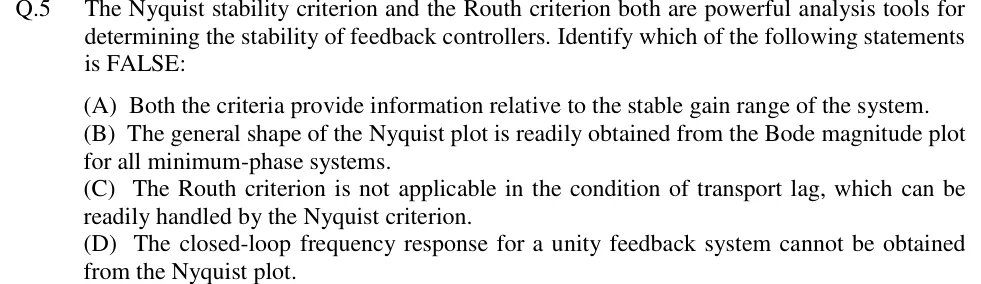
The Nyquist stability criterion and the Routh criterion both are powerful analysis tools for determining the stability of feedback controllers. Identify which of the following statements is FALSE:

  1. (A)

    Both the criteria provide information relative to the stable gain range of the system.

  2. (B)

    The general shape of the Nyquist plot is readily obtained from the Bode magnitude plot for all minimum-phase systems.

  3. (C)

    The Routh criterion is not applicable in the condition of transport lag, which can be readily handled by the Nyquist criterion.

  4. (D)

    The closed-loop frequency response for a unity feedback system cannot be obtained from the Nyquist plot.
See the question in the paper

Answer and solution

ANSWER

The FALSE statement is (D). For unity feedback, is the ratio of the phasors from the origin and from to each point of the Nyquist plot. Constant- and constant- circles use exactly this to read the closed-loop response off the plot.

Official answer: DSource: Official answer key, GATE 2018 EC (IIT Guwahati)

  1. (A) Routh: form the array with the gain as a parameter. No sign change in the first column gives the stable range of directly. Nyquist: the critical gain is the one that makes the plot pass through , and the gain margin follows from it. That is also the stable gain range. So (A) is TRUE.

  2. (B) For a minimum-phase system, Bode's gain-phase relation fixes the phase once is known over all . So the Bode magnitude plot gives both and , and with them the general shape of the polar (Nyquist) plot. So (B) is TRUE.

  3. (C) With a transport lag, the characteristic equation is transcendental, not a polynomial in . Routh cannot be applied to it without an approximation such as Padé. In the Nyquist plot, has and only adds a phase of . The delay is therefore handled exactly. So (C) is TRUE.

  4. (D) For unity feedback, Each point of the Nyquist plot is . The phasor from the origin to is , and the phasor from to is . Hence These can be read off the plot at every .

  5. The constant- and constant- circles apply this same idea. They are drawn on the plane so that , and the closed-loop bandwidth can be read directly off the Nyquist plot. So the claim that the closed-loop frequency response 'cannot be obtained' from the Nyquist plot is FALSE.

  6. (D) is the only FALSE statement, so the answer is (D).

KEY IDEA

A Nyquist plot shows as a set of phasors. With unity feedback, the phasor from to any point is , so is fixed point by point. This is what the M and N circles are built on. The other three statements are standard facts: both criteria give the stable gain range, Bode's gain-phase relation holds for minimum-phase systems, and Routh needs a polynomial while Nyquist handles exactly.

WATCH OUT FOR

One common mistake is to pick (B), thinking a magnitude plot alone can never give phase. For minimum-phase systems, Bode's gain-phase relation says it does. Another is to pick (C), thinking Routh can handle a delay directly. Routh needs a polynomial characteristic equation, so it works only after a Padé approximation, while Nyquist treats exactly. Students also forget that the Nyquist plot gives the closed-loop response through , measured from the point.

From the GATE 2018 EC paper. Every question of this paper · Download the full paper · All 11 Nyquist questions, with notes

More Nyquist questions