
IAE Academy

GATE 2025 EC Q.26: solution and answer

GATE 2025 · ECQ.26 · 1 mark · MSQ

Consider the unity-negative-feedback system shown in Figure (i) below, where gain . The root locus of this system is shown in Figure (ii) below.

For what value(s) of will the system in Figure (i) have a pole at ?
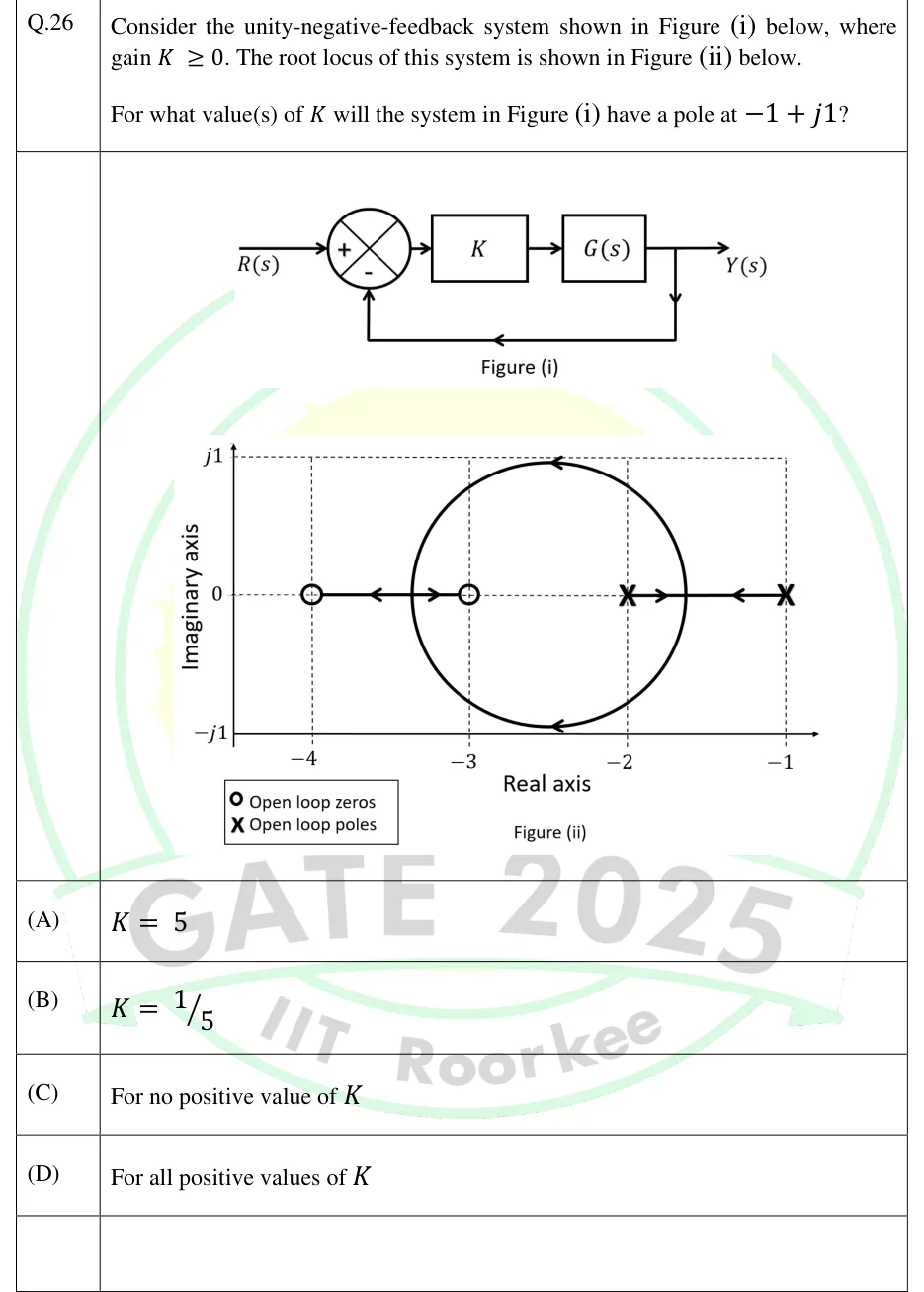
GATE 2025 EC question 26: Figure (i): block diagram.Tap to open full size
Figure from the GATE 2025 EC paper. It is part of the question.
Figure description

Figure (i): block diagram. R(s) enters a summing junction (+ on the input, - on the feedback). The error signal passes through a block K and then a block G(s), giving the output Y(s). Y(s) is fed straight back (unity feedback) to the - input of the summing junction. Figure (ii): root locus in the s-plane. The 'Real axis' arrow runs along the bottom edge of the plot, at the -j1 level, with ticks labelled -4, -3, -2, -1. The 'Imaginary axis' arrow runs up the left edge with labels j1, 0, -j1. Dashed guide lines: vertical lines at -4, -3, -2, -1, a horizontal line at j1 along the top, and a horizontal line at the 0 level. Legend: O = open-loop zeros, X = open-loop poles. Open-loop poles (X) are at s = -1 and s = -2. Open-loop zeros (O) are at s = -3 and s = -4. The locus: from the pole at -1 one branch runs left (arrow pointing left), and from the pole at -2 one branch runs right (arrow pointing right). They meet at a breakaway point between -2 and -1, at about -1.63. From there the two branches leave the real axis and trace a circle centred at about -2.5 on the real axis. Both the upper and lower arcs carry arrows pointing left, so the branches move from right to left. The circle rejoins the real axis at a break-in point between -4 and -3, at about -3.37. From there one branch moves right to the zero at -3 and the other moves left to the zero at -4. The solid real-axis segments of the locus are [-2,-1] and [-4,-3]; between -3 and -2 the real axis is only dashed. The vertical scale of the plot is stretched compared with the horizontal one, so the circle looks taller than it is and its top looks almost level with j1.

  1. (A)

  2. (B)

  3. (C)

    For no positive value of

  4. (D)

    For all positive values of

Answer and solution

ANSWER

(C) For no positive value of . At the angle of is , not , so the point is not on the root locus. Solving the characteristic equation there needs , which is not real.

Official answer: CSource: Official answer key, GATE 2025 EC (IIT Roorkee)

  1. Read the plot. The open-loop poles are at and the zeros are at , so . Any positive constant multiplying this can be absorbed into . The real-axis segments and are the ones with an odd number of poles and zeros to their right, which confirms that this is the ordinary (180°) locus.

  2. A point is a closed-loop pole for some only if it lies on the root locus. That requires the angle condition, (an odd multiple of ). The magnitude condition gives the gain only after the angle condition holds.

  3. Test . Zero vectors: has angle , and has angle .

  4. Pole vectors: has angle , and has angle .

  5. The angle condition fails, so is not on the locus. It is not on the locus either, which would need . So no real puts a pole there.

  6. Cross-check with the geometry. The characteristic equation is , so . Setting gives , so : breakaway at and break-in at .

  7. For the complex roots, write the equation as . Then and . Substituting these gives for every . The complex part of the locus is therefore the circle centred at with radius .

  8. The distance from to the centre is , so the point is off the circle. No puts a closed-loop pole there.

  9. Direct confirmation, which also shows where the wrong options come from. Put into the characteristic equation: and . So The gain needed is imaginary, so no real gain works. Its magnitude is , the same value the magnitude condition gives on its own: , so . That is option (B), and it means nothing here because the angle condition has already failed. Option (A), , is itself, taken wrongly as the gain. Option (D) is ruled out because the point is never on the locus. Only (C) is correct.

KEY IDEA

A point is a closed-loop pole for some only if it lies on the root locus. That is decided by the angle condition, , not by the magnitude condition. A quicker check is to substitute the point into and solve for . The point is reachable only if comes out real and non-negative; here . For two real poles and two real zeros, the complex part of the locus is a circle, here centred at with radius , and is from that centre.

WATCH OUT FOR

Using only the magnitude condition. suggests , which is option (B), or if the ratio is inverted, which is option (A). Both skip the angle test, which gives . Another trap is judging from the drawing: the stretched vertical scale makes the circle look as if it reaches , but its true radius is and it never gets near .

From the GATE 2025 EC paper. Every question of this paper · Download the full paper · All 7 Root locus questions, with notes

More Root locus questions