
IAE Academy

GATE 2026 EC Q.59: solution and answer

GATE 2026 · ECQ.59 · 2 marks · NAT

Consider the unity negative feedback control system shown in the Figure.

The value of gain at which the given system will remain marginally stable is ____.

(Answer in integer)
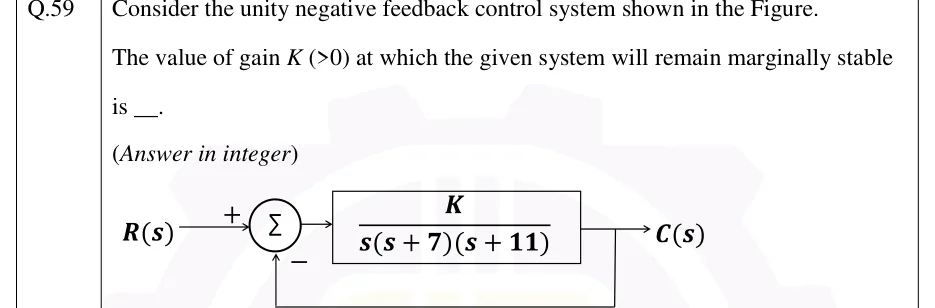
GATE 2026 EC question 59: Unity negative feedback loop.Tap to open full size
Figure from the GATE 2026 EC paper. It is part of the question.
Figure description

Unity negative feedback loop. Input R(s) enters a summing junction (Σ) with a '+' sign on the reference input and a '−' sign on the feedback input. The junction output feeds a single forward block with transfer function G(s) = (K)/(s(s+7)(s+11)), whose output is C(s). C(s) is fed back directly (gain 1, no block) to the '−' input of the summing junction.

Answer and solution

ANSWER

The system is marginally stable at . It then oscillates at .

Official answer: 1386Source: Official answer key, GATE 2026 EC (IIT Guwahati)

  1. With unity negative feedback the closed-loop characteristic equation is . Since :

  2. Routh array:

  3. For stability every first-column entry must be positive: and , so the system is stable for .

  4. At the upper limit the row becomes all zeros: . That is the marginal-stability gain.

  5. Check with the auxiliary equation from the row: . Replacing the zero row by the derivative gives first column : no sign change, so no root lies in the right half-plane. Factorising confirms it: , which gives one real root at and a non-repeated pair on the axis. The system oscillates with constant amplitude at , so it is marginally stable.

  6. Shortcut for a cubic with all coefficients positive: it is marginally stable when . Here , so .

KEY IDEA

Marginal stability happens at the gain that makes one row of the Routh array all zeros. The row above it then gives the auxiliary equation, and its roots are the pair on the axis. For a cubic this reduces to .

WATCH OUT FOR

Expanding wrongly (for example as , or leaving out the factor ) gives the wrong cubic. Another mistake is to report a range such as , or the oscillation frequency , when the question asks for the single marginal gain .

From the GATE 2026 EC paper. Every question of this paper · Download the full paper · All 15 Routh–Hurwitz questions, with notes

More Routh–Hurwitz questions