
IAE Academy

GATE 2025 EE Q.41: solution and answer

GATE 2025 · EEQ.41 · 2 marks · MCQ

Let . Then the closed-loop system shown in the figure below, is
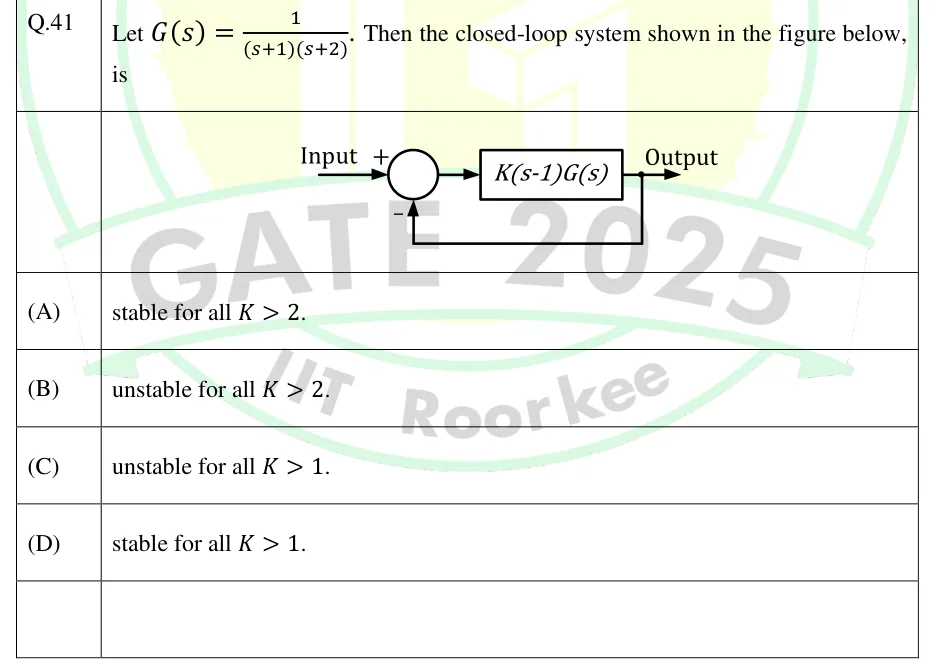
GATE 2025 EE question 41: Unity negative-feedback loop.Tap to open full size
Figure from the GATE 2025 EE paper. It is part of the question.
Figure description

Unity negative-feedback loop. 'Input' enters a summing junction with sign +; the junction output feeds a single forward block labelled K(s-1)G(s), whose output is labelled 'Output'. The output is taken off and fed back directly (no block, unity gain) to the summing junction with sign −.

  1. (A)

    stable for all .

  2. (B)

    unstable for all .

  3. (C)

    unstable for all .

  4. (D)

    stable for all .

Answer and solution

ANSWER

The characteristic equation is , which is stable only for . For every the constant term is negative and one closed-loop pole lies in the right half-plane, so the system is unstable for all . Answer: (B).

Official answer: BSource: Official answer key, GATE 2025 EE (IIT Roorkee)

  1. With unity negative feedback, the open-loop transfer function is the forward block:

  2. Characteristic equation . Multiply through by :

  3. Routh array: row : ; row : ; row : .

  4. For no sign change in the first column we need and , so the closed loop is stable only for . (For a second-order polynomial this is the same as requiring every coefficient to be positive.)

  5. At the characteristic polynomial becomes , so there is a closed-loop pole at (marginally stable). For the first column reads : one sign change, so exactly one closed-loop pole lies in the right half-plane. You can see the same thing from the roots: their product is , so they are real and of opposite sign.

  6. Check the options. For every the system is unstable, so (B) is true and (A) is false. At (which is greater than 1) the system is stable, so (C) is false. At (also greater than 1) it is unstable, so (D) is false. The answer is (B).

KEY IDEA

The forward path has a zero in the right half-plane at . As increases, one root-locus branch leaves the pole at and heads for that zero, crossing the origin at . For a second-order characteristic polynomial the Routh condition is simply that all coefficients are positive, here and .

WATCH OUT FOR

Writing the characteristic equation as or , which loses the sign of the right-half-plane zero. The constant term is , not . That sign slip makes the system look stable for every and pushes students towards (A) or (D). The other trap is picking (C) because "higher gain destabilises": the loop is still stable for , so the threshold is 2, not 1.

From the GATE 2025 EE paper. Every question of this paper · Download the full paper · All 15 Routh–Hurwitz questions, with notes

More Routh–Hurwitz questions