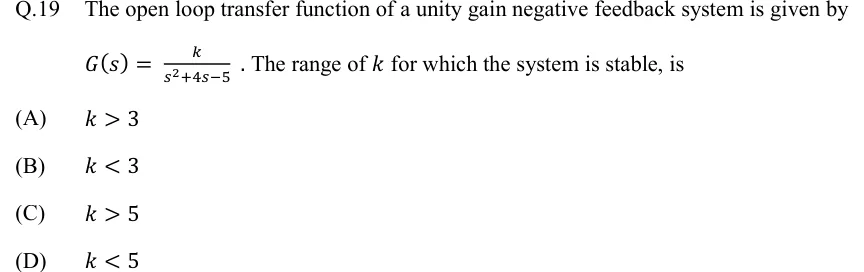
The open loop transfer function of a unity gain negative feedback system is given by . The range of for which the system is stable, is
- (A)
- (B)
- (C)
- (D)

The open loop transfer function of a unity gain negative feedback system is given by . The range of for which the system is stable, is
ANSWER
The closed-loop characteristic equation is , so the system is stable for . The answer is option (C).
Official answer: CSource: Official answer key, GATE 2022 EE (IIT Kharagpur)
For unity negative feedback the closed-loop characteristic equation is . Multiplying through by gives
Routh array: row : ; row : ; row : .
By the Routh criterion the system is stable only if the first column has no sign change. The first two entries are positive, so we need .
Cross-check: a second-order polynomial is Hurwitz if and only if all its coefficients have the same sign. Here that means , and , which gives the same condition.
Boundary check: at the equation becomes . It has a pole at the origin, so the system is only marginally stable there, and the inequality must be strict.
So the system is stable for , which is option (C).
KEY IDEA
Stability depends on the closed-loop poles, the roots of , not on the open-loop poles. The open-loop plant has a right-half-plane pole at , since . Feedback gain moves the constant term from to . For a quadratic, all coefficients positive is both necessary and sufficient for stability.
WATCH OUT FOR
One mistake is to apply the Routh test to the open-loop denominator and conclude the system is unstable for every . Another is dropping the sign of the and writing . A third is treating as stable, which gives : the characteristic equation is then , a pole at the origin, which is only marginal stability. Options (A) and (B) use 3, a number that has no role in this characteristic equation.
From the GATE 2022 EE paper. Every question of this paper · Download the full paper · All 15 Routh–Hurwitz questions, with notes