
IAE Academy

GATE 2020 EE Q.35: solution and answer

GATE 2020 · EEQ.35 · 2 marks · MCQ

Which of the following options is correct for the system shown below?
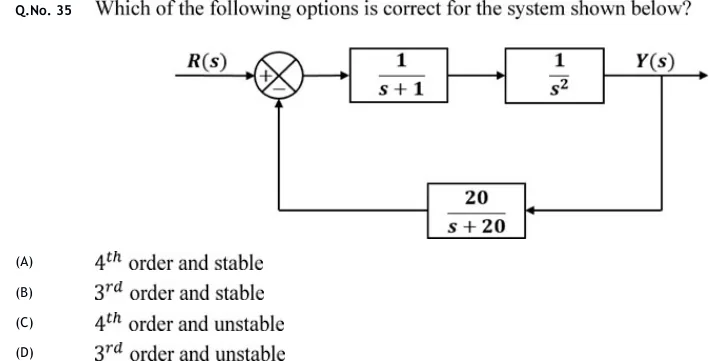
GATE 2020 EE question 35: Negative-feedback block diagram.Tap to open full size
Figure from the GATE 2020 EE paper. It is part of the question.
Figure description

Negative-feedback block diagram. R(s) enters a summing junction with sign + (from R(s)) and sign − (from the feedback path). The junction output feeds a forward block (1)/(s+1), which feeds a second forward block (1)/(s^2) in cascade; the output of the second block is Y(s). Y(s) is taken back through a feedback block (20)/(s+20) into the − input of the summing junction.

  1. (A)

    4th order and stable

  2. (B)

    3rd order and stable

  3. (C)

    4th order and unstable

  4. (D)

    3rd order and unstable

Answer and solution

ANSWER

The closed-loop characteristic equation is , which makes the system 4th order. Its Routh array has two sign changes in the first column, so the system is unstable. Option (C).

Official answer: CSource: Official answer key, GATE 2020 EE (IIT Delhi)

  1. Forward path (two blocks in cascade): . Feedback path: , with negative feedback.

  2. Closed-loop transfer function:

  3. Characteristic equation: . The highest power of is 4, so the system is 4th order. No pole-zero cancellation reduces this: the only closed-loop zero is , and substituting it into the characteristic polynomial gives , so is not a closed-loop pole.

  4. Necessary condition for stability: every coefficient of the characteristic polynomial must be present and positive. Here the coefficient is zero, so the system cannot be stable. The Routh array tells us which kind of instability this is.

  5. Routh array:

  6. The first column is . The sign changes twice ( and ), so two closed-loop poles lie in the right half of the s-plane. The system is unstable, not merely marginally stable.

  7. The system is 4th order and unstable, so the answer is option (C).

KEY IDEA

The order of the closed-loop system is the degree of after clearing fractions, and that degree includes the pole in the feedback block. If any coefficient of the characteristic polynomial is missing (here the term), the system cannot be stable. A Routh array then counts the right-half-plane poles: two sign changes here.

WATCH OUT FOR

Counting only the forward-path poles (, which gives 3rd order) and ignoring the pole of the feedback block at . A second mistake is to treat the missing coefficient as a sign of marginal stability. The Routh array shows two sign changes, which means two poles in the right half-plane, so the system is truly unstable.

From the GATE 2020 EE paper. Every question of this paper · Download the full paper · All 15 Routh–Hurwitz questions, with notes

More Routh–Hurwitz questions