IAE Academy

GATE EC · EE · IN

Stability and the Routh–Hurwitz criterion

Stability tells you whether a closed-loop system's natural response dies out, keeps going or grows, and that depends only on where the roots of the characteristic equation lie. The Routh-Hurwitz criterion counts the roots in the right half of the s-plane from the coefficients alone, without solving the polynomial. With it you can find the number of unstable roots, the range of a gain for stability, the frequency of sustained oscillation at the stability limit, and whether every pole lies to the left of a given vertical line.

15 previous-year questions · 15 solved · 6 practice questions

What stability means: pole locations

Throughout, LHP means the open left half of the s-plane () and RHP the open right half (). The -axis belongs to neither.

A linear time-invariant (LTI) system is BIBO stable (bounded-input, bounded-output) if every bounded input produces a bounded output. This holds exactly when the impulse response is absolutely integrable. For a causal system with a rational, proper transfer function , that is the same as saying every pole of lies in the LHP, with the poles counted after cancelling any factor common to the numerator and denominator of .

For a feedback system, stability is judged from the closed-loop characteristic equation, formed without cancelling anything. If every one of its roots lies in the LHP, every mode of the system decays and every closed-loop transfer function is BIBO stable. A root outside the LHP makes the system unstable or marginally stable even when that root cancels out of (see the last tip in this section).

Absolute stability is the yes/no question: is the system stable? Relative stability asks how stable it is. In the Routh context it is measured by how far the poles sit to the left of the -axis: the pole nearest the axis sets the slowest decay rate of the natural response.

BIBO STABILITY CONDITION

For a causal LTI system with rational, proper (numerator degree denominator degree), with poles counted after cancelling common factors. If is proper but not strictly proper, also contains an impulse , which does not affect BIBO stability. An improper , such as the pure differentiator , is never BIBO stable. A single pole on the -axis, even a simple one, is enough to make the system not BIBO stable.

CLOSED-LOOP CHARACTERISTIC EQUATION (NEGATIVE FEEDBACK)

Here and , written without cancelling any factor. The roots are the closed-loop poles. For positive feedback, and the characteristic equation is , that is .

Closed-loop pole location

Term in the natural response

Verdict (assuming every other pole is in the LHP)

Real, with

, decays

Stable

Complex pair ,

, decaying oscillation

Stable

Simple (non-repeated) pole at

Constant

Marginally (critically) stable, not BIBO stable

Simple pair on the -axis,

, sustained oscillation

Marginally (critically) stable, not BIBO stable

Repeated poles on the -axis

or , grows

Unstable

Any pole with positive real part

or with , grows

Unstable

EXAM TIP

Marginally stable does not mean BIBO stable. The integrator has a simple pole at . A unit step input gives , which is a ramp. has a simple pair at . The input gives , whose inverse contains , an oscillation whose amplitude grows in proportion to . Both inputs are bounded and neither output is. So if a question asks whether a system is BIBO stable, any -axis pole makes the answer no.

EXAM TIP

Don't cancel factors before you test. Take unity feedback with . Keeping every factor, the characteristic polynomial is , which has a root at . The input-output transfer function still reduces to , so the step response looks well behaved. But the mode is still inside the loop, and any initial condition or disturbance that excites it grows without bound. The system is internally unstable, and cancelling first would hide this.

The necessary coefficient test

Write the characteristic polynomial, with real coefficients, as with (multiply through by if needed). If every root has negative real part, the polynomial is times a product of factors , one for each real root , and , one for each complex pair, with every . Multiplying such factors can only give positive coefficients, so no coefficient can be missing or negative.

NECESSARY CONDITION FOR STABILITY

Necessary for every order . It is necessary and sufficient only for and . A missing term or a sign change proves that not every root is in the LHP, but it does not tell you how many roots are in the RHP or whether some lie on the -axis.

EXAM TIP

From third order up, positive coefficients do not prove stability. has every coefficient positive, yet . It factors as , with two RHP roots at . Passing the coefficient test only means you now have to build the array.

EXAM TIP

A missing term can mean two different things. has roots , so it is marginally stable. has two RHP roots, so it is unstable. The coefficient test cannot tell these apart; the Routh array can.

Building and reading the Routh array

Routh's tabular form lays the coefficients out in rows labelled down to , so the array has rows. The first two rows come straight from the polynomial. Each later row is computed from the two rows above it. The criterion applies to polynomials with real coefficients.

Layout of the Routh array

Row

Column 1

Column 2

Column 3

...

...

...

...

ROUTH ARRAY ENTRIES

General rule: with rows and directly above row , the entry in column is . The divisor is always the first-column entry of the row directly above. Take any missing entry at the right-hand end as 0. In an array with no special case, the single entry equals (or a positive multiple of it if you rescaled a row), which is a quick arithmetic check.

ROUTH'S CRITERION

Applies when no first-column entry is zero. With , the system is stable if and only if every first-column entry is positive. If the array is completed with no zero in the first column, no root lies on the -axis, so all the remaining roots are in the LHP.

Procedure

  1. Write the characteristic polynomial in descending powers with . Put a 0 in place of every missing power.

  2. If , then is a root. Factor out (or ) and apply the test to what remains.

  3. Row : Row :

  4. Compute each further row from the two rows above it using the entry formula, down to row , which has a single entry.

  5. You may multiply or divide any whole row by a positive constant to make the arithmetic easier. The sign pattern does not change.

  6. Read only the first column and count the sign changes from top to bottom. That count is the number of RHP roots. If no first-column entry was zero, all the other roots are in the LHP. If a zero appeared, go to special case 1 or 2 below.

THIRD-ORDER SHORTCUT

Assumes . This comes from the entry . If with every coefficient positive, the polynomial factors as . That gives a pair of roots at (equivalently ) and a third root at , which is marginal stability.

FOURTH-ORDER SHORTCUT

Assumes . This comes from requiring the entry and the entry to be positive. When every coefficient is positive, this condition already implies .

HURWITZ DETERMINANT FORM (EQUIVALENT TO ROUTH)

Assumes . Row , column of is , with for or . is the determinant of the top-left block, so , and . When no is zero, the Routh first column is , so the two tests always agree.

Worked array for . Every coefficient is positive, so the necessary test passes and the array has to decide.

Regular case: $s^4 + 2s^3 + 3s^2 + 8s + 4 = 0$

Row

Col 1

Col 2

Col 3

The first column is , which reads . There are two sign changes ( and ), so the polynomial has two RHP roots and two LHP roots. The system is unstable.

EXAM TIP

Count sign changes, not negative entries. The pattern has one negative entry but two sign changes, which means two RHP roots.

Special case 1: zero in the first column

Sometimes a first-column entry comes out as 0 while the rest of its row is not all zero. The next row would then need a division by zero. At this point you already know the polynomial is not stable, because with a stable polynomial has every first-column entry strictly positive. The only remaining job is to count the RHP roots.

The epsilon method

  1. Replace the 0 by a small number and carry on building the array as usual.

  2. Simplify each later entry, let , and keep only its sign. For example, is negative.

  3. Count the sign changes in the first column, treating as positive. The count is the number of RHP roots provided the polynomial has no roots on the -axis. In that case, taking negative gives the same count.

  4. To check for -axis roots, put . They exist exactly when the real and imaginary parts of are both zero at the same real .

  5. Alternative 1: replace by (allowed when ). This reverses the coefficient order, giving . Since , each reciprocal root lies in the same half-plane as the original, so the RHP count does not change, and the zero often disappears.

  6. Alternative 2: multiply the polynomial by with . This adds one LHP root, leaves the RHP count unchanged, and often removes the zero.

Epsilon case: $s^4 + 2s^3 + 4s^2 + 8s + 5 = 0$

Row

Col 1

Col 2

Col 3

The first column reads . That is two sign changes, so the polynomial has two RHP roots. It has no -axis roots, because the real part of is . So the count is valid, and the other two roots are in the LHP. The row was , which is not all zeros, so this is special case 1 and not special case 2.

EXAM TIP

The method can miscount when the polynomial has -axis roots, and it gives no warning. has a zero at the start of the row. With the first column reads , which is four sign changes. Yet the polynomial has only two RHP roots (), plus two roots at and one at . No row of zeros appears. Rebuilding the array for or for the reversed polynomial gives a row of zeros instead, which exposes the roots at and gives the correct count of two.

EXAM TIP

Use only when the rest of the row is non-zero. If the whole row is zero, the method does not apply; form the auxiliary polynomial instead (special case 2). Check which case you are in before going on.

Special case 2: a row of zeros

Assume (factor out any root at first). A whole row of zeros then means the polynomial has an even factor, one with only even powers of . Its roots are symmetric about the origin: real pairs , imaginary pairs , or groups of four . This factor is the auxiliary polynomial , formed from the row just above the zero row. Every root of is also a root of the characteristic equation.

Procedure

  1. Call the row above the zero row ( is even when ). Form from its entries, using the powers

  2. Replace the zero row with the coefficients of and carry on with the array.

  3. The total number of sign changes in the whole first column equals the total number of RHP roots of the characteristic equation.

  4. Count the sign changes from the row down to . That is the number of RHP roots of . By symmetry has the same number of LHP roots, and the rest of its roots lie on the -axis. Sign changes from the top down to the row belong to the other factor, .

  5. To find the -axis roots and the frequency of oscillation, solve , or put .

AUXILIARY POLYNOMIAL

are the entries of row , directly above the zero row (a positive multiple of that row works equally well). divides the characteristic polynomial exactly.

COUNTING THE ROOTS OF A(S)

is the degree of and is the number of sign changes from the row down to the row. If , all roots of lie on the -axis. If a second row of zeros appears lower down, has repeated roots; see the last tip in this section.

WORKED EXAMPLE

The characteristic equation of a closed-loop system is . How many roots lie in the LHP, in the RHP and on the -axis? Classify the stability and find the frequency (or frequencies) of undamped oscillation.

Solution
  1. Row : . Row : , divided by 2 to give .

  2. Row : and . The entire row is zero, so this is special case 2.

  3. From the row, . Then , so the row becomes , divided by 4 to give .

  4. Row : and . Row : . Row : .

  5. The first column is . There is no sign change anywhere, so there is no RHP root.

  6. has degree and sign changes from its row downwards, so all 4 of its roots are on the -axis: gives and , all simple.

  7. That leaves root, which must be in the LHP. Dividing out gives the factor .

Answer: There is 1 LHP root (), 0 RHP roots and 4 distinct roots on the -axis. The system is marginally stable, not BIBO stable. The natural response oscillates at rad/s and at rad/s.

The two special cases side by side

Zero in the first column only

Entire row of zeros

What you see

The first entry of a row is 0 and some other entry in that row is not

Every entry of a row is 0 (an odd-power row when )

What it means

The polynomial is not stable (not every root has )

An even factor exists, with roots symmetric about the origin

What to do

Replace the 0 by and let , or use , or multiply by

Replace the row with the coefficients of

-axis roots and oscillation frequency

The method assumes there are none; if there are, it can miscount without warning

The roots of ; there are of them

EXAM TIP

A row of zeros does not by itself mean marginal stability. (roots ) and (roots ) both produce a zero row, and both have RHP roots. Marginal stability needs no sign change anywhere in the column and every -axis root simple.

EXAM TIP

A second row of zeros further down means has repeated roots. For example, produces another zero row at , and are double roots. Repeated -axis roots make the system unstable, even though the first column shows no sign change. If the column does show sign changes, the repeated roots are off the axis instead: also gives two zero rows, with a double root at .

Range of K, oscillation frequency and relative stability

When the characteristic equation contains a gain , the Routh entries become functions of . Requiring every first-column entry to be positive gives the range of for stability. At a boundary value , either one row (usually ) becomes a row of zeros, or the entry becomes zero. In the first case the row above gives , and its roots give the frequency of sustained oscillation. In the second case the boundary root is at .

For relative stability, shift the imaginary axis to the line and apply Routh again. This checks whether every mode decays faster than .

Finding the range of K

  1. Write as a polynomial, without cancelling any factor.

  2. Build the array with kept as a symbol.

  3. Require every first-column entry to be . Usually the row sets the lower bound, which need not be , and the row sets the upper bound. Combine all the conditions with any stated restriction such as .

  4. Substitute into the row above the zero row, form , and solve for .

MARGINAL GAIN AND FREQUENCY OF OSCILLATION

and are the -row entries evaluated at the that makes the row zero. Both must be positive for the roots to lie on the -axis. If the limit is set by the entry going to zero instead, the boundary root is at and there is no oscillation.

SHORTCUT: THREE REAL OPEN-LOOP POLES

Unity negative feedback, real . Put for , which gives and . The characteristic equation is . The third-order shortcut, with , gives stability for . At the third root is . For any other form of , build the array.

RELATIVE STABILITY: SHIFTING THE AXIS

Substitute into the characteristic polynomial, expand in and apply Routh. The count holds when no special case arises. No sign change and no zero in the first column means every root lies strictly to the left of the line ; a row of zeros means some roots lie on the line.

WORKED EXAMPLE

A unity negative-feedback system has open-loop transfer function . (a) Find the range of for closed-loop stability, and the frequency of sustained oscillation at the upper limit. (b) Find the range of for which every closed-loop pole has real part less than .

Solution
  1. Characteristic equation: , which expands to .

  2. (a) Array: : ; : ; : ; : .

  3. For a positive first column we need and , so . If is restricted to positive values, the range is .

  4. At the row is zero. gives , so rad/s. The three-pole shortcut with agrees: and .

  5. (b) Substitute : .

  6. Array in : : ; : ; : ; : .

  7. No sign change requires and . At , gives , that is , exactly on the line . Cross-check: in the open-loop poles are at , and the shortcut gives .

Answer: (a) , or for positive gain. At the loop oscillates at rad/s. (b) .

EXAM TIP

Get the sign of the shift right. To test whether all roots lie left of , substitute (so ). Substituting tests the line instead, which is an easy slip to make.

EXAM TIP

An unstable open loop can give a stable closed loop. With unity feedback and , the characteristic equation is , which is stable for . Always apply Routh to the closed-loop characteristic polynomial, never to the open-loop denominator.

EXAM TIP

Know what the criterion cannot do. It needs a polynomial characteristic equation with real coefficients. A transport lag in the loop makes the equation non-polynomial, so the array cannot be applied to it directly. Use the Nyquist or Bode method instead, or accept an approximate answer from a rational approximation of . The array also counts RHP roots without locating them; the axis shift above is how you learn how far to the left the roots lie.

PREVIOUS-YEAR QUESTIONS

15 questions from the EC, EE and IN papers

Try each question first, then open the answer. We placed each question under a topic ourselves; the exam paper does not label topics.

See these papers in full: GATE ECE 2026 · GATE ECE 2025 · GATE ECE 2024 · GATE ECE 2022 · GATE ECE 2020 · GATE ECE 2018 · GATE EE 2025 · GATE EE 2022 · GATE EE 2020 · GATE EE 2018 · GATE IN 2025 · GATE IN 2023 · GATE IN 2022 · GATE IN 2018

GATE 2026 EC Q.59

GATE 2026 · ECQ.59 · 2 marks · NAT

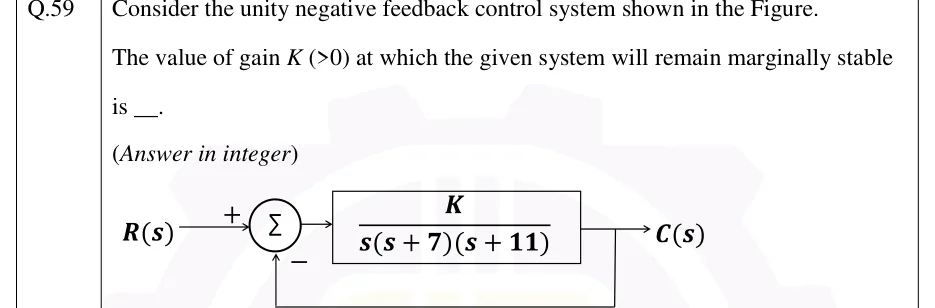
Consider the unity negative feedback control system shown in the Figure.

The value of gain at which the given system will remain marginally stable is ____.

(Answer in integer)

GATE 2026 EC question 59: Unity negative feedback loop.Tap to open full size
Figure from the GATE 2026 EC paper. It is part of the question.
Figure description

Unity negative feedback loop. Input R(s) enters a summing junction (Σ) with a '+' sign on the reference input and a '−' sign on the feedback input. The junction output feeds a single forward block with transfer function G(s) = (K)/(s(s+7)(s+11)), whose output is C(s). C(s) is fed back directly (gain 1, no block) to the '−' input of the summing junction.

Answer and solution
GATE 2026 EC Q.59: answer and solution

GATE 2025 EC Q.37

GATE 2025 · ECQ.37 · 2 marks · MCQ

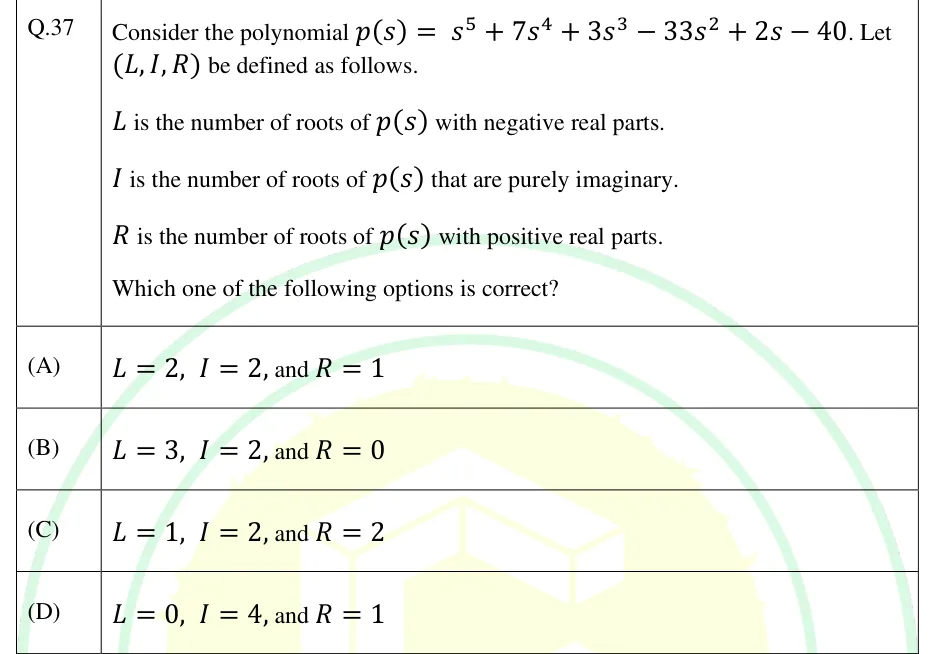
Consider the polynomial . Let be defined as follows.

is the number of roots of with negative real parts.

is the number of roots of that are purely imaginary.

is the number of roots of with positive real parts.

Which one of the following options is correct?

  1. (A)

    , and

  2. (B)

    , and

  3. (C)

    , and

  4. (D)

    , and

Answer and solution
See the question in the paper
GATE 2025 EC Q.37: answer and solution

GATE 2025 EE Q.41

GATE 2025 · EEQ.41 · 2 marks · MCQ

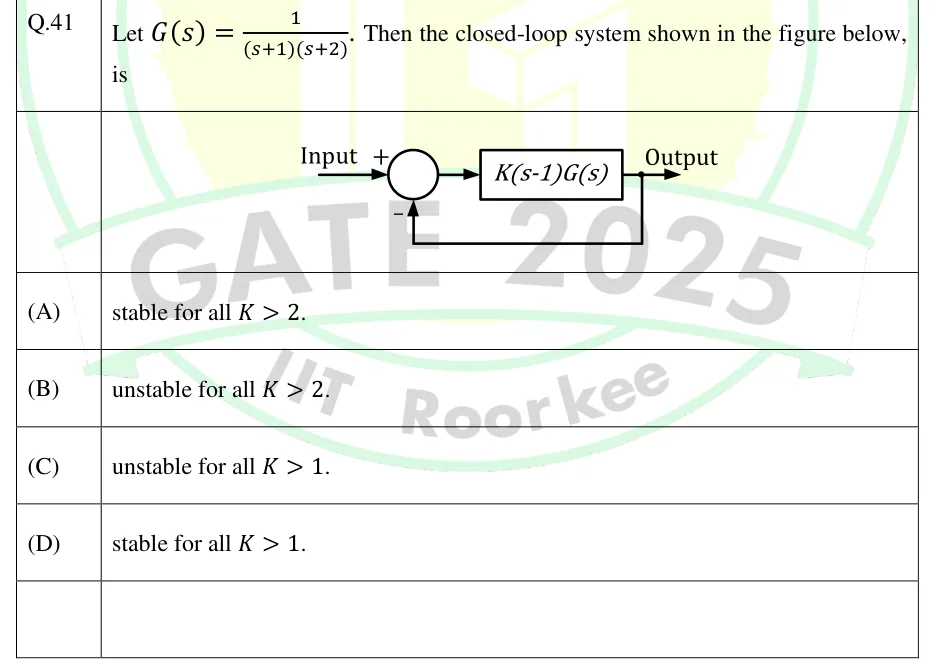
Let . Then the closed-loop system shown in the figure below, is

GATE 2025 EE question 41: Unity negative-feedback loop.Tap to open full size
Figure from the GATE 2025 EE paper. It is part of the question.
Figure description

Unity negative-feedback loop. 'Input' enters a summing junction with sign +; the junction output feeds a single forward block labelled K(s-1)G(s), whose output is labelled 'Output'. The output is taken off and fed back directly (no block, unity gain) to the summing junction with sign −.

  1. (A)

    stable for all .

  2. (B)

    unstable for all .

  3. (C)

    unstable for all .

  4. (D)

    stable for all .

Answer and solution
GATE 2025 EE Q.41: answer and solution

GATE 2024 EC Q.37

GATE 2024 · ECQ.37 · 2 marks · MCQ

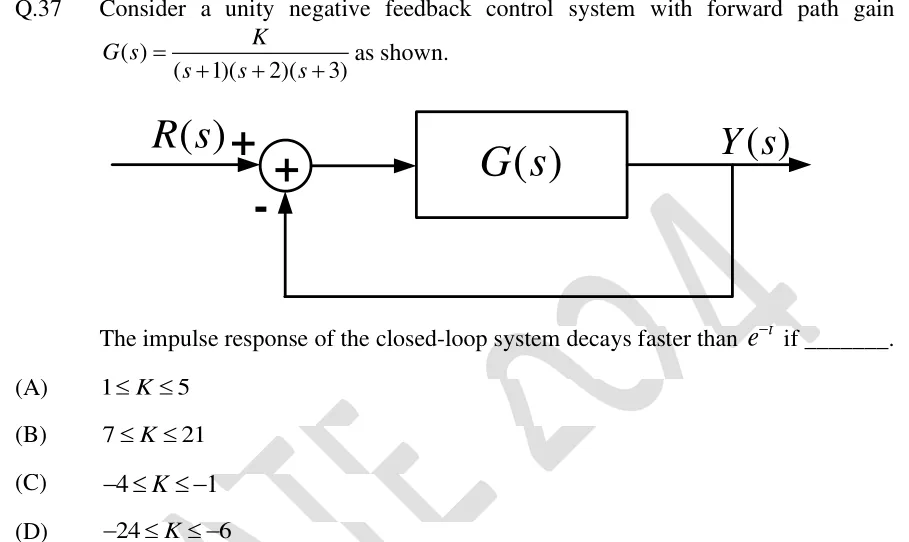
Consider a unity negative feedback control system with forward path gain as shown.

[Block diagram]

The impulse response of the closed-loop system decays faster than if ________.

GATE 2024 EC question 37: Single-loop unity negative feedback block diagram.Tap to open full size
Figure from the GATE 2024 EC paper. It is part of the question.
Figure description

Single-loop unity negative feedback block diagram. Input R(s) enters a summing junction with sign + on the reference input. The summing junction output feeds a block labelled G(s), whose output is Y(s). Y(s) is taken off and fed back directly (unity gain, no block) to the summing junction, entering from below with sign -.

  1. (A)

  2. (B)

  3. (C)

  4. (D)

Answer and solution
GATE 2024 EC Q.37: answer and solution

GATE 2020 EE Q.35

GATE 2020 · EEQ.35 · 2 marks · MCQ

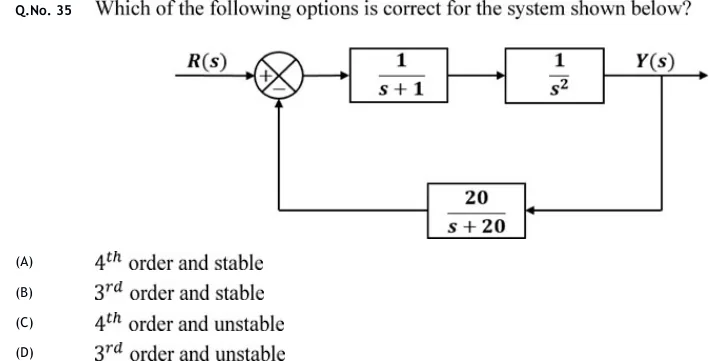
Which of the following options is correct for the system shown below?

GATE 2020 EE question 35: Negative-feedback block diagram.Tap to open full size
Figure from the GATE 2020 EE paper. It is part of the question.
Figure description

Negative-feedback block diagram. R(s) enters a summing junction with sign + (from R(s)) and sign − (from the feedback path). The junction output feeds a forward block (1)/(s+1), which feeds a second forward block (1)/(s^2) in cascade; the output of the second block is Y(s). Y(s) is taken back through a feedback block (20)/(s+20) into the − input of the summing junction.

  1. (A)

    4th order and stable

  2. (B)

    3rd order and stable

  3. (C)

    4th order and unstable

  4. (D)

    3rd order and unstable

Answer and solution
GATE 2020 EE Q.35: answer and solution

PRACTICE

6 questions to test yourself

PRACTICE 11 mark · MCQ

How many roots of lie in the right half of the s-plane?

  1. (A)

    0

  2. (B)

    1

  3. (C)

    2

  4. (D)

    3

Answer and solution

Answer: (C)

  1. The term is missing, so the polynomial is not stable. The array is still needed to count the RHP roots.

  2. : ; : . The 0 in the first column has a non-zero entry beside it, so replace it by .

  3. : (negative); : .

  4. The first column reads : two sign changes, so 2 RHP roots. The count is valid because there are no -axis roots: , with roots and .

PRACTICE 22 marks · NAT

The characteristic equation of a closed-loop system is , where is a real parameter. The system is stable if and only if . Find . (Round off to three decimal places.)

Answer and solution

Answer: (accepted range )

  1. Array: : ; : ; : ; : .

  2. The row needs , so . This also makes the coefficient positive.

  3. With , the row needs . That holds for or .

  4. Combining with : . At itself the entry is zero and a pair of roots sits on the -axis, so is excluded. The third-order shortcut , i.e. , gives the same result.

PRACTICE 32 marks · MSQ

For the characteristic equation , which of the following statements is/are correct?

  1. (A)

    The auxiliary polynomial obtained in the Routh array is .

  2. (B)

    Exactly two roots lie in the right half of the s-plane.

  3. (C)

    Two roots lie on the -axis.

  4. (D)

    Three roots lie in the left half of the s-plane.

Answer and solution

Answer: (A), (B), (D)

  1. : ; : ; : and . That is an entire row of zeros.

  2. , so A is correct. , so the row becomes .

  3. : and . The first entry is 0 but the row is not all zero, so replace it by : the row is . Using is safe here because , so has no -axis roots.

  4. : ; : .

  5. The first column reads : two sign changes, so 2 RHP roots and B is correct. Both changes are below the row, so has 2 RHP roots, 2 LHP roots and roots on the -axis. So C is wrong. Solving confirms the roots .

  6. The remaining factor is , so the LHP roots are and . That makes three, so D is correct.

PRACTICE 42 marks · MCQ

A unity negative-feedback system has with . All closed-loop poles lie strictly to the left of the line if and only if . What is ?

  1. (A)

    192

  2. (B)

    480

  3. (C)

    105

  4. (D)

    240

Answer and solution

Answer: (A)

  1. Characteristic equation: .

  2. Substitute : .

  3. Array: : ; : ; : ; : .

  4. With , avoiding any sign change requires , so . At the poles are and . Cross-check with the three-pole shortcut in : .

  5. Option B (480) is the ordinary stability limit, . It only keeps the poles to the left of .

PRACTICE 51 mark · NAT

A unity negative-feedback system has with . At the value of that makes the closed loop marginally stable, what is the frequency of sustained oscillation in rad/s? (Round off to two decimal places.)

Answer and solution

Answer: (accepted range )

  1. Characteristic equation: .

  2. The entry is , which is zero at .

  3. gives , so rad/s. The shortcut with gives the same: and .

PRACTICE 61 mark · MCQ

The characteristic equation of a closed-loop system is . Which statement is correct?

  1. (A)

    The system is stable.

  2. (B)

    The system is marginally stable and oscillates at 1 rad/s.

  3. (C)

    The system is unstable, although the first column of the completed Routh array shows no sign change.

  4. (D)

    The system is unstable, with two roots in the right half of the s-plane.

Answer and solution

Answer: (C)

  1. : ; : . An entire row of zeros, so and . The row becomes , divided by 4 to give .

  2. : and . : , a second row of zeros. and , so the row becomes . : .

  3. The first column is : no sign change, so there is no RHP root and D is wrong.

  4. The second zero row signals repeated roots: , so are double roots. The natural response contains , which grows. So the system is unstable, which rules out A and B, and C is correct.

OFFICIAL GATE 2027 SYLLABUS WORDING

Copied from the GATE 2027 syllabus; see all 2027 syllabi.

GATE EC

Routh-Hurwitz … stability criteria

GATE EE

Stability analysis using Routh-Hurwitz … criteria

GATE IN

Routh … criteria

Preparing in Kolkata? IAE Academy's course for GATE ECE, GATE EE or GATE IN.