
IAE Academy

GATE 2024 EC Q.37: solution and answer

GATE 2024 · ECQ.37 · 2 marks · MCQ

Consider a unity negative feedback control system with forward path gain as shown.

[Block diagram]

The impulse response of the closed-loop system decays faster than if ________.
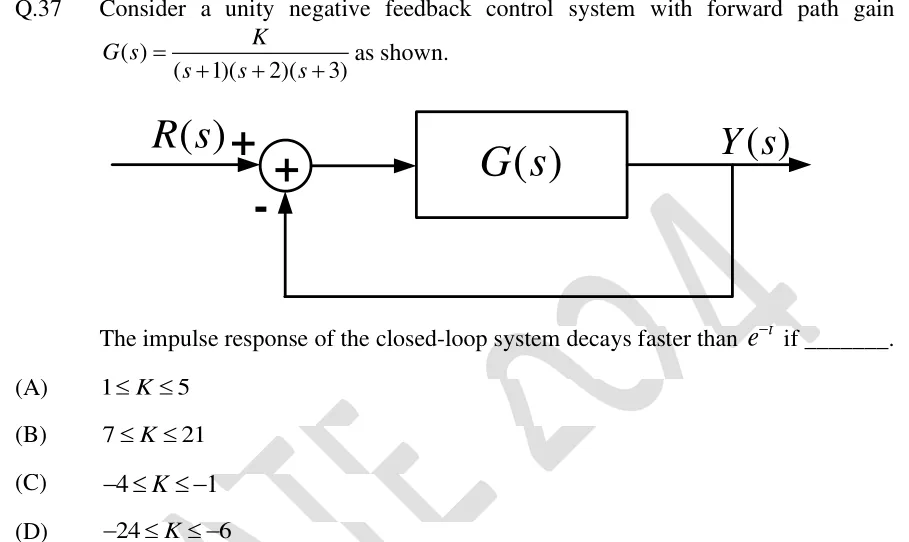
GATE 2024 EC question 37: Single-loop unity negative feedback block diagram.Tap to open full size
Figure from the GATE 2024 EC paper. It is part of the question.
Figure description

Single-loop unity negative feedback block diagram. Input R(s) enters a summing junction with sign + on the reference input. The summing junction output feeds a block labelled G(s), whose output is Y(s). Y(s) is taken off and fed back directly (unity gain, no block) to the summing junction, entering from below with sign -.

  1. (A)

  2. (B)

  3. (C)

  4. (D)

Answer and solution

ANSWER

The closed-loop impulse response decays faster than for . Of the options, only (A) lies inside that range.

Official answer: ASource: Official answer key, GATE 2024 EC (IISc Bengaluru)

  1. Closed-loop characteristic equation (unity negative feedback, ):

  2. Translate the requirement. The impulse response is a sum of terms of the form (times polynomials or sinusoids in ). It decays faster than only if every closed-loop pole satisfies , i.e. all poles lie strictly to the left of the line .

  3. Shift the axis with , so that the line becomes the imaginary axis of the -plane:

  4. Routh array in :

  5. No sign change in the first column (all -roots in the left half plane, hence all -roots left of ): and , giving .

  6. Check the boundaries. At a pole sits exactly at , so that mode decays like , not faster. At the row vanishes; the auxiliary equation gives (indeed ), i.e. , again not faster than . So the interval is open: .

  7. Match the options. Only lies entirely inside . For option (B), makes , giving two sign changes, so two poles lie to the right of . For options (C) and (D), makes the last first-column entry negative: one sign change, i.e. a real pole to the right of (for the constant term puts it at or beyond, so the loop is not even stable). Answer: (A).

KEY IDEA

"Decays faster than " is a relative-stability requirement: every closed-loop pole must lie to the left of . Substitute to move that line onto the imaginary axis, then apply the ordinary Routh test to the polynomial in .

WATCH OUT FOR

Running the Routh test on the original polynomial . That gives absolute stability, , which only puts the poles in the left half plane. With that range, options (A), (B) and (C) all look acceptable. Another mistake is to include the boundary values or : at those values a pole sits exactly on , so the response decays at the same rate as , not faster.

From the GATE 2024 EC paper. Every question of this paper · Download the full paper · All 15 Routh–Hurwitz questions, with notes

More Routh–Hurwitz questions