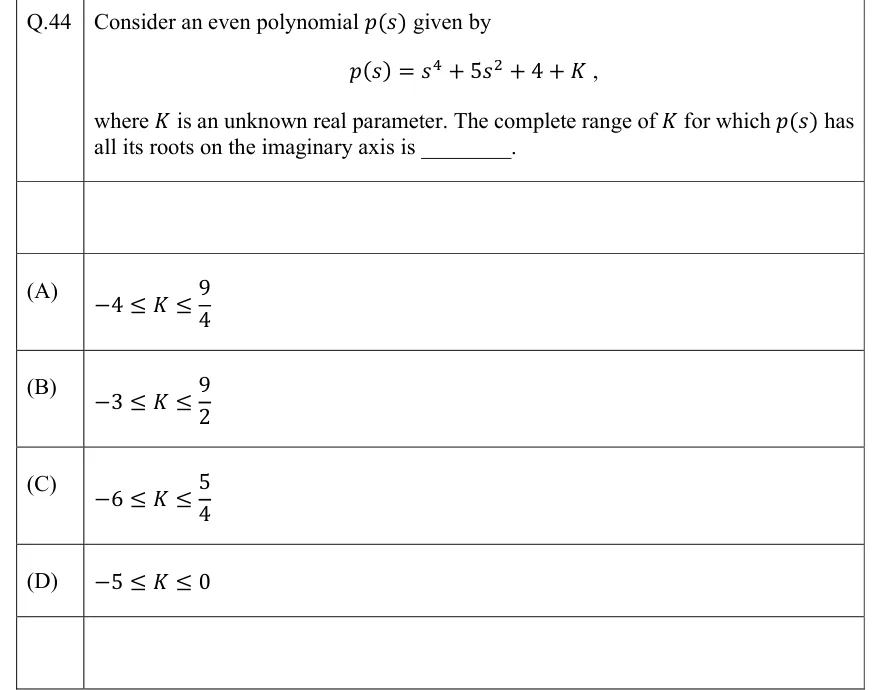
Consider an even polynomial given by
where is an unknown real parameter. The complete range of for which has all its roots on the imaginary axis is ________.
- (A)
- (B)
- (C)
- (D)

Consider an even polynomial given by
where is an unknown real parameter. The complete range of for which has all its roots on the imaginary axis is ________.
ANSWER
All roots of lie on the imaginary axis for , which is option (A).
Official answer: ASource: Official answer key, GATE 2022 EC (IIT Kharagpur)
is even, so its roots are symmetric about the origin: every root comes with . If a root had a non-zero real part, either it or its mirror would lie in the RHP. So all roots are on the axis exactly when has no RHP roots.
Routh array: has no or terms, so the row is entirely zero. is then its own auxiliary polynomial, . Replace the zero row with the coefficients of .
Complete the array: Here : , and : .
The number of sign changes in the first column from the row down equals the number of RHP roots. There are none when and , that is, for . By the mirror symmetry there are then no LHP roots either. For the entry is negative, giving two sign changes and so two RHP roots. For the entry is negative, giving one sign change and one RHP root. The two endpoints make a first-column entry zero, so they are checked directly in step 6.
Check with : . For to be imaginary (or zero), both -roots must be real and . Real roots: . Both non-positive: the sum is and the product .
Endpoints are included. At , and the roots are . The root lies on the imaginary axis. At , and the roots are , each repeated. In both cases every root is on the axis.
So the complete range is , which is option (A).
KEY IDEA
The roots of an even polynomial are symmetric about the origin, so 'all roots on the axis' means the same as 'no RHP roots'. In the Routh array the row vanishes and is rebuilt from . Substituting turns the question into one about a quadratic: it needs real roots that are both . That gives from the discriminant and from the product.
WATCH OUT FOR
Checking only that the coefficients are positive () and missing the discriminant condition . Without it the -roots become complex and the roots of leave the axis in mirror pairs. A second common error is to drop the endpoints. At there is a double root at , which is still on the imaginary axis. At the roots are the repeated pair . A third is to give up when the row comes out all zero, instead of replacing it with the derivative of the auxiliary polynomial.
From the GATE 2022 EC paper. Every question of this paper · Download the full paper · All 15 Routh–Hurwitz questions, with notes