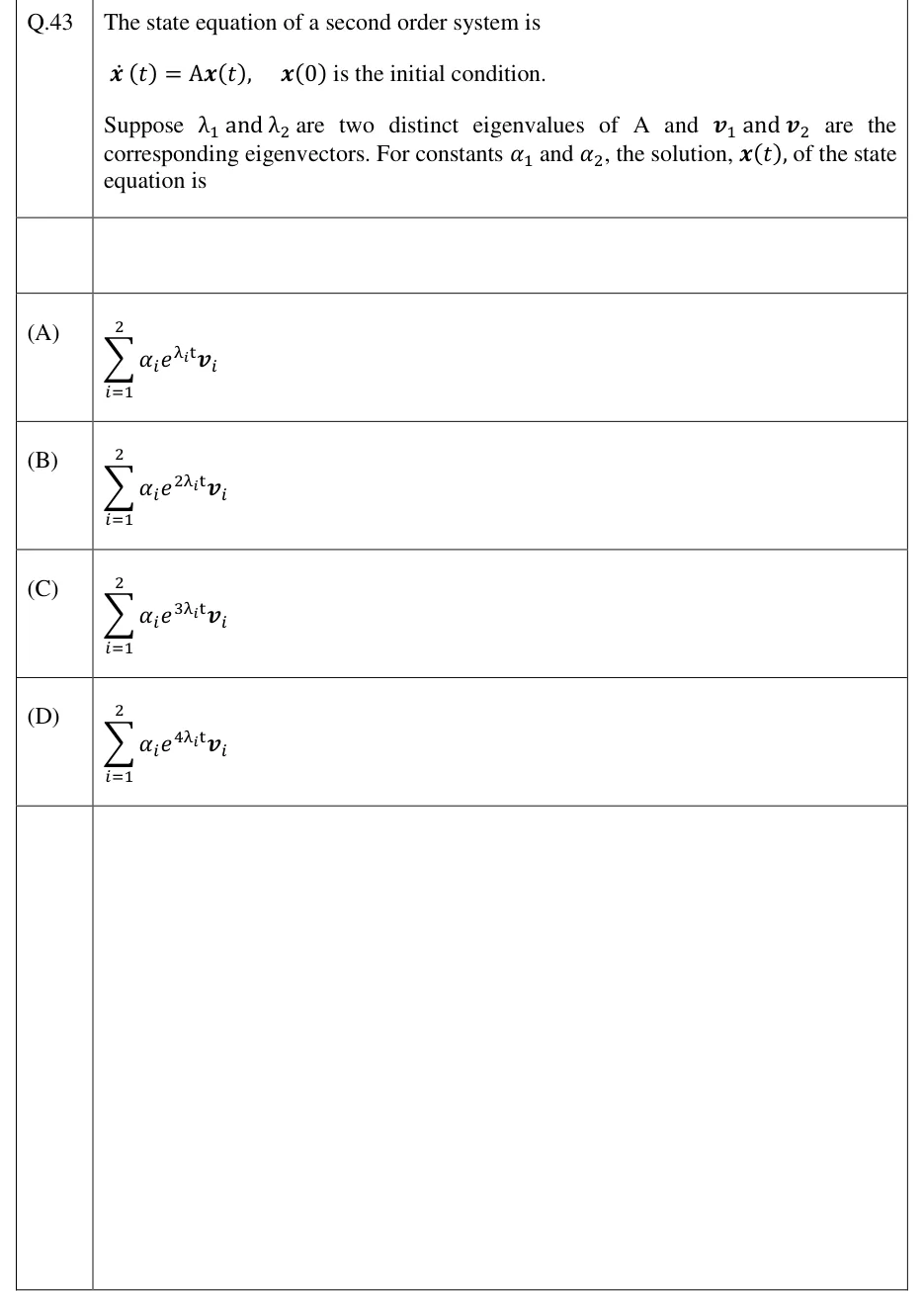
The state equation of a second order system is
Suppose and are two distinct eigenvalues of and and are the corresponding eigenvectors. For constants and , the solution, , of the state equation is
- (A)
- (B)
- (C)
- (D)

The state equation of a second order system is
Suppose and are two distinct eigenvalues of and and are the corresponding eigenvectors. For constants and , the solution, , of the state equation is
ANSWER
The solution is option (A): . The constants come from expanding the initial condition in the eigenvectors, .
Official answer: ASource: Official answer key, GATE 2023 EC (IIT Kanpur)
With no input, the solution of is
The eigenvectors are linearly independent because . Suppose . Multiply on the left by to get , so , and then . Two independent vectors in a two-dimensional state space form a basis. (If is real, its eigenvalues can be a complex-conjugate pair. The eigenvectors and the are then complex, so the basis is of , not only .) So the initial condition has a unique expansion
Use the eigenvector property. From we get for every . Put this into the series:
is linear, so This is option (A).
Check by substitution: At it gives . So both the equation and the initial condition are satisfied.
Rule out (B), (C) and (D). Take with . Then Here are independent, and . So this is zero only if for both . That is a special case (for example, along an eigenvector whose eigenvalue is zero), not the solution for a general initial condition. In fact are the modes of , a different system. Options (B), (C) and (D) are wrong.
Answer: (A)
KEY IDEA
This is modal decomposition. Along an eigenvector, the state transition matrix acts as a scalar: . Distinct eigenvalues give independent eigenvectors, so any splits as . Each part then evolves on its own as the mode , and the free response is the weighted sum of these modes.
WATCH OUT FOR
The usual trap is thinking "second order" puts a 2 into the exponent and choosing (B). The order of the system is the number of modes (two terms in the sum), not a factor on . The term is a mode of , not of . Substituting it back leaves an extra factor of 2. A second slip is to take the as the components of . They are its coordinates in the eigenvector basis.
From the GATE 2023 EC paper. Every question of this paper · Download the full paper · All 16 State space questions, with notes